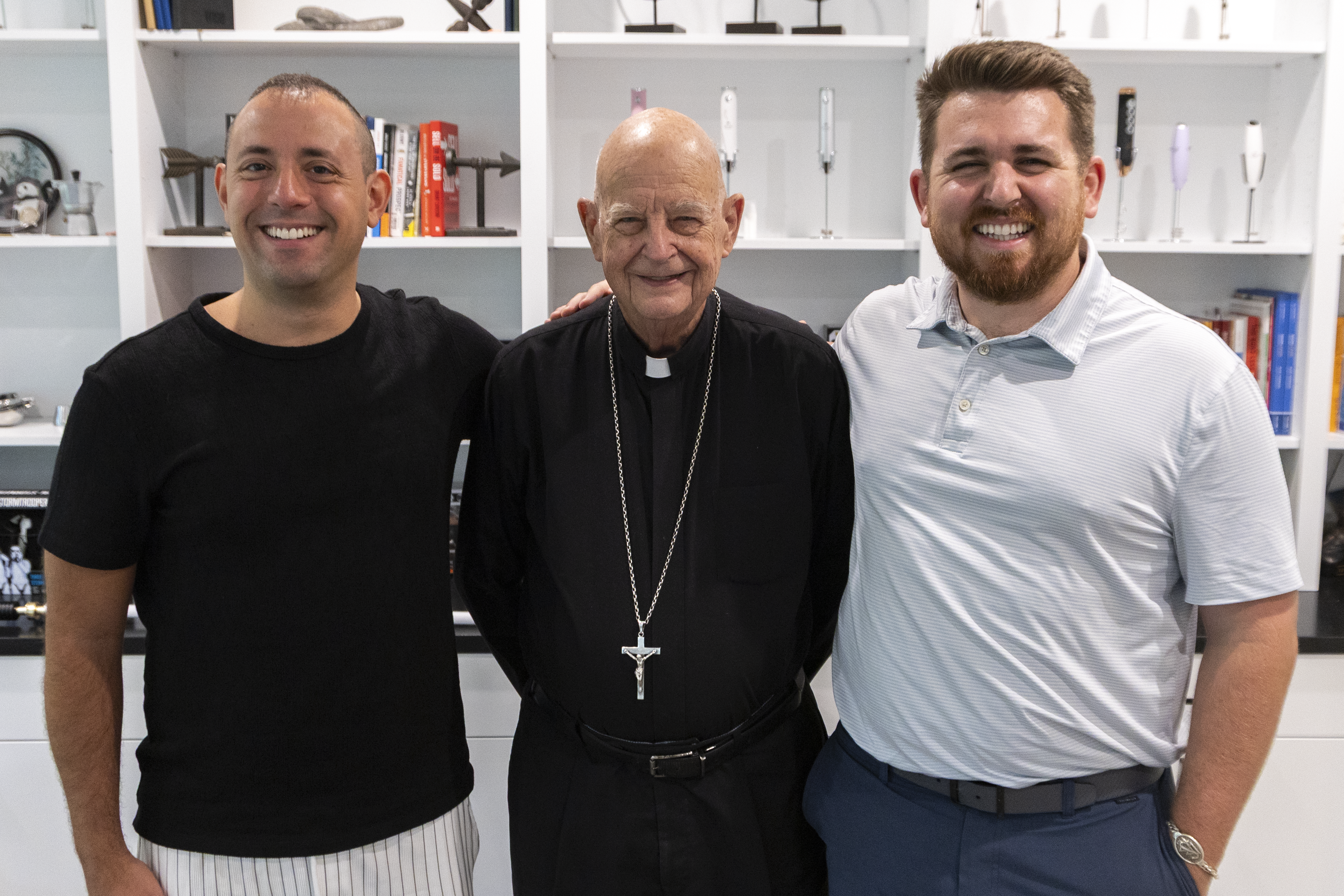
He was wounded in Vietnam five days before he was due to go home. He went from being a Marine in Vietnam to getting ordained as a priest at age 70.
In this episode of the Don’t Do Nothing Podcast, Aaron and Brad sit down with Father Bob Swick, an Old Catholic priest, eight-year Marine Corps veteran, and commander of the Dunedin and Clearwater chapters of the Military Order of the Purple Heart. Father Bob takes us from the Marine Corps’ Platoon Leaders Class to Vietnam as a “90-day wonder,” the night he lost his friend, helping wounded Marines on the medevac flight home, and meeting his wife, whose parents died after the atomic bomb in Hiroshima.
He also explains why he left the Roman Catholic Church, what Old Catholicism is, and what 20 years as a Clearwater Police chaplain taught him. Father Bob talks about his work with the Red Star Foundation, which supports families who have lost a veteran or first responder, and how Clearwater became the first Red Star City in the country. He shares why he leads Mass every Tuesday night at Narconon Suncoast, the veterans he has watched turn their lives around with the Narconon program, and the simple habit he ends every service with: do a random act of kindness.
Let us know in the comments how did you like this episode and remember:
Don’t do nothing.
In this episode:
- Serving as a Marine Corps officer in the Vietnam War
- Being wounded and medevaced five days before going home
- Meeting his wife, whose family survived Hiroshima
- Why he was ordained a priest at 70
- Old Catholic vs. Roman Catholic: the key differences
- 20 years as a Clearwater Police Department chaplain
- Helping Veterans and the Red Star Foundation
- Getting care through the VA
- Faith, the soul, and what happens after this life
- Leading Mass for veterans and students at Narconon Suncoast
- Why a random act of kindness matters more than you think
Watch the full episode here:
Audio Version:
Apple Podcast:
https://podcasts.apple.com/us/podcast/the-vietnam-veteran-turned-priest-at-70-a-life/id1846609884?i=1000798572445
Text Version
Brad: [00:00:00] Hello, and welcome to another episode of the Don’t Do Nothing podcast. Today we have a, an amazing guest, a community leader, Father Bob Swick. So Father Bob is an old Catholic priest. Uh, his parish is St. Francis of Assisi. That is the name of his parish. He is the commander of the Dunedin and Clearwater chapters of the Military Order of the Purple Heart.
And in case you didn’t notice, he’s also an eight-year Marine veteran. And, uh, he’s incredibly active in the Clearwater and Dunedin community. He helps a lot of people here, and we really admire that about you and wanted to have you on today to talk about what you do to help people, ’cause it’s, it’s really amazing.
So thank you for being here.
Father Bob Swick: Well, thank you. Thank you-
Brad: Yeah …
Father Bob Swick: for the opportunity to share some stories.
Brad: Yeah. Pl- I, I, I wanna, I wanna get right into it. Um, if we can go way back, why did you decide to go into the Marine Corps in the first place?
Father Bob Swick: That’s a good question. It [00:01:00] was back in the ’60s, the beginning of the ’60s, and, um, the Marine Corps, um, came aboard the campus of the, uh, college I just enrolled in, University of Scranton.
And Uh, I just felt the, the cause to, to join, and I, uh, I joined what’s called the, the PLC program, the Platoon Leaders Class. And, uh, it’s a four-year program, and the obligations are twofold. Um, maintain a passing grade to get through college, and take 12 weeks of boot camp during that period of time-
which I did down at Quantico, Virgin- Virginia. And, um, let me tell you, Marine Corps boot camp is quite an experience.
Brad: Mm-hmm.
Father Bob Swick: Um, unlike anything you’ve ever had. So, uh, upon graduation, I got my brown bar, and um-
Brad: Is that, is that the lieutenant bar?
Father Bob Swick: That’s the lieutenant, second lieutenant.
Brad: [00:02:00] Yeah, yeah.
Father Bob Swick: Um, all second lieutenants that have graduated through the, uh, the program or similar program, um, end up at Quantico, called The Basic School, TBS, and that’s a six-month course to really understand what your responsibilities are as a, a junior officer, and how to lead your troops, and become an officer and a gentleman by the act of Congress, if you will.
Um, interestingly, uh, that six-month course I was, that I was in is the first one that got cut in half to 90 days because they needed, needed folks over in Vietnam.
Aaron: Hmm.
Father Bob Swick: Wow. So I was one of those, quote, “90-day wonders,” and went to Vietnam. I mean, you talk about being green, holy moly. Um- … it was quite an experience.
Uh, but, uh, I spent my– The Marine Corps tour [00:03:00] duty in the, in the, uh, Vietnam conflict was a month longer than the usual. It was a 13-month tour. And during that period of time, I served under two commands. I was in, initially with the, uh, First Reconnaissance Battalion, and served with them for six months. Um, then I rotated over to the Second Battalion of Fifth Marines.
Um, the– In j- In, uh, the First, uh, uh, Recon Battalion, we were stationed at Chu Lai, quite an interesting, uh, location. Um, a beautiful bay, but you get out into the, uh, boondocks and it’s not so friendly.
Brad: Mm.
Father Bob Swick: Um, from there, as I said, I went up to An Hoa, which is west of, uh, Da Nang, and it was really hot there. I mean, when I say hot, I’m talking about, uh, military, uh, stuff.
And-
Aaron: Meaning activity like fires shot and like- Mm … not [00:04:00] temperature hot.
Father Bob Swick: Both.
Aaron: Okay.
Father Bob Swick: You know, we, we talk about the, uh, the heat and the, the humidity here in Florida. It’s nothing. I mean, think about being in, being, um, 100 degree temperature. You’re wearing a 75-pound pack on your back. You’re dressed in a uniform, uh, utilities.
You got a helmet on your head. You got big boots-
Brad: Mm-hmm …
Father Bob Swick: that you’re wearing, and, uh, now that’s hot.
Brad: Mm-hmm.
Father Bob Swick: Right? So coming over here, it’s a piece of cake. Yeah. The humidity does not bother me anymore.
Brad: Yeah.
Father Bob Swick: Um, but it was hot there and, um, in both ways. As a matter of fact, um, when you come close to finishing up your tour of duty, uh, you’re called a short-termer, and that’s giving you the opportunity to stay back in the rear with the gear.
Um, and I violated a Marine [00:05:00] Corps principle I volunteered for another mission. And wouldn’t you know, it was on that mission that I got wounded, and I got medevaced out of Vietnam five days before I was due to rotate.
Aaron: Wow.
Father Bob Swick: Um, and the medevac was quite an experience, too. Um, we were put on a C-130 aircraft, and all of us were laying prostrate and, you know, you look up, uh, two inches and you got somebody’s butt in front of you.
Uh, I tell you, that, soon as we got up and, and got level on, uh, the aircraft, I rolled out of there. And, um, my wounds were, um, mostly in my arm and leg. Um, I was able to help others. Mm-hmm. And I helped, um, uh, do some tracheotomy and stuff with the nurses, uh, from the flight from Vietnam to, uh, Travis Air Force Base in California.
And from there-
Brad: From Vietnam to [00:06:00] California? Yeah. That’s what the, what the medevac was doing? That was it. And you were doing a tracheotomy on the flight, meaning putting a breathing tube in for people?
Father Bob Swick: Helping, yeah.
Brad: Wow.
Father Bob Swick: Yeah. Um, just trying to save- You were that severe … save other lives.
Brad: Yeah.
Father Bob Swick: And, um, ’cause that’s what I did in ‘Nam, too.
Um-
Aaron: Like a medic?
Father Bob Swick: No, I wasn’t a medic. I was a, a officer. I was a communication officer, and, um, I was out in the field all the time. Um, the occasion in which I got medevaced, uh, was, was terrible. But I saw heroics there that night that, um, still stay with me. I lost a good friend there.
Brad: Hmm.
Father Bob Swick: Uh, Jim Graham, who was a company commander, and it was he who was– we were trying to, to, as our battalion, the 2nd Battalion, 5th Marines, trying to rescue, because he ran into a, a, a Viet Cong regiment, which a huge number of, uh, bad guys.
And, um- [00:07:00] During that period of time, uh, Jim was saving a, a bunch of his, uh, um, people, getting back to this very area where we were, back to safety, if you will, and, um, refused to leave. He, he was holding onto a couple of, uh, s- um, Marines that were, um, severely wounded, and he was wounded himself.
Brad: Mm.
Father Bob Swick: And his last transmission to us was that, uh, he’s being overrun by 25, uh, Viet Cong.
Uh, Jim’s, um, name is up on the Vietnam Wall in Washington, DC, as it should be. Mm. Uh, so another, uh, point of, uh, valor and heroics were the, um, helicopter jocks. Um, the– us Marine Corps guys that are on the ground try to make fun of the, uh, uh, Marines that fly aircraft or helicopters. We call them z-zoomies and jocks.
[00:08:00] And, uh, a little sidebar there, uh, when we called in, uh, aircraft to, uh, support us on, on missions, we could always tell whether the, uh, um, the pilot and the j- and the jet that coming to, to us, the Phantom jets, could tell, tell whether single or married. The married guys were pretty high up. Single guys really, really on top of the, right on top of the tree
And, uh, but they, that, that night, uh, the helicopter jocks, they came in and under fire with their lights on so they could land as close to the wounded as possible.
Aaron: Mm.
Father Bob Swick: And as I helped load up the wounded, um, I, I tell you, I, I can’t– there are not enough words to express my, um, the feelings for their valor.
Um, they saved a tremendous amount of, uh, men, uh, during that engagement. So going back to, [00:09:00] um, being evacuated, uh, uh… By the way, I had signed, um, a, an agreement with the Marine Corps that if they, right after Vietnam, if they send me directly to Japan, which I wanted to go to, um, I’d sign on for another year of duty.
W- that agreement was made, but instead of sending me to a hospital in Japan, they, the wisdom of the Marine Corps, if you will, sent me back to the state in which I enlisted, which is Pennsylvania. I ended up in the Philadelphia Naval Hospital, which no longer is there, by the way. Mm-hmm. There I, uh, re- recovered and recuperated for about four months, and, um, then I tried to get my orders reinstated.
They said, “Oh, no, we can’t afford to do that.” You know, I said, “Come on.” So there was some back and forth on that until the major got so disgusted [00:10:00] with the second lieutenant that he said, “You’re gonna talk to the colonel.” And, and the colonel– I could hear the colonel in the background say, “Just give the kid what he wants.”
So I ended up- … uh, a two-year tour in, um, Japan.
Brad: Nice.
Father Bob Swick: And yeah, then I came back to the States, um, not by myself though. While I was in Japan, I met a lady, uh, from Hiroshima.
Brad: Mm-hmm.
Father Bob Swick: Uh, and, uh, her family, uh, go back, uh, living in Hiroshima all the way back to the time of the samurai. In fact, the oldest hospital in Hiroshima is named after their family.
Brad: Wow.
Father Bob Swick: And unfortunately, uh, the, uh, uh, the mom and dad, uh, died in the bomb, the atomic bomb. Wow. Geez. Um, and the– my wife, uh, Masuko, um, was spared because th- they didn’t expect the bomb.
Brad: Mm-hmm.
Father Bob Swick: Didn’t know anything- Yeah, of course … about the [00:11:00] bomb.
Brad: Yeah.
Father Bob Swick: Uh, but they were expecting an invasion of about 500,000, uh, Allied troops coming on their shore.
Mm-hmm. So they sent all the kids into, uh, the countryside, and there was about a million, um, defenders of Japan waiting for that assault. Um, so when the bomb came, it, uh, uh, uh, scared the heck out of everybody- Mm … naturally, and her parents died, not directly of the bomb, but of the, the radiation thereafter.
Aaron: Mm.
Father Bob Swick: The kids came in from the countryside to try to help their parents, and, um, Masuko, my wife, uh, uh, got the effects of radiation. It lasted her whole life. Um, so come back to the States and, um, uh, that was in 1969. Uh, uh, I ended up as a company commander, uh, uh, uh, at Camp Lejeune, [00:12:00] North Carolina, and from there I got, uh, transferred into, uh, the civilian world, if you will, and got hired by Dun & Bradstreet, uh, so we moved to New York.
Aaron: Okay. And, and, and this time in when you were in the Marines, had you– were you already a man of faith or not yet?
Father Bob Swick: I was a born, uh, uh, a, a cradle c- Roman Catholic, and, um, my faith v- varied up and down, left and right, um, sometimes good, sometimes forgotten. Um, but in Vietnam, I was, uh, I definitely prayed a lot, let me tell you.
And as a matter of fact, you know, there’s that old saying, “There’s, there’s no atheist in a foxhole.”
Aaron: Mm-hmm.
Father Bob Swick: Well, I had a buddy that was proclaimed to be an atheist, and when one night when the crap hit the fan, um, he was praying just as much as I was.
Aaron: Yeah.
Father Bob Swick: Um, no, I, um, I went through a [00:13:00] business career, um, with Dun & Bradstreet and then as a consultant, uh, over a course of many years.
And, um, very much involved when our baby was born, um, on our 15th wedding anniversary, uh, coincidentally. Um, we baptized her, and that’s when I came really back into the faith and-
Aaron: Mm …
Father Bob Swick: uh, very active down here with the parish. Um- But there was something wrong with, uh, my involvement with the Roman Catholic Church.
And suffice it to say that, uh, I just couldn’t take the hypocrisy. I found this Old Catholic faith, um, and I left the Roman Catholic Church and was ordained at the tender age of 70. And as I’ve been- Wow … active, active now for 14 years.
Brad: Wow.
Father Bob Swick: Yeah. [00:14:00] So-
Brad: You were ordained at 70? Yeah. That’s incredible. Okay. Well,
Father Bob Swick: I thought it was pretty good.
Brad: That’s great. Yes. Yeah, that’s really good. Okay, so you, you said differences. So, but I, I, uh, was raised Lutheran, so that’s kind of like Catholicism light. It is. Right? It’s like light- Yeah, that’s right. That’s right … light Catholic. But I’m not super familiar with the difference between Old Catholicism and Roman Catholicism.
Can you, can you clarify the difference?
Father Bob Swick: I can, yes. The, we’re ve- uh, the Old Catholicism, uh, here in the States is very young. We have only five diocese across the country.
Brad: What’s, what’s a diocese or a diocese? A
Father Bob Swick: diocese is just like, uh, a, a Lutheran or the, uh, Episcopal or the Roman, uh, where you have a period, uh, uh, an area.
Brad: Mm.
Father Bob Swick: And, and, and you’re, have all your priests under one bishop. Okay?
Brad: Mm.
Father Bob Swick: So it’s a bishop and priests and clergy and, uh, then the pa- uh, parishioners.
Brad: Okay.
Father Bob Swick: Old [00:15:00] Catholicism, though, goes all the way back to the time of the apostles and, um, where everyone was Catholic, uh, following Christ. Um, when Constantine decided that he was gonna take the, the, uh, chair of St.
Peter and make it the church estate, that became the first separation from every- everybody. And, um, even then… But let me, uh, period, paragraph, let me go into, uh, uh… At that point in time, and keep this in mind, for three centuries, that’s 300 years, Christianity was in, uh, persecution.
Aaron: Mm-hmm, mm-hmm.
Father Bob Swick: You know?
There was still that dominance, uh, by the Roman, uh, folks, and if you got caught, uh, in mass, you g- in a bad day on Calvary, you don’t wanna do that. Mm-hmm. So there was an awful lot of, uh, uh, home sacrifices and, uh, uh, [00:16:00] celebrations. And throughout the course of time, priests were… Well, at the beginning of that period, priests were always mar- uh, married if they wished or single.
Mm-hmm. It, it was up to them. And also because of the, uh, spreading out of everything, um, women became priests, and that’s highly, highly unknown. Highly unknown. Oh,
Brad: wow.
Father Bob Swick: So, um, the priests were married, unmarried, a male, a female, and that included the Roman Catholic Church-
Brad: Hmm …
Father Bob Swick: up until the year 497 when the pope at that time said, “From this point forward, there’ll be no more women priests in the Roman Catholic Church.”
Brad: Hmm.
Father Bob Swick: And yet, uh, for 1,200 years, 1,251, I think it was, years, priests re- continued to be married in the Roman Catholic Church until the pope at that time said, “Celibacy from this point [00:17:00] forward.”
Brad: So that was what, in the 1500s when that changed to celibacy?
Father Bob Swick: It would be in 1200s.
Brad: Oh, the 1200s. Hmm. Okay. Yeah. Wow.
Father Bob Swick: Yeah. So, um, but in the Ro- in the Old Catholic Church, we still have male and female priests. Uh, we go as high as a bishop, and we recognize the pope as the first bishop.
Aaron: Hmm.
Father Bob Swick: Uh, and always recognize him as our leader. And, um-
As I said, we go as high as the bishop. Uh, and, and the Old Catholic faith is very, very inclusive. Mm. Very, very inclusive. Uh, we welcome people seriously.
Brad: Mm.
Father Bob Swick: And not just in, in, uh, verbiage. We welcome people, uh, and we, uh, what we do is try to share everything together. And, um, we have The, the house of bishops, we [00:18:00] have the clergy, and we have the parishioners, the laity.
They all are equal, and wherever we have anything to, to, to build on our constitution, everyone has the same, uh, accord, uh, and, and voice.
Brad: Hmm. What does that mean to build on your constitution?
Father Bob Swick: Uh, well, it, there’s, there’s points of differen- differentiation. Um, should we be doing this or should we not be doing that?
Mm. Uh, um, if there’s any kind of a, a testing of a challenge to what’s happening, we collaborate-
Brad: Mm …
Father Bob Swick: and we get a consensus, uh, to make any modifications.
Brad: And it… And is that just like, um, like I think of, I think there was a th- Now, I think this was the Roman Catholic Church, but there was a, kind of a decision made on birth control at some point, right?
Is that, is that something that, like what you’re talking about, like coming to a consensus on-
Father Bob Swick: Yes, that’s
Brad: [00:19:00] right … changing how- Yeah … okay, good, how that’s viewed officially by the church.
Father Bob Swick: Yeah, that’s correct.
Brad: Yeah. Gotcha.
Father Bob Swick: Yeah. And, uh, going back, though, to, uh, Old Catholicism is very, very strong in Europe.
Brad: Mm.
Father Bob Swick: And we were in alliance with the Roman Catholic Church up until the First Vatican Council in the middle 1800s, and what separated us, along with many, many others, was the pope at that time, for some reason, felt his infallibility went beyond spiritual matters, and he declared it to be infallible on secular matters.
Aaron: Mm.
Father Bob Swick: Well, think about that ramification. In other words, in his mindset, he had final control over, or oversee of everybody.
Aaron: Mm-hmm.
Father Bob Swick: Uh, all countries. And that caused a tremendous amount of separation and, um, um… And I mean a tremendous amount. Um, we’ve stayed in touch with the, the… And we’re in harmony with, uh, the Roman Catholic Church up until that point in time.
[00:20:00] Um, we’re now, as the, as the terminology goes, we’re not in communion with them.
Brad: Mm.
Father Bob Swick: But we do stay in touch and, uh, there is a, um, discussion going on. The Old Catholic Church is headquartered in Utrecht, Holland.
Brad: Oh.
Aaron: Oh, wow.
Father Bob Swick: Yeah. And it’s throughout, uh, um, all of Europe and much other parts of the country, uh, of the world rather.
Aaron: Nice. And how did you, uh, get in touch with this? Like, how did you get connected? Like, was there an event? Was there an introduction? Like, how, how did you get involved and start your, on your road to being a father?
Father Bob Swick: I just thought you’d never ask.
Aaron: Yeah.
Father Bob Swick: It was fascinating. Um- In my veteran arena, which I, I’m all over the, the, uh, the county of Pinellas, um, I came across a bishop, um, in Tarpon Springs that, um, [00:21:00] he was a bishop of the, of the Ukrainian Orthodox Catholic Church.
Brad: Hmm.
Father Bob Swick: And, uh, he and I would have lunch once a month and, uh, talk about a variety of things, uh, uh, re- re- regarding veterans in particular. And over the course of time, he said, “Uh, hey Swick, uh, you ever think about becoming a priest?” Just like
Brad: that.
Father Bob Swick: Yeah. You gotta be kidding me. And, uh, he said, “No, serious.” And we got talking about that and, um, I gave it a tremendous amount of thought.
Um, and long story short, he ordained me, okay, into the Old Cath- I’m sorry, into the, uh, Ukrainian Orthodox Catholic Church. Sadly though, in about a year after, after that, uh, he was on his last legs and, and, uh, about to die. And he released me, uh, [00:22:00] formally, uh, to, uh, with a process called incarnation. I transferred my jurisdiction from the Ukrainian Orthodox Catholic Church into the Old Catholic Church, and the bishop, um, at that time, uh, accepted me.
And, uh, so I’ve been with the Old Catholic Church ever since.
Aaron: Hmm.
Father Bob Swick: Rather extraordinary.
Aaron: And, and what was the, the driver, your urge to become a pastor or priest? Like, how– Like, of course, he asked you. He’s like, “Hey, you ever thought about it?” But what, what drove you to say, “Okay, let’s…” Yes.
Brad: And
Aaron: what do you think made him bring it up?
Father Bob Swick: Uh, he could see there was, uh, something in me that, uh, was driving me toward, uh, ordination.
Brad: Hmm.
Father Bob Swick: And, um, you know, we all believe, all Christians believe in the Father, Son, and the Holy Ghost, right?
Brad: Sure, yeah.
Father Bob Swick: Holy Spirit. Well, in my c- [00:23:00] uh, viewpoint, I’m here to tell you that the Holy Spirit, in my view, is a woman.
And in my case, she’s been a nag, been after me for a long time. Uh, um, and so that’s part of the reason I accepted the, um, the call. And the other reason was that I was really upset with the, um, uh, the faith I was presently in. Um, two examples I was a Eucharistic minister to, to the jails. And I-
Aaron: Wow …
Father Bob Swick: as, as a civilian, you know, I’d bring Holy Communion to the jail.
Aaron: Mm.
Father Bob Swick: And-
Brad: In here
Aaron: in Pinellas County? Prior to being, prior to being a priest.
Father Bob Swick: Right, prior to being a priest. Right. That’s why I’m still in- involved as a lay person-
Aaron: Mm …
Father Bob Swick: um, laity to the, uh, Roman Catholic Church. Um, I’d bring com- uh, communion to, uh, the, the prisons, uh, here locally. And [00:24:00] you give a homily, you, you read, you read scripture and the gospel and give a little short homily.
Then you’re supposed to bring communion, but with re- uh, a statement that only Catholics in good standing can come and receive the true body of Jesus Christ.
Aaron: Mm. Mm.
Father Bob Swick: These are jailbirds, not the most honest people, you know? And, and good standing means you, you have no mortal sins on your, uh, soul and what have you.
Um, well, people would be coming up, and I could… I mean, just, I could tell they’re… Forget about good standing, they weren’t even Catholic.
So I kept saying to myself- You got
Brad: like a Buddhist in there with the
Father Bob Swick: beads? Yeah, just about. Uh, but, you know, I kept saying to myself, “Well, I know what the Roman C- Church wants me to do. You don’t refuse, you just refuse them.”
Brad: Mm.
Father Bob Swick: But what would Jesus do?
Brad: Mm.
Father Bob Swick: What would Jesus do? You know, He met with the [00:25:00] prostitutes.
He met with the, uh, ta- tax collectors. He met with the, the under, uh, the, the lower society, if you will-
Brad: Mm-hmm …
Father Bob Swick: constantly bringing them to God. And so I just gave communion to people that came up and received it. So that was, uh, uh, becoming a hypocrite.
Aaron: Mm-hmm. Mm.
Father Bob Swick: And there were some other reasons, uh, that I won’t go into.
Um, so it was, uh, encouragement to me to split from, uh, the faith that I’ve been born into. And, uh, so that was helping in the drive, uh, to accept the, uh, call by the bishop.
Brad: And how, how long have you been doing l- uh, you know, some form of ministry? ‘Cause even before you were ordained, you were bringing communion and delivering, it sounded like sermons- Yeah
Father Bob Swick: in
Brad: prisons.
Father Bob Swick: I did, I, I taught religious ed for 20 years.
Brad: Uh- Religious ed?
Father Bob Swick: [00:26:00] Yeah.
Brad: Where?
Father Bob Swick: Uh, at, um, a, a parish in, in Clearwater. Oh, okay. Right here in Clearwater. Yeah. And, um, I also was in charge of, um, uh, the altar servers, uh, at that parish. Um, and that was an ar- Oh,
Aaron: sorry, what is, what is that? Hmm? Altar, altar servers?
Father Bob Swick: Altar servers.
Aaron: I don’t know what that is.
Brad: Like, uh, like the people who handle giving communion during a Sunday service-
Father Bob Swick: They’re, they’re- … or like Mass … no, they’re the young kids that, uh, go up on the altar and help the, um, the priest, uh, during, uh, the, the, the Mass itself.
Brad: Yeah.
Father Bob Swick: Uh, bringing water and wine and- Okay
and other things. Um, and that was an era of time when before that moment in time, uh, only boys could be, um, altar servers. Mm. Finally, the girls were allowed to come up, and I had a, a, a number of girls that came into the, uh, uh, servery, uh, being altar servers, [00:27:00] so that was kinda cool. Uh, so yeah, I, I was involved.
Uh, uh, and I was, uh, the major domo of that particular parish, um, meaning I w- What, what’s,
Brad: what’s a domo? Yeah.
Father Bob Swick: I opened the doors every morning, and I served a- as a servant, uh, altar server. I served Mass every, every day of the week.
Brad: Mm.
Father Bob Swick: Uh, Monday through Friday. Mm. And, uh, and, and then on Sunday, of course. Uh, and interestingly enough, the, um, we didn’t have Mass on Saturday at that parish I was, but there was another parish, St.
Michael’s, uh, the Archangel in Dunedin, um, right on 580. They had Mass there, so I went there on Saturdays. And The guy, the old guy that was, uh, the altar server there had to retire out, and, uh, I ended up being an altar server there [00:28:00] on Saturdays for a priest who, uh, uh, became one of my chaplains. Um, now I gotta explain that.
Um, I just retired, uh, as a volunteer chaplain, senior chaplain with the Clearwater Police Department, uh, for tw- after 20 years. Um, I retired out earlier this year, and I had, uh, uh, um, ministers from, uh, the Lutheran Church, uh, in Clearwater. I’ve had, uh, um, Baptist ministers, uh, had this– The priest that I was serving for at, uh, the church, uh, at, uh, at St.
Fr- uh, St. Michael’s, um, he became one of my, uh, um, chaplains as well.
Brad: Hmm.
Father Bob Swick: So it was a what goes around comes around kind of a thing. Uh, and I tell you, as a [00:29:00] chaplain with the, uh, the Clearwater Police, it was an extraordinary experience. Um- You see the dedication of, of people that serve our country and our- Mm.
our communities. Mm-hmm. And the, and I mean dedication. Um, I get calls at 2:00, 3:00, 4:00 in the morning to come on out because of this or that.
Aaron: Yeah.
Father Bob Swick: Um, have to meet- What are,
Aaron: what are this or that? Like-
Father Bob Swick: Um- …
Aaron: an
Father Bob Swick: example … death, deaths-
Aaron: Mm.
Father Bob Swick: Uh, car accidents, uh, having to go to the family and, uh, consult them and, you know, uh, help them.
Um, it’s pretty dramatic.
Brad: Is that the, the primary role of, of a chaplain for a police department? I didn’t know that police had chaplains- Oh, yeah … that they called on. ‘Cause I can think with military, like in the Army, there’s always your chaplain, in the Marine Corps, I’m sure there’s a chaplain. What’s– What are the primary functions of a, of a chaplain in a police force?
Father Bob Swick: To be, uh, there to, to help [00:30:00] the, the, the police themselves, uh-
Brad: Mm …
Father Bob Swick: because it, it, it’s, it’s a hard life. Yeah. It’s, it’s, uh, they see so much drama and tedium at the same time, and it’s, uh, um, we, we cons-consult. Uh, so that’s internal, and then always be available for ceremonial activities, uh, but also to be on the street to, to help, uh, when situations, uh, uh, de-determine that s- the need is there.
Brad: Yeah.
Aaron: Wow. And, you know, I wanna kinda connect the dots here where, so your, your first child was born, and so you f- you found a, a rekindling of, of, of faith and, and of that purpose. And so how did it go from there, you know, to ending up being the chaplain for the police and going to the jails? Like, how, how did you make that bridge?
Father Bob Swick: Only God [00:31:00] knows.
I don’t know. I just was– I felt the calling and I, I do what I, I, I felt I should be doing. And, uh- Mm. Um, and that’s just been my, my course of action over the course of the years, uh, uh, particularly with the veteran community.
Brad: Mm.
Father Bob Swick: Um, there’s so much need out there.
Brad: Mm-hmm.
Father Bob Swick: Uh, you know, transitioning out of the, um, military, which is a very structured-
Brad: Mm-hmm
Father Bob Swick: uh, disciplined environment area into the exact opposite coming back into the society, uh, can be overwhelming, to say the least. And because of that, um, there are upwards of not 22, which is the normal number stated, but double that, suicides every day of the week.
Aaron: Mm-hmm.
Father Bob Swick: Every day of the week. And I buried [00:32:00] some, uh, young men, um, and some women, um, under those, uh, situations.
And I remember one occasion, this young Air Force man, he had sa- he, he did such a wonderful job of saving some of his fellow, uh, airmen from suicide, but it overwhelmed him and he committed suicide. Um, and that was, that was a terrible, terrible, uh, situation. Um- Now there’s an organization called the Red Star Foundation, and the Red Star Foundation has just been started up.
Uh, it’s building itself to be inter- uh, worldwide… not worldwide, coun- countrywide. Hmm. Um, have y’all heard of the Gold Star mothers, the Gold Star families?
Brad: Yeah, I have.
Father Bob Swick: The, the Gold Star.
Brad: Yeah, Gold Star family is somebody who has lost a loved one, uh- Uh,
Father Bob Swick: [00:33:00] yes, in, in combat.
Brad: In combat, yeah. There you go.
Father Bob Swick: Okay.
There– For people that, um, have experienced suicide, there’s no central force for them or- Hmm … to come together, to commiserate, to, to share.
Brad: For the families?
Father Bob Swick: For the families. Yeah.
Brad: Yeah. Mm-hmm. Yeah, yeah.
Father Bob Swick: And, um, this young man, former Marine by the way, um, got this concept and, uh, a couple years ago, and said, “There’s gotta be some way we can help the- these families,” because first off, there’s a stigma.
Mm-hmm. You know? And we gotta get rid of the stigma. I mean, uh, but let me get back to… So he’s looking for a location to, um, start and have a foundation, a city, and he asked me to introduce him to our current, uh, mayor here at Clearwater- Mm … Bruce Rector. Well, arranged a meeting, [00:34:00] and we’re in his, uh, the mayor’s office, and young Jerry, his name is, uh, Jerry Safley, Safley, um, uh, Schaefer rather, uh, Jerry Schaefer, um, starts this presentation about this concept of, uh, helping families, uh, the, uh, people that have committed suicide, for veterans in particular.
Aaron: Yeah.
Father Bob Swick: He gets about one paragraph into, into his presentation, and the mayor says, “Stop.” And I’m thinking to myself, “Oh, gosh, this is gonna be a short meeting.”
Brad: Mm-hmm.
Father Bob Swick: You know, they’re probably gonna exit out the door right away. He says, “Stop. I know exactly what you’re talking about. My father, who served in the military for a, a full career, committed suicide, and that was X number of years ago, and it’s, I still feel the effects of it.”
So, the [00:35:00] symbion, uh, the, the closeness there was so strong, um, Clearwater has become the first pro, um, Red Star, uh, city in the United States, and Dunedin has followed in suit- Hmm … and now the second one. And right now, there’s legislation, uh, at the US Congress to, uh, recognize the Red Star, uh, across the, uh, the foundation of our country, along with our Gold Star and the Blue Star.
So, and I’m the national chaplain for them.
Brad: Oh, that’s great.
Father Bob Swick: Wow. So.
Brad: What does it mean to be a Red Star city? Like you say Clearwater is the first Red Star city.
Father Bob Swick: It, it recognizes, uh, uh, those that have experienced suicide and their families, and we’re trying to put together, um, probably working very closely with the American Legion-
Brad: Hmm
Father Bob Swick: to have a place where we can come together and commiserate and, and help one another.
Aaron: Hmm.
Father Bob Swick: You know, [00:36:00] coming out of Vietnam- We didn’t understand what was wrong with us. Uh, we suffered, uh, this thing, uh, just to suck it up to, you know, get over it.
Aaron: Mm-hmm.
Father Bob Swick: Well, PTSD is, is very, very strong, and there but for the grace of God, um, was I living in Connecticut, uh, in a small town called Ridgefield.
And one former Marine, uh, put out an, an ad in a, a weekly newspaper saying, “I’m looking for 19 more Marines to form a Marine Corps League detachment.”
Brad: Hmm.
Father Bob Swick: Wouldn’t you know, 19 of us showed up, so we had the 20 we needed- … to make a detachment, and that saved some of our lives, and that saved definitely many of our marriages.
Brad: Hmm.
Father Bob Swick: Because we had some place to commiserate, to, to share, to [00:37:00] relieve ourselves of the angst and the everything that’s– And we channeled that into something positive and did the good things for the city and, um, the community. But it was– And that– We started that up 74 years ago, uh, 1972, and I’m a plank member there, and I’m still active-
uh, uh, in Connecticut, uh, in terms of paying my dues and all that.
Brad: Well
Father Bob Swick: done. But, um- Yeah. And so we, we experienced the suffering, and it took me 30 years, 30 years to finally get to treat her for PTSD.
Aaron: Mm.
Father Bob Swick: Because didn’t– we’re told that you don’t qualify for the VA. Uh, you make too much money. You do this.
All that malarkey, uh, is we listened to, never really paid attention [00:38:00] to the, the right, um, course of direction until I came down here. And when I started up the, um, what’s now called the Florida Veterans Coalition, um, we took over, uh, from the city of Clearwater the responsibility to put on Memorial Day and, and Veterans Day programs.
And I was working with a VA, um, representative as one of the volunteers, and, uh, for the next Veterans Day program. And as I– we finished up our meeting in his office, uh, he started to leave. He said, “Hey, Swick, um, are you enrolled in the VA?” And I said, “No, no, I don’t qualify.” And he said-
Brad: Oh …
Father Bob Swick: he said words I can’t say on, on the radio here.
Brad: Thank you.
Father Bob Swick: And, uh, uh, he would not let me leave the office until I signed a, a paper, uh, wanting to [00:39:00] get into the VA.
Brad: Oh, wow.
Father Bob Swick: And, um, then I, I got treated for PTSD, and, um, I’m 100% disabled now.
Brad: Mm.
Father Bob Swick: And I can’t speak highly enough about the, uh, the quality of care that comes out of Bay Pines, uh, Hospital and James A.
Haley Hospital. They’re two of the top tier of the entire United States.
Aaron: Mm.
Father Bob Swick: We’re so very, very fortunate, uh, here in our area. Um- Yeah, they saved me, um, from suicide. They saved me, um, uh, from a lot of problems that, uh, I’ve acquired from being in Vietnam, um, heart problems and, and other stuff. So it’s, um, it’s just- So
Aaron: what was this treatment?
It was-
Father Bob Swick: I’m sorry …
Aaron: what was the treatment?
Father Bob Swick: Uh, I have heart conditions, and I got, um, uh, not only PTSD, but I also have, uh, um, diabetes that [00:40:00] came out of that. Uh, so I, I get all sorts of treatment.
Aaron: Mm. So it’s medical.
Father Bob Swick: It’s all medical, yeah.
Aaron: Yeah.
Father Bob Swick: It would’ve cost me thousands upon thousands of dollars- Mm. Mm-hmm
which I couldn’t afford.
Brad: Mm-hmm. Yeah.
Father Bob Swick: Um, but, uh, their care is e- their care is wonderful.
Brad: Yeah. Great. Yeah, I, I’ve definitely heard good things being in the veteran community about Bay Pines and it-
Father Bob Swick: Yeah …
Brad: providing excellent service.
Father Bob Swick: Really good.
Brad: Yeah.
Father Bob Swick: Really good.
Aaron: And one thing that we, I think, um, recognize as a, a problem that occurs on, for veterans, and you guys know this a lot more than me, but there is a, the mental condition, and a lot of times the, the given solution, uh, or a solution that some people turn to is drugs.
Brad: Yeah. Mm-hmm.
Aaron: Right? And so- A lot,
Brad: a lot of people. A lot.
Aaron: Yeah, so- Yeah … so how, what has your experience been and, and, [00:41:00] and what have you found you can help people that have, that get into that?
Father Bob Swick: Well, first off, one of the drugs is alcohol.
Aaron: Mm-hmm.
Brad: Mm-hmm.
Father Bob Swick: And, uh, it’s an easy solution to, to mask, uh, the, the problem, get your head off, uh, in another direction or just in fog, what have you.
Uh, so you try to talk that out. Um- CCHR does a very good job of, um, recognizing the problem. Um, unfortunately, the general procedure is to provide medications, uh, to help sleep, help whatever, and then more medication- Mm-hmm … and just constantly that. Um, I personally, uh, I’ve, uh, been under the, uh, lots of those medications, but now I’ve gone holistic.
Aaron: Hmm. [00:42:00]
Father Bob Swick: And I, uh, get acupuncture on a regular basis, and I’m, uh, going through, uh, just very good care and attention beyond the medication. So I might get a– I wanna get off the medications, you know? Um-
Brad: Mm-hmm …
Father Bob Swick: life is too short.
Brad: Yeah. Yeah, that’s right. Yeah, and, um, so you get acupuncture?
Father Bob Swick: I do.
Brad: Uh-
Father Bob Swick: Twice a week.
Brad: You get twice a week?
Father Bob Swick: Yep.
Brad: What do you fi- I’ve never actually gotten acupuncture. What i- what is that like?
Father Bob Swick: Well, a, a couple things. Um, number one, I was on a retreat, uh, in Wisconsin, a religious retreat, and the place I was, uh, I don’t know what happened, but I, I got a case of shingles.
Aaron: Hmm.
Father Bob Swick: I came back, uh, here on Sunday, and I had my treatment on, on Mondays at that time, and I told the, uh, the doctor, I said, “I got shingles.”
Um, and she’s giving me this [00:43:00] acupuncture The pain went away for 36 hours.
Aaron: Mm.
Father Bob Swick: But then it came back with a vengeance. Well, next Monday I went and, uh, another treatment, and I have not had any pain whatsoever since that point. I mean, uh, shingles disappeared.
Brad: Wow.
Father Bob Swick: Um, presently, and for the past, uh, couple, three years, I’ve had restless leg syndrome, and if– God forbid you ever have to experience that.
Um, it drives you nuts. It keeps you awake a- and your legs are bouncing all over the place, and the VA’s given me medication for it, and then stronger medication, then stronger medication, and still I got the, the, the problem. And acupuncture has really helped. I mean, it, it almost, uh, um, completely re- removes the, uh, the problem.
Brad: Mm.
Father Bob Swick: Not entirely, uh, but with constant treatment, uh, [00:44:00] it’s, uh, 80 to 90% effective, so…
Aaron: That’s amazing. I w- I will say my father, uh, was in acupuncture. Really? Yeah, actually a full doctor of oriental medicine. Yeah. Uh, really, really magical. Like my, my wife had gone– had a, um, an
Brad: issue- Have you gotten
Aaron: acupuncture?
Of course.
Brad: Oh, dude. Of
Aaron: course. Uh, so- Was
Brad: it good?
Aaron: Yeah.
Brad: Yeah?
Aaron: So my wife had an issue, and she literally was in major pain. Uh, went to the emergency room. They literally were like, “There’s nothing wrong with you.” Mm. Uh, and then we’re like, okay, ’cause she doesn’t like needles, so she didn’t wanna go to my dad first.
Father Bob Swick: Mm.
Aaron: And so then, but after we came from the emergency room, she’s like, “Please,” so Pedro helped me, and then it’s like literally Two needles, entire pain was gone. Yeah. This is literally where the hospital has zero clue what to do.
Father Bob Swick: Mm-hmm.
Aaron: No idea. And my dad goes, “Oh, you have this,” whatever. It’s a… I forget the name of it, but it was like a, a, an inflammation in the intestine.
Father Bob Swick: Mm.
Aaron: Uh, there’s a name for it. And, uh, so he put two needles, and he ended up putting like four or five or six or something. Gone. I mean, [00:45:00] it was literally, she was like, it was from like nine and a half, 10 pain to like two in less than 10 minutes.
Father Bob Swick: Wow. Yeah.
Aaron: Yeah. It’s, the acupuncture is really- That’s, that’s extraordinary
it, it really is effective. Um- It is
Father Bob Swick: extraordinary.
Aaron: It’s unbelievable. I mean, he- Wow … he really cured a lot of people, my dad.
Father Bob Swick: Mm-hmm.
Aaron: Um, a lot of people in the family, this back pain, whatever, and he would, a few needles, gone. And of course you, you, you can do more, but- Yeah … but it’s-
Father Bob Swick: Yeah …
Aaron: uh, yeah.
Brad: It’s, it’s amazing how, uh, simple solutions can, like just simple physical handlings of the body can handle s- like so much that people would just use prescription after prescription after prescription- That’s right
of medication- Yeah … to try to handle.
Father Bob Swick: Oh, yeah.
Brad: Yeah.
Aaron: Do you have an acupuncturist in town that you use?
Father Bob Swick: There’s a doctor, uh, uh, do- by the name of Dr. Healy in Dunedin that, uh, I use, yes. And he’s, um, Asian descent. Um,
Brad: but- His name is Healy?
Father Bob Swick: Healy, yeah. That’s a
Brad: ironic name.
Father Bob Swick: I know. It’s a- An Irish Asian. [00:46:00] He’s an
Brad: Irish Asian?
Father Bob Swick: I think so. Yeah.
Aaron: We’ll put the
Brad: link- Wow …
Aaron: we’ll put the link down below.
Father Bob Swick: Give him some love for you, yeah. He’s quite a, quite a character. And, and, um, oh, yeah, the, the treatment is absolutely outstanding.
Brad: Mm. And, uh, what, so long term with, just going back to the Red Star, uh, really kinda like movement that, that you’re helping to push, what do you see as the long-term solution for handling this, this veteran suicide situation?
Father Bob Swick: It’s, it’s, it’s a very active, uh, uh, I think Jerry Shaffer’s, uh, ultimate goal, once we get, uh, the government, uh, recognition of, of the Red Star Foundation, um, and that they get a bipartisan, uh, movement very, very strong and it continues to build, um, the alliance with the American Legion, which is across the country, becomes a, a focal point, uh, for, [00:47:00] uh, families that are veterans, uh, and veterans themselves to have a place to go locally, um, that is germane to, to their, their, uh, way of life.
Brad: Mm.
Father Bob Swick: Uh, again, to commiserate and, uh, with that action, helping them to get through the problem as opposed to completing the, the, the, it wrongly. And I, I can’t ever be able to get out the right words to talk about how wonderful, uh, this process can be, uh, to re- alleviate you from any kind of negative thought.
Once you have your comrades together and your, your buddy buddy, your sister sister, um, you can talk things through, and been there, done it. Um, and y- you don’t feel ashamed. You don’t, uh, uh… You just feel [00:48:00] relief.
Brad: Hmm.
Father Bob Swick: And you can’t do that with somebody that doesn’t understand where you’re at. Um, so that- that’s the value, um, value point of his whole movement, is to bring people together here.
Um, also, the same situation holds for those that have committed suicide. You know, one suicide affects anywhere from 85 to 125 people.
Brad: Hmm.
Father Bob Swick: Think about the family. Or a lot
Brad: more. Yeah.
Father Bob Swick: Or a lot more. Think of family, friends, uh, you know, um, um, work, uh, engagement people, uh, neighbors, yada, yada, yada, and these people are affected.
Brad: Yeah.
Father Bob Swick: And the, the, there’s a grief period there that they don’t have a place to, to share. And once again, so bring… And that’s what, uh, Gerry’s trying to do, is to help the people that have [00:49:00] experienced suicide in their family-
Brad: Hmm …
Father Bob Swick: that they come to some basis of, uh, resolve and ultimately remove the stigma.
You know- A person that, um, commits suicide is never in his or her right mind.
Aaron: Hmm.
Father Bob Swick: Uh, you’ve, you, you’ve just lost something, and you’re, you’re just not thinking logically. So, uh, there’s, there’s really… There, there should be no stig- no stigma. Um, this is a suffering, this is a suffering, um, that’s occurred, and we gotta s- do everything we can to stop it.
Brad: Yeah. Yeah. Agreed. Uh, I, I have a question that’s a little bit off topic but, but related. Your parish is called, uh, St. Francis of Assisi.
Father Bob Swick: Mm-hmm.
Brad: Right? I’ve noticed that parishes are named after different saints. Yeah. Why is [00:50:00] that? Like what… And, uh, also, how do you pick?
Father Bob Swick: Well, that’s a good question. Um, I’ve admired St.
Francis o- over the years. You know, first off, he was, uh, in the military. Um- That’s cool … he was a prisoner of war.
Brad: Oh, really?
Father Bob Swick: Yep. Yeah, he was in the, in the 1200s, um… It was about the time when, um, where the growth of, of society brought forth the middle class, because you had the haves and the have-nots up to that point.
Mm-hmm. And his father was doing quite good i- in the, uh, middle class area. Had a great, um, um, business, whatever it was. And when Francis, uh, came back, uh, he was, uh, you read his, uh, uh, biography, he had PTSD, no doubt about it. And, uh, his dad wanted him to get into the business, right? And, [00:51:00] uh, there’s this story.
Now, I’m not saying it’s true- … but it’s a good story. Um, when Francis finally decided he wanted to give his life to God, um, he said, “Dad, uh, I’m really not gonna get into business.” Uh, but Dad, being Italian, right, got a little upset. And as the story goes, he said, “Look, kid, you came into this world bare naked.
Uh, that’s your decision. Leave the house the same way, bare naked.” And, uh, I, I don’t think that’s true, but it was pretty close to it. Uh, Francis- really gave his life to God, uh, in so many ways. And he looked at everything, everybody as a creature of God.
Aaron: Mm.
Father Bob Swick: Uh, from a butterfly to, uh, uh, a dog, uh, to, to whatever.
And he embraced, uh, people and he [00:52:00] embraced, uh, uh, animals. And I, I lo- I like animals.
Aaron: Mm-hmm.
Father Bob Swick: You know? And I just liked, uh, what he’s done in his life, and I can go on and on about him. Um- So St. Francis, uh, when I started the parish, I wanted to have a name. Mm. And I said, “St. Francis, why not?” Mm-hmm. And, um, one of the activities of St.
Francis is gonna be taking place tomorrow from 10 to 12, uh, in downtown Dunedin, right at the trail-
Brad: Mm-hmm …
Father Bob Swick: in front of the museum, across the street from the famous, uh, Cafe Alfresco.
Aaron: Mm-hmm.
Father Bob Swick: And I’ll be blessing animals-
Aaron: Mm …
Father Bob Swick: um, which I’ve been doing every year. And I have a certificate, not for the parent, but for the animal.
And it’s a blessing, uh, prayer on it, and there’s a, a line there for the pet’s signature to be placed- … if you will. [00:53:00] Do the pets sign? Yeah, yeah.
Brad: Yeah?
Father Bob Swick: You put a- Paw
Brad: print …
Father Bob Swick: put, put a paw print.
Brad: That’s awesome.
Father Bob Swick: It is. And, um, over the years, um, I’ve had hundreds upon hundreds of, uh, uh, pets have been blessed.
Brad: Yeah.
Father Bob Swick: But I could… Uh, almost 99% are dogs.
Brad: Mm-hmm.
Father Bob Swick: Right? I could probably have a handful of cats over that period of time, and I’ve had one turtle.
Brad: Oh.
Father Bob Swick: Oh, wow. One, one, one injured turtle, um, that was picked up off the roadway and, uh, w- survived. And, uh, the, the owner brought the turtle for a blessing, so thought that was kinda cool.
Uh, so yeah, it’s a, it’s, it’s a fun time. And St. Francis, uh, my parish, I invite people to bring their dogs to, to church.
Brad: Oh, I bet
Father Bob Swick: people love that.
Brad: Why not?
Father Bob Swick: Yep, it is. It’s, it’s-
Brad: Yeah … really nice. Yeah. It’s [00:54:00] beautiful. Yeah, it is.
Aaron: So how, w- how do you view, like, when… A, a lot of what you do is helping veterans. Is that correct?
Father Bob Swick: Yes. Very much so. Yes.
Aaron: And could you talk about what’s something… Like, have you seen… Y- you’re in your faith, and you’re witnessing miracles, I’m assuming, right? So I wanna know of a story, like, when has God intervened? Like, what, what is some miracles that you’ve seen in your time with veterans or not with veterans, but during your day-to-day work, what, what are the miracles that you’ve seen?
Father Bob Swick: Let me put it in another con- uh, along your lines but in a different context. Um, 22 years ago, uh, the mayor of Clearwater, Frank Hibbard- Reached out to our veteran community saying, “Look it, [00:55:00] city can’t do this anymore. We need some help from, uh, you veterans.” Well, it turned out there were three of us, um, two veterans and one civilian-
Brad: Mm-hmm
Father Bob Swick: that, um, answered the call, and with that we formed, um, what was initially called Clearwater Veterans Appreciation Day, CVAD, and put on our, uh, ceremonies, uh, Veterans Day and Memorial Day That grew, uh, very quickly. Uh, again, keeping this a couple decades ago, um We ended up, I think our second or th- third year at Clearwater High School, and, uh, they have a JROTC, uh, course there, Marine Corps JROTC.
Well, for that event, um, I got the United States Marine Corps to have the entire, uh, silent drill platoon come down, uh, to Clearwater, which they did. And- How many people
Brad: is [00:56:00] that?
Father Bob Swick: That’s a full platoon. That’s 30-odd people.
Brad: Okay.
Father Bob Swick: About 35 people.
Brad: And- You
Father Bob Swick: know
Brad: what JROTC is? Yeah. Okay, great.
Father Bob Swick: And, um, we watched– Uh, well, we had a, a beautiful ceremony of, for– And we had the politicians there and all that good stuff, and, um, 5,000 people showed up.
Brad: Wow.
Father Bob Swick: Holy
Brad: cow.
Father Bob Swick: 5,000 people, all throughout the state of Florida and from our surrounding, uh, uh, um, uh, states. Among was Pit- Mississi- No, no, uh, Alabama, and Ge- um, Georgia. At least those two states. Mm-hmm. Somebody was there, and-
Brad: What w- what was the events again?
Father Bob Swick: It was, it, uh, it happened to be Veterans Day.
Brad: Oh- Ve-
Father Bob Swick: Veterans Day
Brad: Veterans Day event. Yeah. Like a Veterans appreciation event on Veterans Day.
Father Bob Swick: On Veterans Day. Oh,
Brad: wow.
Father Bob Swick: And the, the, the performance was to watch the, um, uh, JROTC students do their silent [00:57:00] drill platoon activity, and then the United States Marine Corps silent drill came on and did their– strut their stuff.
Brad: Mm.
Father Bob Swick: And the biggest, um, supporters and, um, uh, accolades of, of the JROTC came from the Marine Corps guys- Yeah, of course … who thought they’re pretty cool. So in the course of the years, um, I, I brought down the, uh, Marine Corps on two occasions. I brought down the Army’s, uh, Third Regiment Battalion Platoon. Um, they’re the silent folks that, uh, do the Tomb of the Unknown Soldiers.
Brad: Yeah.
Father Bob Swick: Uh, they had– They came down here to Cosham Park and, um, performed there beautifully. Along that, we brought, um, Vietnam w- traveling wall twice, and what an experience that was. The first time, uh, they came, it was, um, at, uh, Clearwater High School grounds. [00:58:00] The second time was at Cosham Park. And on both occasions, uh, they– It’s a 24-hour, uh, uh, occasion for, uh, two or three days.
Brad: Mm.
Father Bob Swick: And they have counselors there, uh, just in case. And more veterans came out at nighttime, not wanting to be in the daytime, um-
Brad: Mm …
Father Bob Swick: and that there they got counseling. It, it helped thous- I won’t say thousands, but maybe hundreds of, uh, people.
Brad: Mm-hmm.
Father Bob Swick: And, and having the wall here twice was, was quite an experience.
Brad: Hmm.
Father Bob Swick: Um, we also got, uh, in our, uh, days when the wind wasn’t, uh, blowing too hard, we’d have the, uh, um, Force Recon, um, and, and the Army, uh, Special Forces fly over and, uh, sometimes paratroop down. Um, those- That’s cool … the [00:59:00] day I, I experienced, um, so much patriotism, and then I watched the patriotism kinda die out-
Brad: Mm-hmm
Father Bob Swick: and just go downhill and downhill and downhill. Um, I think
Brad: we’re- You mean just br- broadly, like just in the US?
Father Bob Swick: Broadly. People just not coming out, just not recognizing Memorial Day, not recognizing- Mm-hmm … um, uh, Veterans Day as they had in the past. Um, I mean, years ago, this was always a huge, huge activity.
Mm-hmm. Um, cer- very strong ceremonial, and people would always be out there on the streets. I mean, the town in which I left in Connecticut, every Memorial Day we had two factors. Half the town was in the march, and the other half was there to clap, right?
Brad: Yeah.
Father Bob Swick: And that’s the way it was down here in Clearwater at, uh, uh, the beginning of those, that era of time.
Um, and now- [01:00:00] We’ve evolved to the point that, um, I think, uh, the patriotism is starting to come back again.
Brad: Yeah.
Father Bob Swick: And it’s, it’s great to see. And also, my, uh, successor, a young man by the name of Robbie Groover, um, has taken over the reins of what we evo- evolved to, to call Veterans Coalition.
Brad: Mm-hmm.
Father Bob Swick: Um, is making it statewide in terms of being able to help out every veteran that comes into the state of Florida.
Every veteran. Um-
Brad: Wow.
Father Bob Swick: And what they do is provide communication for them. They link ’em up with, uh, uh, the VA to get, uh, uh, uh, the medical needs they might need, uh, provide them with, um, uh, um, uh, financial support, and I can go on and on and on. And track that and, and stay with them.
Brad: Mm-hmm.
Father Bob Swick: And that is so important because that [01:01:00] transition period of time is when suicides happen.
So here you got somebody that’s gonna be with you, walking with you from day one.
Brad: Mm-hmm. Yeah, that’s beautiful. I, I have a question about just faith in general. You know, it’s, um, something that we talk about sometimes on this show is how, um, it’s become, this might even be changing recently, but the, the idea of having a faith is something that is not as common as it once used to be.
No. And, and, uh, it’s something that some people might even say is a little bit under assault or under attack. Um, so I’d love to know how important do you feel having a faith, whatever someone’s faith is, is to their, uh, their livelihood and just leading a life that they’re happy with and is constructive and adds to society?[01:02:00]
Father Bob Swick: That’s a pretty hard question in my mind because, um, I think I, I, I honestly believe in the depth of my heart that everyone believes in God. Yeah. I mean, I don’t care how you, uh, uh, say against it, uh, just look at a butterfly. Mm-hmm. Look at, uh… Drive across the Courtney Campbell Causeway.
Aaron: Yeah.
Father Bob Swick: Um, look at the skies that we see, uh, uh, sunrise and the sunset over the water.
Aaron: Mm-hmm.
Father Bob Swick: Um, how can you not imagine something so beautiful, uh, being brought to us, um, by a superior being? And
There has been a terrible, um, separation of people from, uh, joining faith communities.
Brad: Mm.
Father Bob Swick: And, uh, but I think it coincides with, um, the [01:03:00] The, the separation we’re having within our, our political, uh, state of mind, uh, instead of coming together, uh, it’s– Back in my era of time, um, when you ran for an office, you talked about what you’re gonna do personally.
Uh, this is my plan. This is what I’m gonna do. Uh, that hardly doesn’t take place anymore. It’s, uh, talking a, a negative about the person running against you-
Brad: Mm …
Father Bob Swick: and, uh, trying to come up with all sorts of dirt, um, as opposed to, “What are you doing? How are you gonna help us?” Mm-hmm. And, and, and then unfortunately, when, uh, uh, we elect people, uh, they might have the great ideas, but then they’re under the obligation of their particular party- Yeah
and they don’t get, uh, to do what they’re hoping to do. So this separation, um, has just evolved, [01:04:00] too. And, um, there’s… I don’t know what it is with the, the younger generation, your generation- Yeah … and the generation behind you, um, don’t have that feeling of, of faith as strong as, uh, uh we were brought up. Um-
Aaron: Mm
Father Bob Swick: so, um, as I’ve grown older, I, I’ve just become more, um, questionable of myself as to why, why, why not? You know? W- what’s, why n- I just don’t have, have a good answer for that.
Brad: Yeah. Okay.
Father Bob Swick: So wish I could give you a better answer, but I don’t have it.
Brad: No, that’s great. Yeah.
Father Bob Swick: You know? Um, it just amazes me that, uh, you just look at, uh, all the beauty that we have in front of us, uh, and you can’t, um…
Uh, maybe, maybe people do a- appreciate it, but they don’t take the initiative. Now, I gotta tell [01:05:00] you something. You know- Mm … I think back, since 1990s, um, our world has changed dramatically from my viewpoint. Um, first off- Parental guidance is, is, uh, deteriorated terribly.
Aaron: Hmm.
Father Bob Swick: Yes. There’s a responsibility to being a parent.
Aaron: Mm-hmm.
Father Bob Swick: And their responsibility is to teach a kid right from wrong. Hmm. And if it’s wrong, a consequence better be, uh, presented.
Brad: Yeah.
Father Bob Swick: Nowadays, for the most part, it seems as though I gotta be friends with my kids- Mm-hmm … you know? And instead of the discipline, “Oh, my friend. Oh, and oh, Johnny is… All the kids ought to get a trophy,” you know?
Uh, you know, no. There’s right and there’s wrong.
Aaron: Mm-hmm.
Father Bob Swick: And, uh, that has to be, I think, underscored more strongly than what it is. Um, and that’s part of it. The second part, uh, of, [01:06:00] I, I noticed this past, uh, uh, years, people have become very isolated.
Brad: Yes.
Aaron: Mm-hmm. Mm-hmm.
Brad: That’s true.
Father Bob Swick: Mm-hmm. These, these mechanisms are supposed to be telephones.
Oh, yeah. Yeah. You know? So many telephones.
Brad: Yeah.
Father Bob Swick: And, uh, now everything is instantaneous. You, you get, uh… And I remember s- I forget who it was, uh, but somebody saying, “You gotta wait, uh, a week to…” I want this right now. Mm-hmm. Everything’s gotta be right now.
Brad: Yeah.
Father Bob Swick: And, uh, these things, uh, and the video games and what have you, um, I remember looking at a cartoon, uh, in one of the national news, uh, magazines.
Um, we’re always told as kids, “Go out and play,” you know? “Get out of the house. Come back when it’s time to eat-” Yeah … uh, or when it’s dark, and go have fun. Um, now I s- this c- cartoon I saw, the kid’s in a, laying on [01:07:00] his bed playing with his video game, right?
Brad: Yeah.
Father Bob Swick: Mom says, “Go out of the house. Go out and play.”
And the kid says, “What’d I do wrong, Mom?” “What’d I do?”
I mean-
Brad: Yeah …
Father Bob Swick: wow. So yeah. Uh, I, I think we need to, um- We need to do something more to, uh, make our kids more active and, um, responsible.
Brad: Yeah.
Father Bob Swick: Responsible. Yeah. It’s not my fault, it’s his fault. It’s always pointing the finger someplace else- Mm-hmm … instead of here.
Brad: Yeah.
Father Bob Swick: So, uh-
Aaron: I, I, I wanna just touch on a, on something and, and I don’t know, you know, if any veterans, uh, will listen and, and who maybe are in that hard place.
But I, I, I wanna touch about… ‘Cause I’ll, I, I could say what I, what I believe, and, um, my [01:08:00] grandmother, you know, a very, very devout Catholic, taught me all the prayers in Spanish. Yeah. I never know anything in English. I can’t pray in, in English. Not that I don’t remember anything. Okay. But Spanish, I got it.
But so she, sh- And I, and I talked to her. She’s really my, uh, my original connection to the Bible, to stories, to all that. And she has an interesting belief, which is she talked about the soul, about the, the human being, right, the, not the body, and how it could live multiple lives, and then one point you go to heaven or you go to hell.
But it’s, it wasn’t one– Either way, it wasn’t one life, you know? So she had like, this is what she talked about, and she said some people, when they’re, when they’re born, they have like this old, they were an old soul, and sometimes they’re a new soul. Anyway, I don’t know. I don’t know how much of it was from her faith or what she, I don’t know.
But she, that’s all she t- what’s something she taught me. And I, I really think, okay, when a person is on that end and they’re [01:09:00] thinking to themselves to potentially take their life-
Brad: Mm.
Aaron: Okay? I don’t know what they think will come right after.
Brad: Mm.
Aaron: Okay? Because you’re trying to solve a problem. Uh, of course, you’re solving some problem.
You feel bad, a, a multitude of things that can occur, and you’re trying to solve it with that action.
Brad: Yeah.
Aaron: Now, as a person of faith, I go, well, life doesn’t end there. Life will continue in one, one way or the, another. What exactly happens? Listen, it’s been debated for millennia. Yep. Yep. Okay? But you, you can’t end a life.
You can only end a body.
Father Bob Swick: Mm.
Aaron: And from your spiritual perspective, and as a father, do you think there is a… And, and I’m, uh, um, I wanna stay away from the stigma thing ’cause it’s a real, real pain. People experience real pain- Yeah … [01:10:00] and real problems and, and, and it’s a lot of suffering. But are there consequences, or what do you think could be a consequence to if you go out that way versus going out another way?
Spiritually, faith speaking, what is the effect?
Father Bob Swick: God is all merciful. God is just, and we’re gonna have a, a moment in time when we pass, uh, this life, uh, experience, uh, going before God and being judged for our actions or our lack of action. Um, at the same point in time, God is all merciful, and we have to recognize we have finite knowledge, understanding, where God is infinite in His wisdom.
Um, um, we don’t have the answers. Life is a [01:11:00] mystery. Life… We’re on a journey that has an end to it that leads to an, uh, eternal life. Uh, we have the body, and we have the soul. The body is just a, a, a, an outward element to, uh, hold the soul together, I guess, uh, for a period of time, whether it’s a day, a na- a nanosecond, uh, or 120 years.
Mm-hmm. Uh, whatever it might be. Uh, but, uh, we r- get released from the body, and we go home. We go home to God. Um, there are many folks that believe w- uh, in reincarnation and, okay, you’re here on this journey for this time, and now you’re gonna go back, uh, again a second time. What, uh, I, I d- personally don’t believe in that.
Mm-hmm. Um, but, um, the wh- ultimate direction on this journey we’re on is to go home to God-
Brad: Mm-hmm …
Father Bob Swick: and this [01:12:00] place called heaven. I heard it’s a nice place. You know? There’s no more pain or suffering or sorrow. It’s all good, right? Pure happiness. Pure happiness for eternity.
Brad: Mm-hmm.
Father Bob Swick: Now, that’s where I separate myself from, um, those that believe in re- uh, reconstitution.
Um, the, uh, eternity, being happy forever, um, gosh, my… You think about that, and you go out and look at a sunset or what have you, uh, how can you not be happy? Um, so I don’t know if that really answers the question, but, uh, um, if we have our, our mindset to doing what we should be doing for, um, not just talking the talk-
Aaron: Yeah
Father Bob Swick: but in my vernacular, in the Marine Corps, you gotta walk the walk.
Aaron: Mm-hmm.
Father Bob Swick: Right? If you s- express, um, you [01:13:00] believe in a God, it has to be shown through your actions. So if it isn’t, it’s just yak, yak, yak. Um, it’s easy to talk the talk.
Brad: Yeah.
Father Bob Swick: In doing so, uh, you, you influence the goodness of other people. You know, every mass that I have, every service that I perform, uh, whenever I’m able to, I always conclude with saying, “Do a random act of kindness.”
Brad: Mm.
Father Bob Swick: I gotta tell you something. That’s got such a ripple effect. Mm. This ex- it’s, it’s amazing. And I’ll give you a, a personal life example.
Mm-hmm. It happened to me a couple months ago. Um, I was in Publix, uh, buying some food, and I had some extra cash with me. I gave it to the cashier, quietly said, “Just pay this forward to the next person.” And I got a call to do a funeral [01:14:00] service in Dunedin, um, sh- some weeks ago. Uh, I didn’t know this lady at all, and I had no idea why I was doing this, but I was honored to do so.
Brad: Yeah.
Father Bob Swick: And afterwards, one of the neighbors said, “Do you know why you’re here?” I said, “Not a clue.” You paid for this lady’s groceries. Oh. And she was so taken by that, she put it in her will that I would be the person to officiate her service.
Brad: Wow.
Father Bob Swick: R- random acts of kindness.
Brad: Mm-hmm.
Father Bob Swick: I mean, a simple smile can make a guy’s, a gal’s day.
Um, just generous act of, uh, open the door. My golly-
Brad: Yeah …
Father Bob Swick: do we ever do that anymore? You know? Uh, saying thank you. Thank… Especially when you go to a restaurant, these people work their buns off, if you will, um, and make v- very little money.
Brad: Mm-hmm.
Father Bob Swick: But if you say thank you, maybe you made [01:15:00] their day.
Brad: Yeah.
Aaron: It’s very true.
Father Bob Swick: Yeah.
Aaron: Love that.
Brad: Yeah, I love that, too. Okay, so personal, your– I’m, I’m interested in your personal opinion on this. Do you… I- is it your viewpoint that, uh, you know, you die, uh, your soul, right, lives on y- you- Yes … from some viewpoint. Is it, is it your viewpoint that that then continues forever?
Father Bob Swick: I do. I do.
Brad: Yeah.
Father Bob Swick: I– We’re here on a journey, and I look at it as a test of, of, uh, love.
Uh, are we loving or are we not? And, uh, uh, I do believe that those that love, uh, go home to heaven. Mm-hmm. And, um, you’re there for that period of time called forever, which is beyond our understanding.
Aaron: Yeah.
Father Bob Swick: You know?
Aaron: Sure.
Father Bob Swick: Absolutely. We are finite in our knowledge. We think we know it all, but we don’t. Um, and I get a kick out of that, frankly, uh-
Brad: Yeah
Father Bob Swick: ’cause, [01:16:00] uh, I can be opinionated all day long and, uh-
Brad: Yeah …
Father Bob Swick: then I sit back and say, “Oh my God.” Sorry about that. So, uh, I do believe that, uh, your soul goes to heaven and, um… And the concept of hell has always been out there, you know, um, the fiery, uh, stories and like. But I, in my opinion, I think hell is of a person that sees heaven But can’t get into the gate and just stationary right there, not being able to, to get what was deserved-
Brad: Mm
Father Bob Swick: what was earned by others. And, um, I mean, that, that would be hell.
Brad: Mm-hmm.
Father Bob Swick: Um, but again, we’re off on a tangent, uh-
Brad: Yeah. No, that’s okay. Yeah. That’s, that’s what it’s for. Fair enough. Yeah, that’s totally what it’s for. [01:17:00] So you, uh, if, if I understand correctly, you also deliver, uh, mass at… Or I actually, I don’t know if it’s mass or a different type of service at the Narconon Suncoast-
Father Bob Swick: I do
Brad: in, yeah. How-
Father Bob Swick: I was, I was invited there, um, by Travis and, uh, his people, uh, um, almost a year ago.
Brad: Yeah.
Father Bob Swick: And, uh, we have mass there at Tuesday evening at 7:00.
Aaron: Mm-hmm.
Father Bob Swick: And, um, those that wish, that are in the program and wish to come, do. And I tr- um, my, um, lady friend, Beth, and I, uh, stay with some of the folks that have, uh, uh, completed the course and, um, um, uh, it, it’s just been a wonderful experience.
Yeah. Uh, I really enjoy the sincerity of the program, uh, the success of the program. Yeah. Um, I gotta get into that sauna [01:18:00] myself, by the way.
Um, it’s really, really– It’s a wonderful program and the fact that we’re trying to help, uh, veterans, uh, financially to g- get into the program, uh, I really wanna stay- This
Brad: guy has done a lot on that …
Father Bob Swick: I really wanna stay active on that activity. Uh, anything I can do to help. Um, like, like to get, uh, people to, um, get to veterans court and get them, uh, onto the docket to, to get into the program, um, any which way.
But I think the Narconon program is an extraordinarily good program.
Brad: Yeah.
Father Bob Swick: And I’m very happy to, to, uh, continue having mass there on every Tuesday night at 7:00.
Brad: Yeah. I’m f- I’m sure it’s super well-received. It is. I’m sure that the, the students really appreciate it.
Father Bob Swick: Yep.
Brad: Yeah.
Aaron: Be good. Is there a, is there a favorite quote or, um, like a, a [01:19:00] passage or something from the Bible that you really resonates with you, that you share often in your sermons, um, that you could share here?
Father Bob Swick: There are many quotes from, uh, St. Francis of Assisi that I’ve used and, um, I have a, a book, uh, called, um, Act of Kindness. I get a lot of quotes out of that. But, uh, the essence of the quote, uh, all the quotes are, “Love one another with your actions, with your actions.”
Brad: Mm.
Father Bob Swick: Um, again, lip service is, is– means nothing to me.
Brad: Mm-hmm.
Father Bob Swick: It’s how you perform. Yeah. What you guys are doing here, I think is extraordinarily good. Um, you’re reaching out to the public and, um, trying to make life better in your own way. And, uh, for that, I thank you for allowing me to be here.
Brad: Yeah, likewise.
Aaron: Thank you. Of course. Yeah.
Father Bob Swick: Yeah.
Aaron: And, and having witnessed, [01:20:00] um, some changes with veterans that have gone through this Narconon program, could you describe what you’ve seen?
You’re gonna know way more than me. I didn’t go there. I actually need to go. I haven’t been, uh, to go and visit, but-
Brad: I literally just came from there.
Aaron: Really? Okay.
Brad: Yeah, yeah.
Aaron: Uh- Nice. Yeah. Could you describe, like, what you’ve seen with a veteran going through the program?
Father Bob Swick: You know, a veteran going int- into the program, uh, like everyone that goes into the program, is really suffering from a state of, huge state of depression.
Aaron: Mm-hmm.
Brad: Mm.
Father Bob Swick: Um, giving up on themselves. I mean, they, they’re, they’re down. They’re, they’re finally saying, “I need help.” So they’re taking their first step on this, and, uh, they go through that detoxification process, and the, the value of, uh, the, the program is that, uh, through the sauna, it sucks out all of the residual elements that give you cause to wanna go [01:21:00] back.
Brad: Mm.
Father Bob Swick: Uh, and, uh- So I’ve seen, I’m thinking of one individual in particular that so much he suffered in, um, in the military, um, fellow officer, uh, and yet was trying to do good for everybody around him, but he was just drawing himself down with the drink. And he went into the program. He’s clean now, and, um, um, he’s now able to do that much more, uh, for his, uh, fellow service personnel and fellow veterans.
Um- So another fellow that was a, um, a Navy veteran-
Aaron: Mm …
Father Bob Swick: um, just I think, uh, at about 64 years old now, um, he came out of the program. Um, he’s now down in St. Petersburg. [01:22:00] He’s a dishwasher. He’s very proud of being a, “I’m the best dishwasher you’ve got.” Oh,
Brad: that’s awesome.
Father Bob Swick: It is awesome. And he’s carrying down two jobs.
Brad: Yeah.
Father Bob Swick: And, uh, he’s getting… He came down from Jacksonville, where he was a lot of, uh, bad influence up there and, um, after he got out of the program, we got him situated, um, in, in St. Petersburg, um, with St. Vincent de Paul-
Aaron: Mm …
Father Bob Swick: uh, for some h- housing for a coup- a few months, and, um, immediately got a job, then immediately got a second job, okay?
And, um, now he’s working with the VA to get, uh, the disability that he’s earned and some compensation for that, and also housing, uh, in a, in a better situation. Um, but a few weeks ago, [01:23:00] he wanted us to, uh, take him to the bus station in Tampa. But first he wanted to take a bus station to go to Jacksonville, where he came from.
Brad: Mm.
Father Bob Swick: In reluctance, uh, we went down to… But it turns out he wanted to go, uh, the bus station to the Tampa. This is at nighttime to begin with, so we missed the bus by 10 minutes, and, uh, he’s frustrated. We’re frustrated because we thought it was gonna be right there, just take him locally to Greyhound Station in St.
Petersburg. But, um, he got on a bus, uh, next couple days, and we’re– went back up to Jacksonville, saying to myself, “Oh, God, he’s just going right back in that den of in-iniquity.” He came back stronger than ever.
Brad: Mm.
Aaron: Wow. “
Father Bob Swick: That’s behind me. That’s behind me.” So-
Brad: Wow.
Father Bob Swick: Yeah. That’s another [01:24:00] example of what, uh, Narconon has done.
Brad: That’s incredible. People- Yeah … especially when somebody is able to go back to the old environment-
Father Bob Swick: Mm-hmm. Yeah …
Brad: and not give in to doing drugs or going back, back to alcohol or whatever the thing was.
Father Bob Swick: But here’s another example. Yeah. A woman veteran, okay? Uh, came from the Panhandle.
Brad: Mm.
Father Bob Swick: Uh, she’s a dentist and, uh, just had too much.
Um, got through the program, went back. She’s doing great-
Aaron: Mm-hmm …
Father Bob Swick: and, uh, staying in touch. Uh- So yeah. You know, as, uh, Brett said that our success rate is more than double than what the average is. I think we’re close to, uh, in Narconon, 80% of, or so of the people that go through the program stay clean.
Brad: Yeah.
Father Bob Swick: That’s extraordinary. Yes. Mm-hmm. Especially when you get 10, 15% of the, of the usual rehab programs, so.
Brad: Yeah.
Father Bob Swick: Yeah.
Aaron: It’s huge.
Brad: Yeah, it is amazing. [01:25:00] You know, one, one thing that I didn’t know, uh, about Narconon, I just got to see literally like an, an hour or two ago, the intro video that students see when they first arrive.
Father Bob Swick: Yeah.
Brad: Have you seen it?
Father Bob Swick: Yeah.
Brad: Yeah. It’s incredible. You need to see it at some point. It’s, like, awesome. The first thing that the video opens with is, “You are not an addict for life. We don’t believe that.”
Father Bob Swick: That’s right.
Brad: That’s the first thing. I like. It’s like, you can be more than just a non-drug user.
Aaron: We can
Father Bob Swick: be much more
Brad: That’s the f- that’s the opening- That’s right
message of the film.
Aaron: Wow.
Brad: Yeah. Yeah. And then it goes on to describe the program. But it’s like,
Aaron: you know. I mean, that’s the core. You have to get rid of that because in, in the, I don’t know, broad world, it’s, oh, if addiction is from your brain or it’s a disease, it’s uncurable.
Brad: That’s right.
Father Bob Swick: Yeah.
Aaron: Right? If that’s- Yeah
if that’s what you’re told- Yeah … then that’s what you believe, and you go, “I’ll never get better.” And- That’s terrible.
Father Bob Swick: Yes. But then it
Aaron: goes- And it’s clearly not true, as we’ve seen.
Father Bob Swick: No,
Aaron: it’s not true. I mean, that’s easily disproven.
Brad: That’s right.
Aaron: But people- Yeah … people still believe it, [01:26:00] unfortunately. Yeah.
Father Bob Swick: And there, again, it goes back to society to say, “Oh, you’re, you’re nothing but a drunk,” or, “You’re, you’re-
Aaron: Mm.
Mm-hmm …
Father Bob Swick: uh, you know, you’re addicted and, uh, there’s no hope for you.”
Brad: Yeah.
Father Bob Swick: Um, it’s… Where, where’s the positive stuff?
Brad: Yeah.
Father Bob Swick: And that’s where, um, Narconon comes in.
Brad: Yeah, I– So I’m, I’m in the construction field, and one thing that I’ve seen, uh, is just throughout… My dad has been in construction for al- almost 20 years now.
I’ve seen kind of like on a, you know, even as a kid, I would notice guys would come in, like, looking a little rough, and then I would just never see them again. And it was like five years later, “Whatever happened to that guy?” “Uh, kinda fell off the radar. OD’d. He’s dead.”
Father Bob Swick: Yeah.
Brad: You know? And, and, and, uh, that is such a common thing of they start– So somebody starts down the spiral, and it just ends in disaster.
Like-
Father Bob Swick: You know, it’s so true. I, I remember, um, some years ago, uh, we were trying to help, uh, some homeless [01:27:00] veterans-
Brad: Mm …
Father Bob Swick: uh, with a meal, and we’re sitting around chatting and, uh, there was this young man, I mean, young man, uh, in his 20s. Um, and I, I was sitting down with him. He had a little bag alongside him and, um, kinda like a shopping bag, and that was all the possessions he had in the world.
And on the top of the bag were a pair of sneakers. And, uh, so we’re talking and I said, “Well, what you got here?” He said, “Um, all my possessions.” And I said, “Well, I see your sne-…” “That’s my most important thing.” I said, “Well, why is that?” He said, “Well, I walk every place.” As a matter of fact, um, when I finished my hot dog, I’m walking up to, um, where it was, Safety Harbor or someplace, or to, um, Home Depot someplace, about five, 10 miles away from where he was.
Um, he said, “I gotta be there, um, before [01:28:00] dawn so that I could be in line to do a, um, on-call to get day, a day job.”
Brad: Mm.
Father Bob Swick: That was his whole life. And where he’s going from there, who knew?
Brad: Yeah.
Father Bob Swick: You know? But, uh, it’s a mental thing and-
Brad: Mm …
Father Bob Swick: and that’s why- You wake up in the morning, whether you realize it or not, we all make a decision.
Brad: Hmm.
Father Bob Swick: We’re either gonna be happy this day or we’re not gonna be happy this day, right? Mm-hmm. I like to be happy. It’s more fun. You know? It’s all about attitude. It’s about attitude. Yeah. And if we can get people to recognize the value of themselves-
Aaron: Mm-hmm. Mm-hmm …
Father Bob Swick: value of themselves, it’s attitude. Yeah.
And, uh, and the strength of that, that comes out to the lady veteran I just mentioned up in the Panhandle, a dentist, and the dishwasher guy down here. Um, two totally different people, different age groups, [01:29:00] different, uh, uh, ethnicities, and, um, but they have attitude.
Brad: Yeah.
Father Bob Swick: Can-do. Love of s- love of self. You gotta love yourself.
Aaron: Yes.
Brad: True. Yeah. It’s a good point. It’s amazing. Yeah. Well, thank you- You’re welcome … for, for what you do for people who are doing something for themselves. You know what I mean? ‘Cause I think if somebody has gone into a rehab center, there’s, there’s some, uh, inkling of, “Okay, I need to treat myself better.”
Aaron: Mm-hmm.
Father Bob Swick: Yeah.
Brad: And, and you’re definitely, you know, just, just by being there and acknowledging them by, “Hey, you’re important enough for me to come here and make sure that you are, uh, basically attended to spiritually, right?” That, I mean, it, it makes them important, and it, I would imagine, I mean, I don’t know, but I would imagine that it probably allows them to feel that they’re more important, which then starts them [01:30:00] upward.
I
Father Bob Swick: hope so, yeah.
Brad: Yeah.
Father Bob Swick: I mean, that’s, that’s all we… Try to reach out. Try to be kind. Um, why not?
Aaron: Mm-hmm.
Brad: Yeah, it costs
Father Bob Swick: nothing. Why not? It doesn’t
Aaron: cost anything. That’s
Father Bob Swick: right. That’s right. Doesn’t cost that, uh- Yeah … a penny.
Aaron: It actually costs to not do it. Yes.
Brad: It’s true.
Father Bob Swick: That’s right. That’s well said. You know, um, the more we ignore each other or put each other down or sep- keep us separated, it’s destructing.
It, it’s destructive. And we need the harmony-
Aaron: Mm-hmm …
Father Bob Swick: and love of one another, but it has to start with ourselves. And, uh, if we can build up, um, the spiritual core with the individuals that are not feeling it, um, well that’s, that’s my job.
Brad: Yeah. Lovely. Good.
Aaron: It’s amazing. And so in honor of, uh, you coming onto this show, um, I have, I’m gonna put a, a link.
So we’re actually gonna be fundraising, um, for veterans to be able to come into the program, uh, Narconon. Um- Please
Father Bob Swick: do.
Aaron: Yeah … we’re [01:31:00] fundraising, so we’re putting a link down below where people can go and donate for that, for people to come.
Father Bob Swick: Mm-hmm. Wonderful.
Aaron: And actually a friend and I together, we are s- we actually are sponsoring one veteran in your name.
Um, I mean, that is, that’s 15,000 each, um, as- But not in my name, though … as to put- paying it forward. I’m putting it in your name- … because it’s, it’s inspired by you- Please … because we’re working together, and it’s, it’s what you said, the message, the kindness to someone who may never know your name, may never know, and, and maybe they will know, like the cashier who paid it forward to the lady.
Who knew? Who knew? But if we pay it forward, that can always come back and enter our lives through who knows. That’s right. Maybe that ends, end up doing something good to my daughter or my son or s- you know? We never know, so paying it forward is so beautiful, so we’re doing that in your name for, for today.
Father Bob Swick: Oh, you guys are s- tremendous. Thank you so very much. Uh, God bless you for that. Um-
Aaron: Absolutely …
Father Bob Swick: and I thank you for the opportunity to [01:32:00] be here and share some stories. Um, I tend to get Per-periodically philosophical, but, uh, I did ma-major in philosophy, so, uh, um, it’s just part of my nature.
Aaron: It’s been lovely.
That’s
Brad: great.
Aaron: That’s amazing. That’s amazing.
Father Bob Swick: Some people call it long-winded.
Brad: I, I thought it was great.
Aaron: Um, I, I wanna ask if we could End with a prayer.
Father Bob Swick: Mm. Oh,
Aaron: absolutely. If you could pray on behalf of everyone who doesn’t have a voice, who isn’t feeling heard, who needs something, who needs the, the, the kindness, um, the compassion like Jesus obviously shared and, and gave his life for all of us, and if you can pray for those who are still in need[01:33:00]
Father Bob Swick: Let us pray. In the name of the Father, and the Son, and the Holy Spirit. Amen. Almighty God and Father, you so loved us, you brought your beloved Son, Jesus, to be with us, to give Him all of Himself, a life, death, and resurrection. Let us mimic and follow the s- footsteps of your beloved Son, Jesus, by reaching out, reaching out to the downcast, those that are so terribly in need.
Uh, forgetting about, uh, glory, forgetting about honors, forgetting about anything. Just help us focus on love. Give us the love of ourself. Give us the love of neighbor. And guide us in your journey as we come ever closer to you. And we ask all this, Father, in your beloved Son, Jesus’ name. Amen.
Brad: Amen. Amen.
[01:34:00] Thank you for that.
Father Bob Swick: Thank you guys very much.
Brad: Yeah.
Father Bob Swick: It’s an honor
Brad: having
Father Bob Swick: you on. Yeah, it’s been a pleasure. It’s been my honor. Thank you
Links mentioned in this episode:
- Red Star Foundation: https://redstarfoundation.org
- Fundraiser to sponsor veterans through Narconon: https://donorbox.org/narconon_suncoast
- Narconon: https://www.narconon.org
- Citizens Commission on Human Rights (CCHR): https://www.cchr.org
- Military Order of the Purple Heart: https://www.purpleheart.org
Follow Father Bob Swick: - Facebook: https://www.facebook.com/ReverendRobertSwick
- St. Francis of Assisi Old Catholic Parish: https://saintfrancisdunedin.org/
- https://redstarfoundation.org/board-member/father-bob-swick/
Follow us on other places: - https://www.instagram.com/dontdonothingpodcast/
- https://www.facebook.com/DDNPod
- https://www.tiktok.com/@dontdonothingpod
- https://x.com/dontdonothing8
Curious about yourself? - Take a personality test: https://ddnpod.com/test
#dontdonothing #fatherbobswick #veterans
Leave a Reply