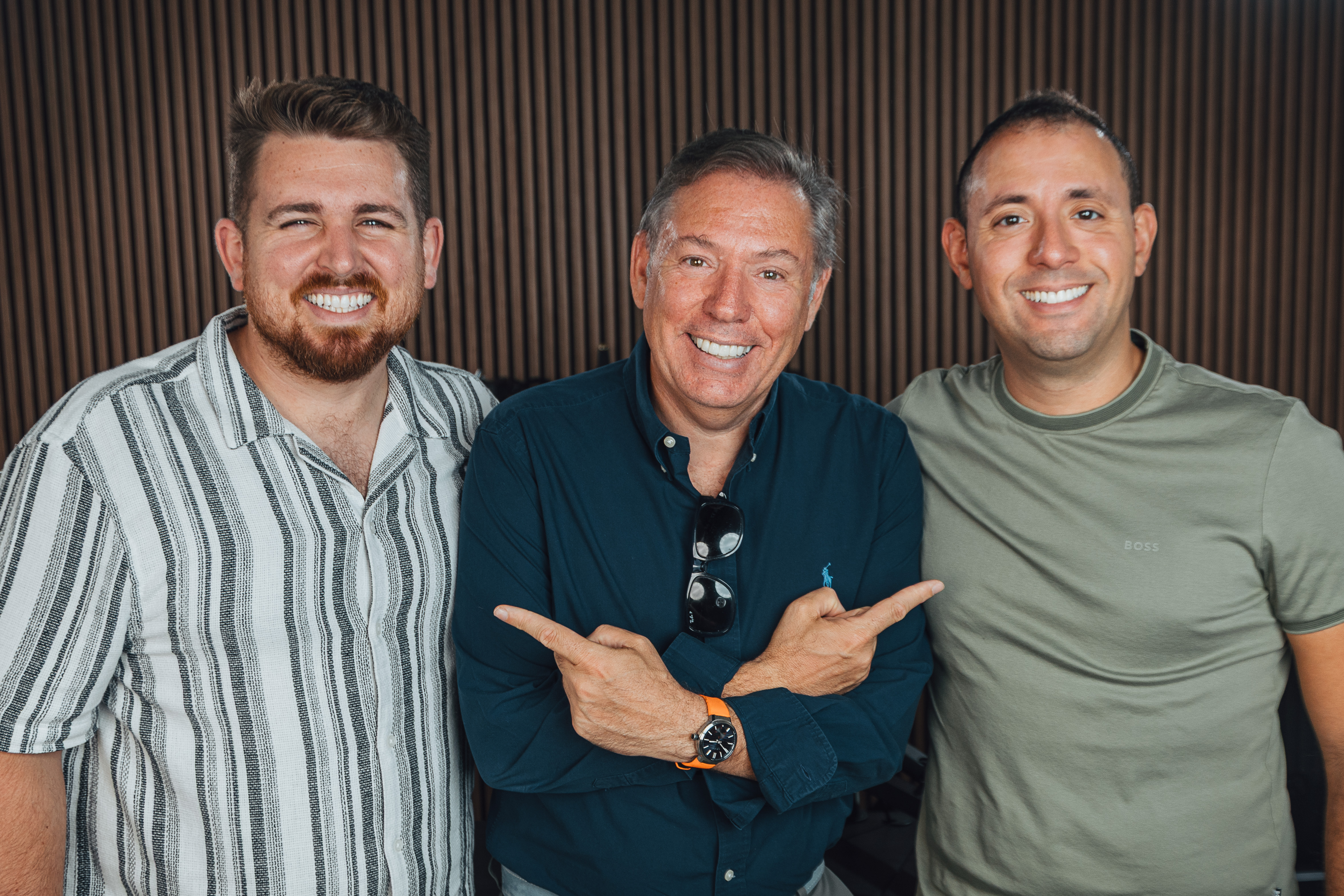
Have we lived before? Serge Ramelli is certain of it, and he says it changed the entire course of his life.
In this episode of the Don’t Do Nothing Podcast, French photographer Serge Ramelli opens up about growing up in Scientology and how it shaped everything he’s become. His mom discovered Scientology in Paris in 1977 after a shy, standoffish neighbor suddenly transformed into a warm, outgoing person, so his mom literally knocked on her door and asked what she had done. When Serge was seven, his mother told him he was a spiritual being who had lived before, and he says it instantly rang true. At 11, he wandered into a lecture on past lives, the speaker asked the room to recall something from 300 years ago, and something came up. A Dianetics session the next day, he says, brought it back with full emotion and detail. Years later he even researched one past-life incident and says he found that the person had existed and died exactly as he’d remembered.
As a young man, Serge was weighed down by deep self-doubt and sadness that held him back from the creative life he’d always wanted. His mom gave him over 400 hours of Dianetics auditing, and he went clear at 25. That, he says, is where the confidence came from. He was a broke sales VP living paycheck to paycheck when he finally decided to walk away and become an artist, funded the leap by pitching a Paris hotel owner (“I have a dream, I want to be an artist”), survived toxic business partners, and rebuilt through a scrappy YouTube channel that took off.
Today Serge is the official photographer of the city of Las Vegas, has work in 120 galleries worldwide through Yellow Korner, has published eight coffee-table books, and is widely considered the number one photography coach on the internet. He credits the whole journey to Scientology. He now builds his whole production company around past-life stories, including his song “You’re Not Your Body.”
Let us know in the comments how did you like this episode and remember:
Don’t do nothing.
In this episode:
- How his mom found Scientology
- Being told at seven that he was a spiritual being who had lived before
- The past-life memory that hit him at a lecture when he was 11
- Researching a past-life incident and finding the person really existed
- Going Clear at 25 through 400 hours of Dianetics with his mom
- How Dianetics lifted the self-doubt that held his dreams back
- Leaving a broke sales career at 40 to become an artist
- The hotel pitch that funded his leap: “I have a dream”
- Why he says “when you truly decide, solutions appear”
- Spotting toxic people, and the Scientology tools that helped
- Becoming the official photographer of Las Vegas, 120 galleries, eight books
- What is Scientology in his own words
Watch the full episode here:
Audio Version:
Apple Podcast:
https://podcasts.apple.com/us/podcast/dont-do-nothing-podcast/id1846609884?i=1000784392166
Text Version:
[00:00:00] Brad: The official photographer of the city of Las Vegas
[00:00:03] Serge: So one day I’m doing dynamics with my mom, and I find an incident, which is how I died last lifetime. I was really living paycheck to paycheck. We barely had money to go on vacation. Never had a camera in my life before that dynamic session. I don’t know how, I don’t know where I get the money, but I’m doing this.
[00:00:17] Serge: I’m gonna resign, and I become an artist today. I travel the world teaching photography or taking photos. If you have people in your environment and when you talk to them, you feel smaller after, there’s a good chance they are toxic people.
[00:00:27] Brad: Welcome back to another episode of the Don’t Do Nothing podcast.
[00:00:30] Brad: Today we have a, a Frenchman with us. Mister- Yes,
[00:00:34] Serge: I am from Paris.
[00:00:35] Brad: Oui. Mr. Serge Ramelli. So I want to tell you about this guy because he’s pretty incredible. First off, Serge is a photography pro. Total pro. How do you say ph- photography?
[00:00:45] Serge: Photographer. I am a photographer. That’s how we say in French.
[00:00:48] Brad: Oui.
[00:00:49] Serge: Uh, yeah.
[00:00:49] Serge: Fine art photographer.
[00:00:50] Brad: Let me give you the stats on this guy. So his work is in 120 galleries worldwide. He’s published eight coffee table books, but this isn’t like he just self-published [00:01:00] them. Like this is with a legit very well-known publisher that publishes like beautiful, amazing work. Absolutely, yeah.
[00:01:06] Brad: Yeah. Of which I would classify your work in that same category. Uh, this is insane. I just learned this today. You’re the official photographer of the city of Las Vegas. Yes. Which is wild. I didn’t even know that existed. Uh, he’s massively successful as a photography coach by my and Aaron’s opinion, the metrics he shared with us.
[00:01:25] Brad: In our opinion, he’s the number one photography coach in the world on the internet. Different statistics, different whatever- Over
[00:01:31] Aaron: a million followers online and, and showing people how to become successful professionally and artistically as a photographer, which is incredible. Yeah, I
[00:01:37] Serge: sold, I sold like 600,000 course on photography and I, I, um, I do a lot of workshop around the world and they are sold out two years in advance.
[00:01:44] Serge: Yeah. This, I, I love teaching photography. Like it totally gave me a life purpose. I love taking photos. I love sharing the beauty of this world. Love it. So not totally done. Let me wrap this up. He’s also a father of four. That’s right. He’s a dedicated loving husband. [00:02:00] Absolutely.
[00:02:00] Brad: Recently became a grandfather.
[00:02:01] Brad: That’s right. Loves his grandson.
[00:02:02] Serge: Emilio
[00:02:04] Brad: Emilio? When he sees- Emilio
[00:02:06] Serge: Yeah I’m a huge fan. I, I have a gr- I have the most incredible grandson that, his name is Emilio. I just shout out to Emilio if he’s watching. And he just so happens to be a Scientologist. That’s right. Been a Scientologist most of my life, through my mom, actually.
[00:02:19] Serge: I’m a S- not quite S- I was seven years old when I became a Scientologist. I mean, 12, 13, really. Well, guess what I’m gonna ask you first. First, welcome. Thank you. Can you please tell us that story?
[00:02:31] Brad: Let’s just
[00:02:32] Aaron: dive right into it. I mean, it’s, yes.
[00:02:33] Serge: Yeah, yeah,
[00:02:33] Aaron: yeah. Like,
[00:02:34] Serge: how
[00:02:34] Aaron: long?
[00:02:34] Serge: Let’s just dive right in. ‘Cause that,
[00:02:35] Aaron: that’s a great, that’s a great
[00:02:36] Serge: question.
[00:02:36] Serge: So, I, uh, my mom was a nurse in Paris in the ’70… I was born in 1970, so in ’77, she, through our neighbor, discovered Scientology. And the reason she discovered Scientology is because the neighbor was, um, a very, let’s say, shy, introverted s- she was, a, like a, pretty famous in the world of fashion, and would never say hi to my mom.
[00:02:58] Serge: And my mom is a very lovely woman, [00:03:00] and then one day she started saying hi. Hmm. So my mom knocked on her door and says, literally, she went up, she was on the fourth floor, we’re on the second floor. She walked, she, she, she knocked on her door. She says, “You changed. What did you do?” Like, literally like this. No.
[00:03:13] Serge: What? Yes. Wow. ‘Cause she was, like, that, she was like a high fashion girl, you know, she was a designer, and she was just for years saying, you know, my mom would say hi to her, she would not even respond. Hmm. And now she was responding, and she said, “I found Scientology.” That was in 1977. And then my mom went in the dictionary and looked what is Scientology.
[00:03:31] Serge: She went down two floors, couldn’t find a definition of Scientology. Went back up two floors, knock on the door. “What is Scientology?” And then so she introduced her to a lecture on Scientology, and my mom fell in love and, and I remember I was, like, seven years old. She like- Do you
[00:03:44] Brad: know what lecture it was?
[00:03:46] Serge: Oh, it was just… No, it was not a, a, a lecture by- A talk. It was a, a talk … it, a talk by some- Oh … by a Scientologist- Oh, I got it … who came to the home on the fourth floor. She went to that talk, and she never looked back, and she got really deep in Scientology, started becoming an auditor, which is the [00:04:00] technique to help people using Scientology.
[00:04:02] Serge: And, like, and, um, I remember I was seven, and she was like, “Gr- good news, you’re a spiritual being and you have lived before.” Whoa, oh my
[00:04:10] Aaron: God.
[00:04:10] Serge: And, and it so much talked to me. I don’t know what. I was like, the fact, the idea that I’ve lived before just talked to me so much as a kid. I didn’t really do Scientology back then, and I sort of went in off and on at different points, but, um, that’s how I found out about the subject, through my mom.
[00:04:26] Serge: Wow. We have become so soft in this world. I know. It’s like, “Hey,
[00:04:30] Aaron: you’re a spiritual being.” Like, “Welcome,” like, “You’ve lived before.” Now it’d be like, “By the way, I read this book.”
[00:04:37] Serge: Like- Yeah. … “
[00:04:38] Aaron: What do
[00:04:38] Serge: you
[00:04:38] Aaron: think about this?” You know? Like, yeah, I, I just, this is incr- I just wanna say props to your mom. That’s such a…
[00:04:43] Aaron: Like, she’s so outgoing.
[00:04:45] Serge: Oh my gosh,
[00:04:46] Aaron: she- And just going out there- … true … just reaching out. Yeah. You know what I mean? True. Like,
[00:04:48] Serge: geez. I, and I, I, and when she told me that I was a spiritual being and that I, you know, she says, “You’ll find by yourself, but you have lived before,” I was like, “Absolutely.” Like, it just was very obvious to me.
[00:04:59] Serge: [00:05:00] Mm. And, um, I have a crazy story, uh, how I found a past life-
[00:05:06] Brad: Where- … at 11. Before that, where- What? … where did that occur? Oh, man.
[00:05:09] Serge: Wait, don’t stop. Yeah.
[00:05:10] Brad: Where, where… But hold on, I wanna know, where did that occur? Where did, where were you with your mom at that time when you’re seven? Uh, I
[00:05:14] Serge: was in my bedroom in Paris, uh, you
[00:05:16] Brad: know.
[00:05:16] Brad: In Paris.
[00:05:16] Serge: In Paris, yeah.
[00:05:17] Brad: Okay. 11-year-old story.
[00:05:19] Serge: So one night, uh, the Church of Scientology of Paris was doing a lecture on past life. It was called, uh, If You Lived Before This Life lecture. Yeah. It was packed. There was, like, 300 people, but I was playing soccer. I was playing car, soccer in, um, about 100 yards away from, uh, from, from where the lecture was happening, but it was getting dark, so we couldn’t play soccer anymore.
[00:05:40] Serge: So I went to the lecture, waiting for the lecture to finish so I could go home with my, my parents. And, um, the guy that was doing the lecture, uh, that’s what they used to do back then, is he, he used to say, “Okay, I’m gonna snap my finger, and, um, if you can remember something, like, uh, I’m gonna ask you to remember your breakfast.
[00:05:57] Serge: I snap my finger. If you have an image coming up, you can [00:06:00] talk about it. If you don’t, no problem. Okay, remember something that happened this morning.” He would snap the finger, and people would share or not share. Okay, then he would say, “Remember something that happened five years ago.” He would snap his finger, and people would share or not share.
[00:06:15] Serge: When I walked in, he said, “Remember something that happened 300 years ago,” and he snapped his finger, and something came up And, um, I was like, “What? What’s going on?” We drove home. Uh, it was super late. It was midnight. I was with my brother. He’s younger than me. He was sleeping. Uh, my mom and dad went to bed, and I went to see my mom.
[00:06:34] Serge: I was, like, in the, in the living room. So my, my s- brother is sleeping. My father is sleeping. I never told this story, by the way. I hope it’s not too much, but it is what it is.
[00:06:42] Brad: No, it’s great.
[00:06:43] Serge: And, and my mom, I go see my mom, and I said, “You know, when he snapped his finger and he said 300 years ago, something came up.”
[00:06:51] Serge: And she looked at me, absolutely focused, and she said, “What was it, honey?” And the m- second she said that, [00:07:00] I felt an emotion that came. I fell on the floor. I was crying. I was, like, s- stuck in some emotional thing, v- very strong. I started screaming. My dad came out, like, “What’s going on?” And it sort of got me out of it right away.
[00:07:11] Serge: I went to bed. The next day, I did a Dianetics auditing- Mm … to sort of clear up what, what happened. Mm-hmm. And discovered, with full evidence and full emotion, that I had lived before. And my life- Wow … was never the same from that moment on. Wow.
[00:07:26] Brad: And I was 11 years old. That’s
[00:07:27] Aaron: amazing.
[00:07:27] Brad: Yeah. Okay, I have a, kind of a philosophical question related to that.
[00:07:32] Brad: I lo- I’d love to hear your take on this. Did that change your viewpoint on life or what you wanted to do with your life or…?
[00:07:40] Serge: 100%, because I, I felt… From that moment, I felt that I had no idea what I had done before, but I felt that I was playing a game for a long time, and I was losing at that game. Mm. And, uh, and, uh-
[00:07:52] Brad: Wow
[00:07:52] Serge: and I was always… I don’t know. I had this concept that I was losing at that game and always, you know, having the same issues [00:08:00] over and over and that… I felt something terrible had happened before. I don’t know what it was, but I, I, I’m, I was always a nice kid, but I was very sad as a kid. I would s- sometime would, you know, I would, um, literally cry for no reason, or I just, you know, would wake up in the morning and just didn’t want to live, or had like a, just a lot of emotion, uh- Mm
[00:08:22] Serge: which I couldn’t tell. I was very, very sad when I was a kid, and I always felt something bad had happened just before, uh, you know- Mm … I took this body. And so I’ve, since then I’ve been, uh, doing lots of Dianetics. I think I’ve been able to find my answers, which was unbelievable, and, uh, took out so much emotion charge from my chest because, uh, you know, Dianetics, and this is what I love and this is why I keep talking about it all the time, is you handle this, you know, these hidden fears.
[00:08:51] Serge: You know? I mean, when I was 20 years old, there were a time I thought about suicide, literally. Yeah. Like, I was so much emotional. I had so much… I don’t [00:09:00] know why. I would wake up and I just felt I had no future and, uh, and that I lost somebody and I didn’t know what, ’cause I didn’t lose anybody. And- Mm. And, but I felt somebody really dear to me was missing, and I couldn’t explain these feelings.
[00:09:11] Serge: I was sad all the time. And, uh, I, um, that went away in 20 minutes of Dianetics, you know? And, um, my mom actually gave me Dianetics auditing for over 400 hours.
[00:09:23] Aaron: Wow.
[00:09:23] Serge: And, uh, and I a- Oh, that’s beautiful … yeah, and I, I became clear, uh, through my mom, which is- Wow … somebody who does not have a reactive mind.
[00:09:29] Serge: That’s what we do in Dianetics, and that completely changed my life. Wow. And, but that was later. That’s, that’s, that’s, that’s l- um, I went clear at the age of 25. It, that took a while. I, I sort of stopped doing Dianetics and Scientology for quite a while, and then, then felt really bad. I was like, “This was so good.”
[00:09:45] Serge: And then so get, got back into it through my mom. And my mom, you know, we had this game. So I used to work in Saint-Étienne, which is, uh, south of France, and she was in Lyon, so about 60 miles away. And every Monday, religiously, I would take the train, go see my mom, and she would give me Dianetics processing for the [00:10:00] entire Monday afternoon, and I would go back.
[00:10:02] Serge: And we did it for two years. Wow. 400 hours.
[00:10:04] Aaron: Wow. Incredible.
[00:10:05] Serge: And that was amazing. That changed my life. That’s when I started getting the idea I could be an artist. Yeah. You know, it’s after, you know… Uh, ’cause it’s a crazy story, but I’ve always wanted to be an actor. I’m actually an actor today. I have a movie out.
[00:10:18] Serge: Didn’t mention that. That just came out on Apple TV last month. What? S- sorry for-
[00:10:22] Brad: Excuse me?
[00:10:23] Serge: Sorry to- Was it, is there any type of photography? What movie? Yeah, we’re held from a, from the virus. No, no, no. No. It’s a full-on movie. It’s called From Paris to Hollywood. It’s a two hours comedy. It’s on Apple TV.
[00:10:31] Serge: It’s a movie that came out 10 years ago, and that, um, it’s a long story, but I distributed the movie myself. Did really well doing that. Yeah. And somebody gave me the really bad advice to go with a classic Hollywood distributor, which I did, but that distributor was not good. Buried the, the movie completely.
[00:10:47] Serge: Wow. Couldn’t find it typing my own name. We got, me and Darris Liljer, who, which we did the movie, got very upset. We lost interest in the movie, lost the rights of the movie. Got the movie rights two years ago. There was a few things we didn’t [00:11:00] like about it. We redid all the color corrections and all the, um- All the music and we changed the name because the name is called The Hollywouldn’ts and just a little funny.
[00:11:10] Serge: So the, it’s a story about a, a French guy who is in LA who is trying to make it into Hollywood and, um, he has an angel with him which is kind of like very mouthful like Eddie Murphy that only him can see. Mm. Like a spiritual being- Yeah, yeah, yeah. Yeah … that walks him into the craziness of Hollywood and he gets routed to a place called the Hollywouldn’t and the Hollywouldn’t what it is, is a place, you know, like the people go to stop alcohol like, “Hi, my name is Jeff.
[00:11:35] Serge: Hi, Jeff.” Alcohol Anonymous. So-
[00:11:36] Brad: Yeah.
[00:11:37] Serge: The, exactly. Yeah. The Hollywouldn’ts is like the Alcohol Anonymous but for people that have dreams in Hollywood so you go there-
[00:11:42] Aaron: To get rid of your dreams …
[00:11:44] Serge: of your addictions. Oh. To, to Hollywood, to your dreams. Wow. So it’s like- So
[00:11:47] Aaron: you become average and like it’s, it’s, it’s kinda, okay, okay, okay.
[00:11:50] Serge: You go in there and they’re like- That’s a great concept … “Okay, so what do you wanna d- Oh, I wanna be an actor. Okay, but what do you do for a living? Okay, maybe you should focus that on more.” Oh. So it’s, it’s, it’s not a nice organization.
[00:11:59] Aaron: It’s a, it’s a crushing soul [00:12:00] place. It crushes
[00:12:00] Serge: your soul. It’s a crushing soul place.
[00:12:02] Serge: Wow. So I fall in love with the most beautiful actress ever who’s been trying to be an actress. She’s really beautiful, see her in the movie. Uh, and she’s been failing for 10 years and we both get to these places and I’m very uplifting in a movie and I break the whole thing, get everybody to make a movie and it’s a very uplifting movie about making your dreams.
[00:12:19] Aaron: Wow.
[00:12:20] Serge: And it just came out last month on Apple TV. It’s, we rebranded. It used to be called The Hollywouldn’ts but people couldn’t even spell it. Right. Mm. So now it’s called From Paris to Hollywood. Okay. Pretty simple.
[00:12:28] Aaron: Okay. Nice.
[00:12:30] Serge: Wow So I wanted to be an actor, uh, but because of the sadness I had in me when I was a kid, I, um…
[00:12:37] Serge: My mom is the most loving mom and the, the less judgmental, judgmental, judgmental- Mm-hmm. Yeah, judgmental … mom ever. Sorry. I am from Paris, so sometimes, uh, English words-
[00:12:45] Brad: Part of the problem
[00:12:46] Aaron: Wait, that’s detrimental. Like, like harming. No, she would never judge me. Jud-
[00:12:50] Brad: not judgmental.
[00:12:50] Aaron: Oh, judgmental. Judgmental.
[00:12:52] Aaron: Sorry. Okay. Yeah, I was still not… didn’t get that one. Okay. Sorry. Judgmental. Okay. Good. Good. It’s, uh, Paris- No, no. Perfect. Perfect I
[00:12:56] Brad: turned on
[00:12:57] Aaron: my
[00:12:57] Brad: French- I’m good. … my French brain
[00:12:58] Aaron: right before- Yeah, I was like Fr- Brad got it for once. I was
[00:12:59] Brad: like- Yeah … [00:13:00]
[00:13:00] Serge: usually Aaron- … he, he’s more international, you know? True.
[00:13:03] Serge: ‘Cause you’re different from, like, uh, you were, like, more from- Yeah … the United States of America, you know? I- Oh,
[00:13:06] Brad: I’m definitely American.
[00:13:07] Serge: You’re definitely American. Yeah. I am, uh, more from Paris. You know, it’s different.
[00:13:10] Brad: Yeah.
[00:13:10] Serge: Anyway, so… And, but I was so sad. I had… I lacked so much self-confidence, I couldn’t even tell my mom I wanted to be an actor.
[00:13:17] Serge: Wow. Really? And I remember being 17 and, and I, I don’t know, I was afraid that my brother and her would judge me, and I couldn’t even tell. And I remember calling acting school, then they would pick up, and I would hang up the phone, reading magazines. Wow. And I just had so much desire, but so much emotion and not belief in me that I would just…
[00:13:39] Serge: I didn’t know what to do with my life. And it’s only when I became clear that I was like, “I’m gonna be an artist. I’m gonna be a photographer, photographer, filmmaker, and, uh, and an actor,” and which is what I’m doing today.
[00:13:50] Aaron: Wow.
[00:13:52] Serge: Wow, that’s amazing. Long story, but anyway.
[00:13:52] Aaron: I, I, I wanna know, I mean, obviously, look, you, I know you love your mother, obviously.
[00:13:57] Aaron: Like, it’s very clear in the way you’re speaking. [00:14:00] And how did that evolve when you started spending that much time together, right? This is probably the highest definition of quality time. You’re, you’re talking to your mom about your most deepest fears, you know, during the Scientology- Yeah … counseling time with your mom.
[00:14:13] Aaron: Like, how did that shape your relationship with her?
[00:14:15] Serge: Oh, I mean, we’re so tight, it’s unbelievable. I don’t think, you know, history of mankind, there’s more a mom-son relationship than her and me. I’m not kidding. We’re very, very close. You know, she’s 83 today. She’s with me. She’s l- staying with me, uh, at my…
[00:14:28] Serge: here in Clearwater, and, uh, we’re taking care of her. You know, she’s getting old. But, um, she… I, I owe her everything.
[00:14:36] Brad: Wow.
[00:14:37] Aaron: Beautiful
[00:14:38] Brad: That is beautiful. Yeah. I, I also love my mom, as does Aaron. Yeah, yeah, yeah. He, he named his company after her as well. Yeah,
[00:14:44] Aaron: that’s true. That’s
[00:14:45] Brad: true.
[00:14:45] Aaron: Yeah. Thank you, mothers. Okay.
[00:14:46] Brad: Yes, mothers
[00:14:47] Aaron: suck. Um, and, and, like, in this, how… Like, what happens? Like, the normal person, you know, maybe listening to this may not understand how this happens, like, the, the, this counseling. H- [00:15:00] how would you describe to somebody- Mm … or, like, h- how could you talk about this time-
[00:15:03] Serge: Yeah …
[00:15:03] Aaron: was such a change for you?
[00:15:05] Serge: The thing I find the most amazing about Dianetics is you can come in in the morning and really feel like and really feel like- … you know, not wanting to conquer any mountains and just you’re upset with everybody. You do an hour of counseling and you come out and you wanna conquer the world. Wow. Like, never ever I have seen such a change when you walk in feeling bad and coming out, you know, feeling great.
[00:15:25] Aaron: Wow.
[00:15:25] Serge: And, uh, the thing is the quantity of reactive mind that every one of us have is so big. It’s a lot bigger than you think. I mean, look, there’s a reason why people, you know, have crazy ideas, are cheating on their wife, uh, don’t wanna live, are drinking, uh, have drug addiction. You know, uh, I mean, I know a lot of successful people that are not doing Dianetics and there’s, like, stories which are crazy, like cheating on their wife or drinking problems or stealing money or being sued by the IRS or, you know, drama, drama.
[00:15:58] Serge: I see drama everywhere, you [00:16:00] know? Mm-hmm. And the drama comes from all this weird thought that we have, you know, and all this, this… You know, every time you feel like crying, every time you feel like, you know, you, you’re, you’re pissed off, you know? That comes from the reactive mind. And so in Dianetics we just…
[00:16:15] Serge: You know, there’s just a lot to do, you know? And, um, you just, you know, layer by layer you do it. What’s amazing about Dianetics is even so you’re not clear, uh, sometime after an hour of Dianetics you feel so good that you’re kind of, like, like clear maybe for four hours. Then you see some pretty girl and you’re like, “Oh, I wanna do stuff with her,” and, and then, you know, you go down again.
[00:16:37] Serge: Uh, you know what I mean? But you… Or, you know. The thing is what Hubbard talks… I c- you know, Dianetics is the book you have to read. Yeah. Um, he talks about restimulation where- Basically the idea, you know, you, you know, some- you see somebody, like for example, I give you an example for me. I used to hate, but hate people that had
[00:16:57] Serge: that were tough executive. Like, you know- Hmm … I [00:17:00] would look down on people like military people or people, CEO of companies that would talk back. I just could not stand these people. Mm-hmm.
[00:17:06] Aaron: Mm-hmm.
[00:17:07] Serge: Absolutely not. But to a point where it, it became irrational, you know? And, uh, you know, I’d just wanna beat them up or get out of there or scream at them, or just don’t wanna be there.
[00:17:16] Serge: It would just like, you know, or, you know, somebody, some people may get … So I was re-stimulated by something, you know?
[00:17:22] Aaron: Mm-hmm. Mm-hmm.
[00:17:24] Serge: And, uh, and this, I found out the source of that, you know? And, uh, but the one thing I’m, I’m, I’m the most passionate about is the whole concept of past life. I, I think, you know, a lot of people on this planet believe in past life.
[00:17:36] Serge: Sure. And, you know, one of the thing that’s amazing about it is we don’t ask anybody to believe in past life whatsoever. Yep. It’s, you know, whether it’s true for you, you’ve experienced it, uh, you know, I’m- I, I used to live next to a Buddhist center, talk to Buddhists, you know, uh, you know, uh, and I have a lot of friend in India also.
[00:17:52] Serge: Mm-hmm. They are all into past life. And, um-
[00:17:55] Brad: This is a point that people miss a lot, like being in the West. Yeah. And really in the US in [00:18:00] particular. I don’t know how it is, I, I haven’t really lived in Europe, but I’d love to know. But in the East, there’s billions of people who it’s like, “Yeah, you get reincarnated.”
[00:18:10] Brad: Yeah. That’s just like the thing. Oh, it’s, it’s, yeah. “And I’ve been reincarnated, and I’m gonna be reincarn-…” It’s like we’re still going after this life. Yeah. It’s not just this body.
[00:18:16] Serge: Yeah. I know, and I, you know how I, I read recently an article how they find the new Dalai Lama, you know, in, in a, you know, with the toys thing?
[00:18:23] Brad: Yes. Mm-hmm.
[00:18:24] Serge: Where he has to look at like- Can you
[00:18:25] Brad: explain this?
[00:18:25] Serge: Yeah. So I- I lo- I love this … I’m not an expert on it, but what I, what I read from the article is basically, uh, during a life of Da- of the Dalai Lama, he has toys that he plays around, especially as a kid, and in the next life he has to recognize five of the toys or s- some kind of numbers.
[00:18:39] Serge: That’s what I remember, and they’re like, “Okay, that’s him,” you know? So they have this whole thing to find out who… You know, because they’re, it’s the same being life after life, you know? Uh-huh. That’s, that’s the idea of the Buddhist theory. And crazy past life story I gotta tell you guys. Uh, you know, um, and I- Let’s do
[00:18:55] Brad: it.
[00:18:55] Brad: I’m ready.
[00:18:55] Serge: Yeah. Okay.
[00:18:56] Brad: Yeah.
[00:18:56] Serge: So one day I’m doing dynasties with my mom, and [00:19:00] I, uh, I find an incident which is how I died last lifetime.
[00:19:03] Brad: Mm.
[00:19:03] Serge: So I find the date, I find the name, I find how the person died, and I do some research after the session. I actually do some research, and I find out the guy existed. He died exactly on that day and exactly in these conditions.
[00:19:17] Serge: I was like, “Oh my God.”
[00:19:19] Aaron: Wow.
[00:19:19] Serge: You know, it is… You know, I don’t wanna get spooky or anything, but when you experience something like this with so, so much certainty- Mm … it totally changes perspective on life. Like, you know, I don’t think in terms of like, “Oh, I don’t care about the future because I’m gonna die in 20 years or t- 30 years.”
[00:19:32] Serge: No, I’m coming back, so I gotta make sure that I take care of my people so they are doing well. I ca- I gotta make sure I do my what- my share to f- care for the planet ’cause I’m coming back and on that planet. It gave me a complete different… Especially that one session. That one session, there was so much certainty in that session.
[00:19:48] Serge: The- Wow. Mm-hmm. You know? There’s a book called Have You Lived Before This Life that is a collection of incident like this, and I lived one of them. And it was just the way it was done, like I, I had to do some research if the guy existed. It did exist. Did he [00:20:00] die that day? He did. Was that in a hospital?
[00:20:02] Serge: Like, you know, people cannot b- b- choose not to believe me or believe me and say, “Oh, it’s just…” I, I know what I know. I, I, you know, I did not know that person. I was not aware of that existence until that session, found out about it and found the truth and, and, you know, it was g- it was just… My life has been different.
[00:20:19] Serge: I don’t look at life the same way since that session, to be honest.
[00:20:23] Brad: Yeah. Yeah. Well, it changes what… It would have to, by necessity- Yeah … change what your goal is for this lifetime or your goal- Oh, yeah,
[00:20:30] Serge: 100%,
[00:20:30] Brad: like- … like what game you’re playing.
[00:20:31] Serge: Yeah, like- In this life, you know, it took me… I, I started being an actor at the age of 50 because of all the reactive mind and all the re-stimulation I’ve had.
[00:20:39] Serge: But next lifetime, you’re gonna see me at five years old. And I’m gonna be on fire. Like, I’m not gonna, I’m not gonna do the same thing I did this lifetime. Wow.
[00:20:47] Aaron: I, I also think something is so important and You know, in, in, in Scientology, right, it’s kind of the East meets the West. Yeah. Yes, that’s right.
[00:20:55] Aaron: Because there’s a lot of logic and scientific approach to a lot of these spiritual [00:21:00] concepts. And I, I find that it’s so wonderful because these ideas, for example, you said yourself, like, before at, at, at a younger age, you wanted to, let’s say, end your life and, and you weren’t- Yeah … happy with, with the way that your life was.
[00:21:16] Aaron: But after you find out that you can’t run away from life-
[00:21:19] Serge: Yeah, you cannot …
[00:21:20] Aaron: you, you get what I’m saying? Like- Yeah … like, if, if you understand that you get rid of this body, you’re, you, you’re not gonna just go not be somewhere. You, you’re gonna gotta, gotta go again, so you might as well solve the stuff now because you can’t run away from it.
[00:21:32] Serge: Exactly.
[00:21:32] Aaron: There is no, like, escape. And when you really truly see that, why would anybody-
[00:21:39] Serge: Yeah …
[00:21:40] Aaron: do this kind of activ- Like, why would you- Yeah … ever do that? Mm. Yeah,
[00:21:43] Serge: but you see, the thing that I find is people can’t cope with their emotion. You know, they just get pissed off. Yeah. They get sad, you know, and they do crazy stuff in life.
[00:21:50] Serge: They, you know, they cheat on their wife. They, they, they, they do financial stuff they’re not proud of.
[00:21:55] Brad: Mm.
[00:21:55] Serge: And, uh, they just go down because they don’t have the tools, and that’s what Scientology is, is [00:22:00] tools to undo that, you know, to have a, a life. Like, I have a li- I always say if I had not met Scientology, I would be a car salesman in the suburb of Paris, Aubervilliers, which is not a nice one, uh, selling cars with four ex-wife and about 60 pound overweight- Mm-hmm
[00:22:17] Serge: and a big drinking problem.
[00:22:18] Brad: Mm-hmm.
[00:22:20] Serge: 100%. And you’d be selling Renaults, which aren’t even nice cars.
[00:22:23] Brad: That’s right. Do you know what a
[00:22:26] Serge: Renault is? Yeah, I wouldn’t work for Dacia. No, I’m sorry. I would work for, for Peugeot or Renault. Yeah, P- Peugeot, yeah, yeah. But you know what I mean. It’s like I have… You know, there, there’s a philosopher that says, you know, when you do what you love, you, you, you don’t work anymore, you know?
[00:22:39] Serge: And I feel like I’ve been on vacation for 16 years. I travel the world, uh, teaching photography or taking photos. I’m doing a book on Copenhagen right now. I just came back from the most crazy tour ever. In May, I went to Monument Valley, Page, Arizona, Monument Valley, Page, Arizona, Yosemite for one week, Lake Tahoe, did an event in San Francisco.
[00:22:57] Serge: Wow. Six event in Los Angeles, [00:23:00] flew to South of France. Did one week, uh, for the lavender field in South of France, went to Paris, Normandy, back and forth twice, then one week in Copenhagen and then back here. Wow. And now I’m leaving in two weeks. I’m going to Switzerland, Geneva, Lausanne, then I’m going to Padova, Venice, Florence, and Tuscany, fly to, uh, to Iceland, do an event in New York and back, and then I re-fly to London and then Africa.
[00:23:24] Serge: So when- Adventurous.
[00:23:25] Aaron: Yeah.
[00:23:26] Serge: Yeah, I mean, it’s like this, I’ve, I love traveling. I love seeing the world. Oh, I forgot I spent one week in Croatia, vacation with my wife in the middle of all that.
[00:23:33] Aaron: Yeah.
[00:23:34] Serge: I’ve dreamed of that life my whole life. I love sharing the beauty of this world. I love taking photos. I love making movies.
[00:23:39] Serge: And being able to make a great living out of it is is a gift from Scientology. Wow. Oh Like, I would have never in a million year done this if I hadn’t, if my mom hadn’t done and, you know, this 400 hours of, of, of, of auditing, of therapy to get me to the state of clear. Absolutely This n- never would have hap- because [00:24:00] the most crazy story is how I was living paycheck to paycheck, like living paycheck to paycheck for, you know, ’cause we bought a big house for my wife.
[00:24:08] Serge: We fell in love with that house that had a garden with a forest that was just really way over, uh, what we could pay. And, you know, I was making about $10,000 a month, but the house itself was, like, four. And then when was this- When, when was this?
[00:24:19] Brad: Yeah …
[00:24:20] Serge: that, so we bought the house exactly 20 years ago, so it was in 2005.
[00:24:25] Serge: Mm. And I was really living paycheck to paycheck. We barely had money, we barely had money to, uh, go on vacation. And, uh, because four kids cost a lot of money, you know? And we had, like, you know, two scooters, rentals, and cars, and two dogs, and, and just a lot of credit card debts. And, uh, one day, I come out of processing of Dianetics, and I tell my wife, “I wanna quit my job,” and I was a s- VP for sales at the time of a company.
[00:24:51] Serge: “I wanna quit my job and I wanna become an artist.” And she, my wife is super supportive. She’s like, “Yeah, we just have to figure it,” we, you know, we- … hardly can pay the credit card bills, you [00:25:00] know? And, um, and you want me to tell the story how-
[00:25:03] Brad: Wait, was she, what was her, her a- she was just like, “
[00:25:06] Serge: Yeah, let’s do it”?
[00:25:06] Serge: She’s always been supportive. She was like- Wow … “I believe in you more than anybody. I know you can make this happen.” Because I was, you know, I also was a very suc- I was the number one salesperson in that company. Mm. Did really well, you know. But it was just, you know, it’s just the tax in France is very high.
[00:25:21] Serge: I mean, you know, and 10,000 seems to be a lot of money, but with tax, like, I don’t know. Were you living
[00:25:25] Brad: in France at the time?
[00:25:27] Serge: Yeah, Paris. Oh, got it. I was living in Paris. Okay. Yeah, I was living in Paris. One day, I’m like, “I’m gonna become an artist,” you know, after this Dianetics thing, and, ’cause I had this sort of regain of self-confidence, you know?
[00:25:37] Serge: And so I went to see my boss and I said, um, you know, uh, and, “I wanna become an artist.” He says, “You know, Serge, you are the best salesperson we ever had. You know, uh, you don’t have any share in the company, but I do wanna sell the company. If you stay one more year, uh, I’ll, I’ll give you about $200,000.” Nice.
[00:25:53] Serge: “Uh, that should give you enough money to figure your, your life out, where you can, you know, buffer money, you know. Uh, you, you should be [00:26:00] able to change life,” you know. I had no idea how to make a dollar with photography. Uh, he says, “But I need you to stay one more year.” I stayed one year, and he says, “Look, I tried to sell the company, couldn’t find a buyer.”
[00:26:10] Serge: And I remember all my life because after one specific Dianetics session, I started, I came out, I bought a camera, I started taking, taking photos. So 2005, I start taking photos. No w- You
[00:26:20] Aaron: had no, no f- photography experience before?
[00:26:22] Serge: Never t- had a camera in my life before that Dianetics session. I went out of the session, bought a, a camera.
[00:26:28] Serge: I, I bought a Canon EOS 350D, which is, like, the, uh, the cheapest Canon camera you can find at Best Buy today. It’s, like, today it’s, uh, it’s called a Canon Rebel T2i. Yeah. It’s the, it’s, if you walk into Best Buy tomorrow and says, “What is the cheapest camera you have?” That’s the one I bought. Okay,
[00:26:42] Aaron: okay.
[00:26:43] Serge: It’s, like, 300 bucks.
[00:26:44] Serge: Oh, I mean, that, that you, where you can change lenses. Right, right, right. Not like point and shoot where you can’t change lenses. So I, I, I, uh, you know, I came out of session, I started learning photography on my own on YouTube and on reading books, and, you know, after work I would take photos. And then [00:27:00] this thing happened with my boss- Can, can I ask why?
[00:27:03] Serge: Because, okay, great question. I was trying to make … I have a big goal in filmmaking, which we can talk about that, where I want to make movies. And so I was trying to make movies at the time, but making movies requires cameras, requires actors, requires gaffer, a set, a story, a lot of stuff. I used to live in Paris back then.
[00:27:22] Serge: Paris is one, if not, we can debate that, the nicest city in the world. Mm-hmm. Yeah. And so I’m like-
[00:27:28] Brad: Do you think it is?
[00:27:30] Serge: I, yeah, I think, I think it is. Okay. I think it is. Yeah. I think, I think, my three favorite cities in the world is number one, Paris, number two, New York, and number three, Venice in Italy. Mm-hmm.
[00:27:39] Serge: That’s like my, for photography- Yeah, yeah … I find where you get the most incredible stuff, you know? And I’ve been- In a lot of places. But so I, I started taking photos and, um, because I was like, at least with a camera, I’m in one of the nicest city in the world, after work I can take photos. And I c- I at least I can do something artistic.
[00:27:58] Serge: Mm-hmm. You know? It was just [00:28:00] to get the artistic thing going on, you know? And so I started taking photos. I was really bad at it at first. Uh, I think it took me two years to really get a sharp photo is. I, I was, uh, I was not… It took me a while to figure it out. And- What was
[00:28:11] Aaron: your… H- how did you figure it out?
[00:28:13] Aaron: Did you take classes, courses,
[00:28:14] Serge: books? What? Yeah. Uh, there’s a guy named Scott Kelby, uh, who is, uh, he actually he lives here in Altamonte. He has, there’s a huge company called KelbyOne. They’re the best. Mm-hmm. And I’ve been a member of that, uh, used to be NAPP, National Association of Professional Photographer.
[00:28:28] Serge: They, it’s kind of like a Netflix for photographer. Mm. So you pay like $20 a month- Oh, yeah … and you got unlimited courses. I’ve been doing this for 21 years with him. Wow. And I actually became one of his instructor. He’s a personal friend now. He’s 10 minutes away from here. But it’s the biggest hub of photographer on the planet, Altamonte- Wow
[00:28:44] Serge: believe it or not. Wow. And so, uh, I learned a lot with him. Mostly, honestly, Scott Kelby is one of my biggest mentor. And, uh, there was another guy that I met, a black and white artist, which I became his assistant, named Jean-Michel Burtz, which I learned a lot from. Amazing ph- amazing artist. [00:29:00] And, um, uh, what the funny thing is, so I had this number, $200,000.
[00:29:05] Serge: If I can find $200,000, I can figure out a way to stop being a salesman. Mm-hmm. ‘Cause I’ve been selling since the age of 16. I was a good salesman. I was the number one in every company I worked with. But, you know, my only reality was, you know, you sell something, you get a commission. That’s the only way- Yep
[00:29:20] Serge: you survive on planet Earth. Mm-hmm. That was, that was what I thought.
[00:29:23] Brad: And what a way to survive it is. It worked. It worked for you, right?
[00:29:24] Serge: It worked. It worked. Yeah. And then, um, so one year goes by and he’s like, “Look,” uh, he was treated trying to sell a company, didn’t work. Good thing he didn’t ’cause he ended up selling it for a lot more money years later.
[00:29:38] Serge: Uh, good for him. Uh, so I went to see my wife, uh, and I said, uh, “What, what, what if we sell the house?” Uh, we had a, this big house. If we downgrade a little bit, I could get about 150, 200,000 in cash. That was in May of 2008, and my wife loves that everything is super clean. She said, “Look, I wanna redo all the painting.
[00:29:57] Serge: If you wanna sell the house, I’ll support you. We can downgrade, [00:30:00] get something small.” It was a really big house. Like, it was very fancy because we had this garden that was in front of a forest, which is really rare around Paris. So we literally had a view on a forest, which is-
[00:30:09] Aaron: Wow …
[00:30:10] Serge: like a luxury. We had a lot of- Yeah
[00:30:11] Serge: celebrities. It was like a fancy house, you know? A little bit ab- above what we were m- We could afford.
[00:30:17] Aaron: Yep.
[00:30:17] Serge: So we had this plan to sell the house, so, but it took us, ’cause we didn’t know Brad, three months to do all the painting. I’m just kidding.
[00:30:25] Brad: Yeah, yeah. Thank
[00:30:26] Serge: you. You do renovation. Uh,
[00:30:26] Brad: yeah, yeah.
[00:30:27] Serge: Uh, and, um, no, we just, we took, uh, a renovation company and it took forever to do the painting.
[00:30:32] Serge: Yeah, yeah. And we put the house on market on September of 2008. Now, remember what happened September 2008. The subri- supreme, subprime? Is that what it’s called? Like, this huge, biggest real estate crash- Yeah … of the last two decades.
[00:30:43] Brad: Yeah.
[00:30:44] Serge: Couldn’t sell the house. Could not sell the house, and one month goes by, two months go by, and it’s an incredible house.
[00:30:51] Serge: Actually still own it, I’m selling it now. Just, uh-
[00:30:53] Aaron: What? Wow.
[00:30:55] Brad: Yeah, yeah. ‘
[00:30:55] Serge: Cause let me finish the story. So eight months goes by, couldn’t sell the
[00:30:57] Aaron: house, and, um, by [00:31:00] the way, I didn’t know this real estate crash was worldwide. I thought it was just the West. Oh, my God. Oh, yeah, yeah, yeah. I thought it was the
[00:31:05] Brad: West.
[00:31:05] Brad: Paris. No, worldwide. Worldwide.
[00:31:05] Aaron: Paris. Nothing
[00:31:06] Brad: was selling. Especially super high-end real es- all the high-end real estate markets, ’cause it was all propped up by people-
[00:31:12] Aaron: Fake.
[00:31:12] Brad: I’m, I’m gonna know about it- No, no of- no offense … but I thought
[00:31:13] Aaron: that whole
[00:31:14] Brad: mortgage thing was US … but who were in more house than they should have had.
[00:31:16] Aaron: Exactly.
[00:31:16] Brad: They would get- Oh … approved for more house
[00:31:18] Serge: than they could. No, no, it went planet
[00:31:19] Aaron: wide. So, so you were part of the getting the house that you- Well, no, I, I-
[00:31:22] Serge: Well, he could pay for it … I was paying the mortgage. But, okay. I didn’t have any late payments. I didn’t have- Oh, okay, okay, yeah … I didn’t have any late payments.
[00:31:26] Serge: But it was just, it was rough, paycheck to paycheck.
[00:31:29] Aaron: Okay.
[00:31:30] Serge: And when I see that the house is not going, now I really feel trapped. I feel trapped by what we call- Mm … the, my financial obligation. Yeah. I’m like, “I am never going to be an artist this lifetime.” Wow. “I’m gonna have to wait till kids are big or that I’m retired to be able to do it.”
[00:31:42] Aaron: Mm.
[00:31:43] Serge: And so I did what I always do, is I do Dianetics.
[00:31:47] Aaron: Mm.
[00:31:47] Serge: I went back, uh, f- I did, um, it was not a session, but I did something we do in Scientology, and um- And I remember it was just actually a, a Scientology friend who helped me and, uh, using Scientology [00:32:00] tools. One of the, one of the theory I love about Scientology is that if you validate somebody on his, what he does well in life-
[00:32:07] Brad: Mm
[00:32:07] Serge: uh, he goes up something called the tone scale. Yeah. Tone scale is the emotion we are into. So I was very, I was like at, you know, very low on the tone scale because I felt like I, I didn’t know what was going on with the real estate, but I just, that was my last solution. However, I had a huge collection of photos of Paris by then, ’cause that’s now three, four years I’m taking photos.
[00:32:28] Serge: And I go see this guy, he’s a Scientologist and, and he… I mean, all, honestly, all he really did is just, like, validate the heck out of me. He was like- … “You is a top salesperson that ever worked in that company. You do that come from, from this to this. You did this. Your photos are amazing,” blah, blah, blah. You know, and it just sort of, you know, I just remember going clear and what it meant to me, and I just went up the tone scale.
[00:32:52] Serge: And I remember he was living on the fourth floors of a building. I swear, I walked out of this building on the fourth floor, and on the third floor, [00:33:00] I take a decision. I said, “I’m doing this. I’m doing this, and I’m doing this now. I don’t know how, I don’t know where I get the money, but I’m doing this. I’m gonna resign, and I become an artist today.”
[00:33:08] Brad: Yeah.
[00:33:09] Serge: I go down one more floor and an idea pops in my head. I swear to God. And there’s a theory in Scientology, which is that when you decide something- … solutions happen.
[00:33:17] Brad: Yeah.
[00:33:17] Serge: A lot of people in their, in their life don’t do things because they’re stuck on a maybe. Mm-hmm. And so-
[00:33:23] Aaron: Mm-hmm.
[00:33:24] Serge: Mm-hmm … basically, I was stuck on a maybe for years.
[00:33:26] Serge: Like- Gosh … I was, I was not 100% in, I was 80% in. Right. Yeah. You know? Yeah, but I gotta sell the house. I gotta get the money from the boss. I gotta do this, you know? That third floor event, I went 100% in. I’m like, “I’m doing this.” Mm-hmm. I don’t know how. An idea pops in my head. The idea is simple. You know a lot of wealthy people in the hotel business.
[00:33:43] Serge: You have an incredible collection of photos. What if you sell your work and you make $200,000 with your photos? The next day, I go see a guy named Michel Saouk If you ever see that Michel, mwah, I love you. Uh, I go see this guy. He’s, um, he’s one of my customer [00:34:00] in the business of my, uh, uh, of my company, and he has a hotel called the Hotel Abbatial.
[00:34:04] Serge: It’s a very nice hotel in, uh, Saint-Germain-des-Prés, the nicest part of Paris. And so I go see the guy, and I literally, I walk in and says, “Michel, I have a dream. I want to be an artist in this life.”
[00:34:15] Aaron: Wa- wait. That’s a fantastic opening.
[00:34:16] Serge: That is a fantastic opening. Yeah.
[00:34:17] Aaron: Is that how you actually opened? To, to talk to somebody who’s a successful person, and that’s just, that’s a fantastic opening.
[00:34:23] Aaron: Yes. I was gonna say, well, you’re, you’re a master salesman.
[00:34:26] Serge: Yeah. I’m not bad.
[00:34:27] Aaron: It’s all giggle.
[00:34:28] Serge: And so I, I- Did you say it in French, though? I said it in French. How do you say it in French? Michel, j’ai un rêve. Mm. Uh, I have a dream.
[00:34:33] Aaron: Yeah, yeah.
[00:34:34] Serge: And I said, “Look, I, uh, in this life, I really want to be a photographer and want to be a filmmaker,” and I had a crazy idea.
[00:34:40] Serge: See, one of the issue hotels in Paris have is there’s 1,800 hotels privately owned in Paris, and, you know, you go on- Wow … on Google, like which one do you pick, you know?
[00:34:49] Brad: Yeah.
[00:34:49] Serge: So I said, “Look, what if I became the artist of the hotel? What if every room had a huge print? It’ll cost you $1,000, a thousand euros for every room, which would cost [00:35:00] me 200 to produce.
[00:35:02] Serge: Uh, and, uh, you do, put one in every room, and we put, like, 10 in reception. And, you know, I know you’re doing renovations. I know it’s $5 million. You just give me like, you know, 50,000, 44,000, and now I become the artist of the hotel.” And he was like, “Oh, okay, let me think about it. Give me 48 hours.” And, um, he calls me two days after.
[00:35:24] Serge: I remember all my life I was in Gares de l’Est, which is the worst part of Paris. It’s not kind of like red-light district. It’s not nice. It’s not, it’s not the nicest part of Paris. Mm-hmm. Yeah. Especially where I was was kind of like not nice. Whatever. And he calls me up, and he says, “Serge, I was very touched by your story.
[00:35:40] Serge: Now, you don’t know this, but I actually have two hotels. I’m renovating both, and I want you to become the artist of both hotel. I’m gonna give you 100,000 euros.”
[00:35:49] Aaron: Wow.
[00:35:50] Serge: And I’m like, “What?” Like, literally like this. Like, no questions. Like, I’m even gonna take more photos. Like, he was not trying to get a dollar discount.
[00:35:59] Serge: He was like, he actually [00:36:00] ordered more. You know, for me, it’s nothing. It’s $8 million, 100,000. I can write it off. It’s just decoration. I love the idea. I love what you do. Not much people, you know, are, are, are taking the risk you’re doing. You’re getting $100,000. Wow. I, I went to see… On that note, I went to see four or five other hotels and did another $80,000 in four days.
[00:36:21] Serge: Wow. So just think about that. Wow. Selling the share couldn’t work. Selling my house couldn’t work. My photography, which I decided on becoming clear to do- Mm … is what actually gave me the money to make the switch.
[00:36:33] Brad: Yeah.
[00:36:34] Aaron: Wow.
[00:36:34] Serge: Isn’t that insane?
[00:36:35] Brad: Yeah.
[00:36:36] Serge: Unbelievable.
[00:36:36] Brad: It actually doesn’t sound insane at all to me.
[00:36:38] Brad: I mean, it’s so nuts. Like, it, yes, but at the same time, no.
[00:36:41] Serge: Yeah. ‘
[00:36:41] Brad: Cause it’s like when you follow through on what you intended to do- It just works. Yeah. Like, that’s what I’ve always found, is like when I have a decision to do something and I follow through on it, if I veer off of it, it starts, starts not working.
[00:36:53] Brad: But if I’m on what I decided, it’s like the path to just g- you just clear it.
[00:36:58] Serge: Yeah. I, [00:37:00] the number of miracles, including the Vegas story, I can tell you, that has happened in my life from the moment I went clear and decided to follow… You know, Hubbard has a definition which I love about living. Living is following a, a purpose.
[00:37:12] Serge: Mm. I started following a purpose. I started being happy. I started… It gave me just a sense for my life. Mm-hmm. Mm-hmm. Going clear and having this idea that I’m gonna be an artist and a filmmaker just gave a p- But it was late. I mean, like, you know, I sold this, I was, I was 38 years old, you know? And, uh, no, I was 40 years old.
[00:37:29] Serge: I remember I resigned for the Cannes Festival May of 2010-
[00:37:33] Aaron: Oh,
[00:37:34] Serge: wow … and I’d just turned 40.
[00:37:35] Aaron: Wow.
[00:37:35] Serge: And, uh, I, I, I resigned f- I found somebody to replace me in the company, and in three weeks I was gone and I became an artist. But then I got scammed with, of all the money. Can I tell you that story? Hold on. Hold on.
[00:37:46] Serge: No. Before we get into that- We need to s- Wait one
[00:37:47] Aaron: more pause and a sec … we need to end on the dream.
[00:37:48] Serge: Yeah, yeah,
[00:37:49] Aaron: yeah. Exactly. No, no, I’m kidding. No, hold on. It get- But wait, but wait, but
[00:37:51] Serge: It gets better.
[00:37:52] Aaron: Stop. Hold on. But those, the f- the photographs that you did, did you reshoot photographs or was it the ones that you already had taken?
[00:37:59] Serge: No, it’s the one I just [00:38:00] did for the last four or five years. That’s the
[00:38:01] Aaron: one I was like- So you’d been taking them already.
[00:38:02] Serge: I had the asset. Had…
[00:38:03] Aaron: So you, you, you did the work but you never- Yeah … sold it. Which I just wanna say, it’s a lesson for artists.
[00:38:07] Serge: Yes. Yeah.
[00:38:09] Aaron: Because you do the work, you do something brilliant, but if you do not sell it and no one sees it-
[00:38:14] Brad: Mm-hmm
[00:38:14] Aaron: then, I mean, you did it only for yourself. You might as well
[00:38:16] Brad: not have even d- well, my viewpoint is you might as well not even have done it. Wow. But that’s my- ‘
[00:38:20] Aaron: Cause you gotta go and then you gotta- Non-artist viewpoint … take it to the next level. Yeah. Anyway, sorry. Let go- Yeah, I mean,
[00:38:24] Brad: uh- Let’s
[00:38:24] Aaron: talk how it all went down the drain
[00:38:25] Brad: little parenthesis. Do you guys know the, the Vincent van Gogh story? Yes.
[00:38:29] Aaron: He
[00:38:29] Brad: only, all his- Do you
[00:38:30] Aaron: know he sold- … all artwork
[00:38:30] Brad: sold when- What, one? … he
[00:38:31] Aaron: was dead.
[00:38:31] Brad: He only sold one during his lifetime? I don’t
[00:38:33] Aaron: know much about… I, I know-
[00:38:33] Brad: Okay, can I tell the story? Yeah, please. Please, please. ‘Cause I know you read it well.
[00:38:35] Brad: Yeah. It’s
[00:38:36] Serge: incredible.
[00:38:36] Brad: Wait, can we hold that? ‘Cause I have a question about purpose.
[00:38:39] Serge: Okay.
[00:38:39] Brad: Okay. Who gives you your purpose? Me. As a Scientologist.
[00:38:43] Serge: Oh, I found that purpose. I rehabilitated. I don’t know if that’s an English word. Yeah, yeah, yeah, yeah. Yeah, I, I had this purpose. Well, the truth is, I’ve always, since the age of three, I knew I wanted to be an artist, except that every time I would think like, “Oh, oh, I wanna be an actor.
[00:38:56] Serge: Oh, I’m just not good-looking enough. I will never be able- Yeah, yeah … to make it. [00:39:00] I don’t have any talent. Oh, I wanna be a filmmaker. Oh, come on, you’re a nobody. You’re an imposter.” Wow. Like, come on. The demons. Who, who do you th- d- oh, my gosh, demons, demons, my whole child world. I would do one step forward, two step backwards, or one step, nonstop until I went clear.
[00:39:14] Serge: Mm. That’s why I always say I owe everything to Dianetics, everything. And, um, so I lost track. We were saying, so- Thank you for
[00:39:22] Brad: that …
[00:39:23] Serge: uh, on van Gogh, because it’s- Yeah … it, it, it’s a true story. So during this life he only sold one painting. Mm. When he passed away, so he had a brother that had a wife. And, uh, crazy story, and it’s all about marketing, uh, the, um The, so the brother gets all the painting back, but he dies too.
[00:39:40] Serge: So the wife- Oh … is left- I didn’t know
[00:39:42] Brad: his brother
[00:39:42] Serge: died. Yeah, his brother di- Oh … later on. And, um- His brother supported Van Gogh his whole life, I understand. He’s, exactly, but like paycheck to paycheck. Mm-hmm. Like, not, not, I mean, like he’s the most acclaimed mo- like I think he’s one of the most valuable artists- Yeah
[00:39:55] Serge: you know, in history now. Mm-hmm. Uh, but crazy story. So the wife [00:40:00] has the painting. Her husband dies. N- nothing is selling really. She does an exhibit in Paris. Nothing sells. She finds a box, and in that box there’s letters from Van Gogh for every painting explaining why he did the painting.
[00:40:12] Aaron: Oh.
[00:40:13] Serge: She does a new exhibit with one painting and the story behind the painting.
[00:40:17] Aaron: Just one?
[00:40:18] Serge: The… No, no, no. Okay. Maybe 10. Each one with a letter accompanying- 10 paintings, and each painting had a- The story … the original letter from Van Gogh explaining why he did the painting.
[00:40:25] Aaron: Oh.
[00:40:27] Serge: And that became Van Gogh. That was the beginning of Van Gogh. And it’s all about sto- story- The story
[00:40:31] Serge: storytelling in, you know. Yeah. You know, I remember I’m a, I’m a big watch guy. I got chills listening to that. I, I love watch, right? Yeah. I, I, uh, but- What is this? This is a Leica, a Leica who makes camera. They used to make watch. It’s a Leica watch. Oh. Uh, which is, costs the same price than the Leica camera.
[00:40:45] Serge: It’s a very expensive watch. Uh, that was my birthday last year. The, um, I remember at 2:00 in the morning I wa- I wanted to buy a watch. I saw a guy from New Zealand doing a watch, and it was like, it was like $400, $500 and I, and I go on his website [00:41:00] and I’m like, “What’s the story behind the watch?” And there’s no story.
[00:41:03] Serge: Mm. Like, why did he become a watchmaker? What story? Didn’t buy the watch. Like, uh, I, I find in marketing, uh, you know, that’s just a little tip, you know. Like, if you want to sell a photo, what’s the story be- the, the guy bought my photos- Yes … because the story was he was helping me becoming the person I wanna be in this life, you know?
[00:41:18] Serge: Right.
[00:41:19] Brad: You know what’s funny about that, Serge, is I’m gonna talk about Aaron for a second. Aaron does this with Amazon. I have noticed this. He- And you tell other people to do it as well. So I’m in, uh- He
[00:41:28] Aaron: tells stories about your product?
[00:41:29] Brad: Yeah. Go ahead. I, I need to do
[00:41:30] Aaron: it- Tell people … more. I need to do it more.
[00:41:32] Aaron: But of
[00:41:32] Brad: course- But you te- I’ve heard you tell at least five different people to do this in, during Amazon training.
[00:41:37] Aaron: Yeah, yeah. Yeah. About the story. Well-
[00:41:38] Brad: Mm-hmm …
[00:41:39] Aaron: I think that as, I, no, what you’re saying is so valuable, right? And the Van Gogh piece is, is- … it’s so enlightening because if you have… Oh, take that, that painting right there, that, that’s on, on the wall.
[00:41:52] Aaron: That’s a guy, right? His name is Walfrido, and he takes pictures, and it’s in Hawaii and whatnot. And sorry, uh, uh, paintings, and they’re real locations. [00:42:00] But at least when I go to buy it, it’s in the place in Hawaii and whatever. If it was that painting and I had seen it right down the street, it wouldn’t mean the same thing.
[00:42:07] Serge: Right.
[00:42:08] Aaron: I can say, “Hey, I was in Hawa- ” And I can tell a story of how I got and I was inspired and I was there and it’s my daughter and whatever. And okay, cool. You know, so you, there’s a story that goes along with it, which you can create or the person can tell you their story.
[00:42:20] Serge: Right.
[00:42:20] Aaron: Right? And so with us, of course, Zulai Kitchen is the story of my mom, and she’s a single mom, and she would cook for us on Monday, right?
[00:42:27] Aaron: She’d make like, she’s working probably 70, 80 hours a week to, to, to make enough to support her family. She’s a single mom, like, uh, like me and my brother, like it, there’s a lot. But she would find time to cook for us anyway. She would do one big meal, massive ground beef, and she would f- like, leave us how to reheat the food or whatever she’d cook on Monday, and we’d have food for a whole week.
[00:42:45] Aaron: It’s always home food, home-cooked meals. Mm-hmm. And so I go, “Okay, we’re gonna do a kitchen company. Well, who, who better to name it after than my mother?” And so that’s our… I mean, listen, I need to do a lot better. That’s a great story. I need to bring, I need to bring around and do, like, I’ve also told her like, “We’re gonna do the podcast.
[00:42:57] Aaron: We’re gonna talk.” Like- [00:43:00] About stuff because she remembers stuff that I didn’t know. After I had four kids, she told me, “You know, when you were a little boy you said you were gonna have four children.”
[00:43:06] Brad: Wow.
[00:43:06] Aaron: And I said, “No, I don’t remember that at all. I have ze- I don’t know. I didn’t even know I wanted to have kids ’cause I…”
[00:43:12] Aaron: L- anyway, you get lost sometimes. But like- Wow … my mom reminded me of that. Anyway, whatever. I don’t know why we’re talking about this. But, um, yes, stories are important because it gives meaning to what you’re doing. You’re not just buying a microphone to support some nameless- Yeah … corporation. Mm-hmm. So when I talk about if you’re gonna start a company, you need to say, you need to say why you have the product.
[00:43:30] Aaron: Yeah. Like- You test it with your baby, whatever. You test it with y- you know, you have a hair product, you just do your hair. You, whatever it is. You have a camera, well, this is the first camera. I made this camera because I fi- I didn’t find a camera that was good. Whatever it was. Yeah. You need to have the story.
[00:43:41] Serge: Mm-hmm. 100%. And anyway, so now I got $200,000 and I quit my job, and I make a big mistake. I partner with two people which are very toxic people. You know, and, um, by the way, I have a great definition for toxic people. Oh, what is it? Uh, which is, uh, you talk to someone [00:44:00] who is toxic, and after that discussion you feel smaller than before you started.
[00:44:04] Serge: Yeah. You know, if you have people in your environment and when you talk to them you feel smaller after, there’s a good chance they are toxic people. Anyway, I had this dream about making movies, and it was, um, a guy that was a screenwriter and it was a director. The screenwriter had five scripts, and he’s very toxic, but he, he is a great writer, and he had these five scripts.
[00:44:24] Serge: And, um, and I’m good with people, and he was like, “Oh, let’s make a deal. You help me finance the first movie, I’ll get you to direct the second movie. You find me, you know, the m- uh, it was a $30 million movie. You find me $30 million and then you can, I’ll give you the second script and you can be the main lead and the actor.”
[00:44:43] Aaron: Sounds like a deal.
[00:44:44] Serge: It was great.
[00:44:44] Aaron: Just bring 30 million and your problem’s
[00:44:46] Serge: solved. Just find 30 million, no problem. Well, what actually happened is we changed movie. We went on a much cheaper one. But anyway, i- in any case, started, uh, a three years manipulation, mental manipulation that was very toxic, where [00:45:00] we would do meetings and he would, uh…
[00:45:02] Serge: You know, he had this saying, he says, “You’re such a lucky bastard that when we do a meeting with a studio,” uh, ’cause the se- the first movie was, um, like a sort of a dark movie, the second was a comedy. And he said, “When we go in meetings, uh, I don’t want you to say, um- That you have a comedy. Because you’re so lucky in life that they might go with you and there’s no way we’re going with a comedy.
[00:45:25] Serge: We’re doing that dark movie first. And every meetings we would do, like 90% of the time, you know, they would say, “Oh, do you have a comedy?” And he would like literally kick me under the table, like, “Don’t mention anything.” Wow. Also, every time we do meetings, he had notes for me. “Oh, you know, you did this wrong, you did this wrong.
[00:45:41] Serge: That joke was not great. I didn’t like how you dressed today. You shouldn’t have talked about that. You talk too much.” You know? Also, we were producing a lot of short movies in that production company, and every time there was a part that I could have played, physically I matched the, the char- He was like, “Eh, no, let’s get somebody else.”
[00:45:56] Serge: It was a lot of hidden invalidations. Mm-hmm. Like il- uh, I don’t [00:46:00] know if invalidation that any- Invalidation. Yeah, yeah. Invalidation. You understand what invalidation means? Yeah. And I just… That was the unfortunate part. I went- But how did you get
[00:46:06] Aaron: involved with the guy in the first place?
[00:46:08] Brad: Yeah, great
[00:46:08] Serge: question.
[00:46:08] Serge: It was a friend of a friend. It was, he was the only one I knew. He just had finished a big TV show that had some kind of connection with movies that I knew firsthand. And, uh, I mean, there’s a lot of cool aspect, but unfortunately, you know, he had this toxic personality. And,
[00:46:24] Aaron: uh- Was this the inspiration for Hollywood and…?
[00:46:27] Serge: Not really. No. ‘Cause he was more toxic than that. I, I mean, it was, it was bad. It was a bad relationship. I- Yeah … I sort of completely gave up. And it was a lot of like, “Hey, I don’t think you have the looks for being an actor,” stuff like that every once in a while, you know? Mm. And just a lot of like, a lot of, uh- A lot of bad things.
[00:46:48] Serge: It was, it was, it was rough. It was rough. I started getting sick. I started doing stupid stuff in life. Oh, yeah. I, I kind of went off. I started do- stopping doing Dianetics, which was always s- a success for me, always, always. You know, doing Dianetics therapy was always [00:47:00] helping me, and I stopped doing it. And, um, I just…
[00:47:04] Serge: Things g- got really bad. It got to a point where I kinda lost all the money. Uh, but one incident happened. So one time, we, um… Anyway, one time I, I meet a guy without this toxic person, and I basically found a solution to finance movie number one and even movie number two, like an incredible connection. And, um, so I go see the guy and said, “Look, we’ve got the money for movie one.”
[00:47:29] Serge: You know, it was not the $30 million version. It was the $1 million version. But the $30 million version was kind of really well going. I mean, it was incredible connection. And he was like, “No, come on. Look, give up, you know, stop with your movie thing, you know. Like, you, you, y- your job is to find us money,” you know.
[00:47:44] Serge: Like, and I realized that day that, you know, this was gonna go nowhere. Like, I was… There’s no way in hell-
[00:47:51] Brad: Yeah …
[00:47:51] Serge: that staying with these people I’ll be able to do what I wanna do in life, you know. They didn’t like my photography. They didn’t like my acting. They liked nothing artistic about me. Mm-hmm. They only [00:48:00] care about my ability to call people and get money.
[00:48:02] Serge: And I remember- Oh, wow … when I, when I, when I started facing that, I was driving home. I almost got into a car accident. I was on a scooter. I was, like, crying, and I was like… ‘Cause I, I’d, I’d lost almost all the money by then. I, I’d burned… It’s been three years now. I’d burned a lot of that 200,000 I had, ’cause- ‘Cause
[00:48:19] Aaron: you no longer have any income, right?
[00:48:21] Serge: No, I, I, I was doing some shoots here and there, but when you make movies, you, you invest a lot of money at first. So I was losing all my money. And I said, and I applied a principle, uh, that, that is a Scientology principle which I love, that night I said, “I gotta do something causative about my dream.
[00:48:37] Serge: Whatever it is, whatever step I can do,” and I’m like, “I’m gonna start a YouTube channel.”
[00:48:41] Brad: Mm.
[00:48:41] Serge: And I’m thinking I’m gonna do a YouTube channel, uh, about comedy and I’m like, “Ah, comedy I’m sure can pull off. You know what? I’m gonna do a thing on photography but with a comedy twist to it.” Like, “Bonjour madames and monsieurs and in this episode I will tell you,” French accent, the whole thing.
[00:48:56] Serge: And, uh, and, but I was so, I was [00:49:00] so desperate to do something causative about my dream that the s- the night that I did the video, I, I, you know, when you do a setup like this, I had bought this mic, it’s a little box, and you have, like, a little lavalier that you put here for the mic.
[00:49:13] Brad: Yeah.
[00:49:14] Serge: And you can either pick up the sound from the box that was about 10 feet away or from the lavalier.
[00:49:18] Serge: I knew nothing about YouTube. I had, like, a, a, I knew about the camera but not about sound. And so there was a switch. The switch was the wrong way, so it was picking up the sound, like imagine we pick up the sound from over there. Over there. So it’s very echoey, right? But I didn’t care. I posted a video anyway and this is back, now we are in 2013.
[00:49:34] Serge: That’s- Wow … 13
[00:49:36] Brad: years. That’s early.
[00:49:36] Serge: Early YouTube. Four videos into it I get an email. Uh, every video, by the way, gets hundreds of thousands of views organically. Really? Yeah. I mean, that’s-
[00:49:45] Aaron: With, with terrible sound.
[00:49:47] Serge: Terrible sound. But it was- Wow … I, I got early on YouTube. Yeah, yeah, yeah. You know? And it just- Yeah
[00:49:50] Serge: it does really well. And, um, I get an email from a guy, it says, “I’m the, uh, the head of a school called the Da Vinci School.” Mm. “And we absolutely [00:50:00] love your YouTube channel.” Although it was in English, uh, but they were French school, turns out it’s the biggest marketing school in, in France. And I go, it’s like huge campus.
[00:50:10] Serge: I go there and it’s, and, uh, “We have a proposal for you. We have, we want to give you a class. So we are a marketing school. We love your energy and we want to give you a class of six students that will build a, a business around your YouTube channel. We’ll collect emails, they’ll help you make a course, uh, they’ll help you to make a website, a logo.”
[00:50:29] Serge: What? “You’ll have six employees for one year to just create a business around your YouTube channel. Would you be up for that?” I’m like, “Let me think.” So it’s ’cause they’re,
[00:50:41] Aaron: it’s like an internship almost. They can ask him to give you 40 hours. Like, the guys get to work and learn about business-
[00:50:44] Serge: Exactly …
[00:50:44] Aaron: by working for
[00:50:45] Serge: you.
[00:50:45] Serge: And-
[00:50:46] Aaron: That’s a, that’s amazing.
[00:50:46] Serge: But you see- That’s incredible … when you’re connected to toxic people, I w- I, I really felt under the, um, the thumb of the guy.
[00:50:53] Aaron: Yeah. Mm.
[00:50:54] Serge: Uh, you know, I mean, I, it, it came to, it was so bad that if he would say, “Jump,” I would say, “How high?” You [00:51:00] know? I was really under his influence and it was a bad influence.
[00:51:03] Serge: So I call up the guy and I said, “Oh, I got this opportunity with a school. I’m gonna create a business.”
[00:51:07] Aaron: You told him about that opportunity. Yeah. Okay, okay.
[00:51:09] Serge: Oh, worse than that. Oh. And I said, and I was so appreciative with him that I said, “I’ll give you half of the money that it creates.” And, like, and he said- Wow
[00:51:16] Serge: “Look, I don’t believe in a thing. Your thing is to find me money, you know, and, you know, find me the money. Like-” Like I said, “Yeah, but I’m gonna have to spend a bit of time with the school.” He was like, “Fine, do whatever you have to do, but like I don’t want the half of the money. Just get me the money for the movies.”
[00:51:30] Brad: Wow. Wow.
[00:51:30] Serge: And things got worse and worse and worse between us. It got more and more tense. I, it’s, it’s very personal. He started, you know, invalidating the fact that I was doing Dianetics and Scientology, which for me has like changed everything. You know, and, um, I was like, “This is going nowhere.” And, uh, I remember I came here to Florida and did more counseling, and I was talking to somebody and, uh, and I, I felt really trapped because I had two companies with them, you know, a lot of the apartment was on my name and two [00:52:00] companies, and I, I was looking and I was like, “Is this ever gonna work?”
[00:52:03] Serge: And I was like, “It’s not gonna work.” Uh, and I had put quite some money in the company. I was like, “Okay, I’m just gonna lose everything.” So I send an email, and at that point I have no money, like no more money, and I’m that close to, uh, go back to my old job and, and I rather would kill myself to do that ’cause I was- Yeah
[00:52:20] Serge: it would’ve been a big failure for me. I have no more money. So much so that I couldn’t pay my mortgage for six months. I had to renegotiate my mortgage from 25 years to 30 years so, and get six months of free mortgage.
[00:52:30] Brad: Mm-hmm.
[00:52:31] Serge: Really bad move. Cost me a fortune in interest looking back. Whatever.
[00:52:35] Brad: Yeah.
[00:52:35] Serge: I’m like dying, uh, again, uh, but I’m doing some Dianetics again, which has always been successful for me, and I come out of the Dianetics session and I’m like, “You know what?”
[00:52:46] Serge: I’m just gonna cut ties with these people. I wrote an email saying, “I’m selling my shares. You know, pay me whatever you feel it’s right, you know, what, at, at least the money I put into it. You know, I, uh, I’m giving up the apartment. Bye-bye.” That’s on [00:53:00] a Monday. On a Tuesday, I get a call from the school saying, “Hey, good news.
[00:53:03] Serge: Your website is up.” And I’m like, I’m t- financially dry. I couldn’t even pay my flight ticket. My dad paid my flight ticket to come to Clearwater. Uh, you know, I couldn’t even pay the taxi for me. I was out of, like I was bad. Wow. I was sick. I, I, I was really in a bad spot again. And, um, but I’m doing- So you’re
[00:53:21] Aaron: at the starving artist phase.
[00:53:23] Serge: Starving artist phase, and the school calls me, says, “We got a great news. Uh, we got your black and white course. We edited the course. Uh, we got 5,000 emails. We’re sending an email today.” It was like a $97 course on black and white. They sent out the email. First day, $10,000 in sales.
[00:53:40] Aaron: Wow.
[00:53:41] Serge: Second day, $10,000 in sales.
[00:53:42] Serge: Wow. Third day, $10,000 in sales. Mm. It goes like this, $52,000. And I’m like- Wow … “What is that?” I had no idea you could make money with training. I had no idea you could make money with coaching. And it’s, like, almost the most amount of money apart from selling the, the work. And again-
[00:53:56] Brad: Yeah …
[00:53:57] Serge: on my purpose line. Wow.
[00:53:58] Serge: ‘Cause I became really good at teaching [00:54:00] photography. And, um, good thing I didn’t, he didn’t say yes, I’m getting half of the money.
[00:54:04] Aaron: The
[00:54:04] Serge: half of the- That, because I’ve made millions. You know, now I have a company of 16 people. I’m the n- number one trainer on the planet. We do very h- y- you know, I do big workshops all over the world.
[00:54:13] Serge: It’s a big company. We make several million dollars a year. I mean, lucky I didn’t give him half of that. And, uh, so I cut ties with them. It took, you know, a little while to, you know, do the paperwork, but I, I cut ties, lost a lot of money. But, uh, and then I was like, “I’m doing Dianetics again,” ’cause I had stopped Dianetics for many years, and I s- decided to go back and keep going on doing Dianetics.
[00:54:36] Serge: And oh my gosh, three weeks into it, um- I, I had this dream which was to work with this gallery. So you guys maybe don’t know this, but the biggest gallery, um, in the world. Like, I don’t, I don’t know anybody. Privately owned, it’s called Yellow Korner. They have 120 galleries, and I’m not talking small galleries.
[00:54:55] Serge: You’re talking, like, prime location, big location, 120 galleries around [00:55:00] the world. They’re also the guys behind Iris. You know Iris, where you take a photo of your eyes? You’ve seen that around the world?
[00:55:04] Brad: No.
[00:55:05] Serge: You- big posters of just the inside of your eyes. Oh,
[00:55:07] Brad: wow.
[00:55:07] Serge: Anyway. Oh, that’s cool. They also have 600 stores around the world.
[00:55:10] Serge: Wow. Anyway, big guys, amazing guys. Can I
[00:55:11] Brad: ask you a question? Is a gallery just a place where they, uh, sell art?
[00:55:15] Serge: Yeah.
[00:55:15] Brad: Okay, got it.
[00:55:16] Serge: Yeah. It, it’s, it’s a photo gallery, prime location all over the world- Mm-hmm … mostly in Europe. I think in the US you had one in Orange County and Palm Springs, so, ’cause shipping of…
[00:55:26] Serge: Whatever. They’re mostly Asia and Europe.
[00:55:29] Aaron: One more thing before I lose it. The school, did they get any profit share from all this?
[00:55:35] Serge: No, but I offered a MacBook to, uh, the leader of the school. I offered, like, the latest MacBook, which was not planned. I gave him, like, a 3,000, 4,000. He- they couldn’t believe it.
[00:55:43] Serge: The school couldn’t believe it. They were like, “Oh my God.” And I, I took the, I took the business and I, I hired my own staff and took it over pretty fast. But they were like, they were like, they couldn’t believe they’d created that effect, uh, you know, as kids, you know? Yeah. And they were very proud, so I gave them money, which was not part of the deal, but I thought it was fair.
[00:55:59] Serge: Of
[00:55:59] Aaron: course.
[00:55:59] Serge: Yeah, yeah. You know? So [00:56:00] I gave them a little bit of money, especially to the, the head guy.
[00:56:02] Aaron: Nice, nice. Yeah.
[00:56:03] Serge: Yeah, so they did get profit share a little bit. And, uh, and then I built a company around that. I hired… And now I have 16 people doing this, you know, so 16 families that council- That’s amazing.
[00:56:11] Serge: Amazing … need to, to provide, you know? And, um, the, uh… But then I went back hard on Dianetics. Like, I’m like, “Okay, I learned my lesson,” you know? Y- you see, the thing is, Dianetics makes me happy. When I do Dianetics processing, I just feel I can conquer the world. I just feel I can do stuff. Mm-hmm. I don’t feel sad.
[00:56:30] Serge: I don’t want to kill myself. I don’t want to drink. I don’t want to cheat on my wife. I just, I have so much life into me, I just wanna be ethical and help my fellow f- friends. So I’m like, I’m, I’ll just keep doing it. And, um, so I keep on doing that, ’cause I had stopped for almost five years. Five years I have not walked into a Dianetics center.
[00:56:49] Serge: You know, like, I was… Anyway, I was happy, I was clear, but, you know, then that happened. So, you know, you have to, whatever you do, you know, if you do get connected to the wrong people- Yeah … you have to also deal [00:57:00] with that, you know? Mm-hmm. And there are tools in Scientology, like the Up and Down Course, that goes…
[00:57:04] Serge: The Up and Down Course, just one minute on that, is incredible because it shows you the 12 characteristic of a toxic person. Yeah. Which the guy had 12 of them, by the way. Anyway. All 12. Which I- all 12. Yeah. And I just couldn’t see it. Whatever. Uh, but I keep on doing Dianetics, and the most crazy thing happened that takes things even further, is- So now my YouTube channel is blowing up, 100,000 followers on YouTube.
[00:57:29] Serge: And, uh-
[00:57:31] Brad: What, what year about is, was that?
[00:57:32] Serge: So now we are in 2013 still. Okay. 2013. And I
[00:57:35] Brad: con- Well, that was an eventful year for you, huh?
[00:57:37] Serge: Yes, it was a great year. And I contact the, the CEO of Yellow Korner, which I’d been writing to for years, and years, and years, and years. And there’s a funny story. A friend of mine who had gave me the name of the owner said, “Oh, I heard you’re doing dynamics again.
[00:57:49] Serge: Well done. It’s great. And, uh, did you ever get into the galleries?” And I’m like, “No. You know, he never answers my email. I’ve been writing him for five years.” He’s like, “Yeah, but now you’re doing dynamics. Miracles [00:58:00] can happen.” And, uh, I’m like- And I’m like, “Okay.” And, uh, and so literally I’m on the phone with the guy, I take my MacBook Pro, and I, I, I did something clever.
[00:58:10] Serge: I find the last email two years before the CEO of the company did not respond, and I said, “Hey, I looked at your YouTube channel. You only have 5,000 followers. I’m at 100,000 followers. Maybe we can do a deal.” And, uh, and so all that while being with my friend on the phone who was telling me I’m doing dynamics and I should do something.
[00:58:27] Serge: And I press Enter, and within 10 seconds the phone rings and I’m like, “Can you imagine it’s the guy?” And I pick up and it’s the guy. And, uh, and he says- … “I was intrigued by your email. Come and see me.” I go see him- Well, wait, wait, wait. This was a draft email you never had sent or you just drafted it right there?
[00:58:44] Serge: I was on the phone with the guy and he said, “You’re doing dynamics again. It’s-” Send it. I, I know-
[00:58:48] Brad: Tell him to send the email. You sent an email earlier and he never responded, right?
[00:58:49] Serge: Yeah, yeah. So then you replied to that unresponded email. Oh, I’d sent many, many emails but he never responded. Yeah. I took the last email that I sent- Mm-hmm
[00:58:54] Serge: and I just pressed Answer. Reply. And I said, “Hey, I just passed 100,000 followers on YouTube.” Oh. “You only [00:59:00] have 5,000. Maybe we can talk.”
[00:59:01] Aaron: Good, good, yeah.
[00:59:02] Serge: Boom. But it was a good button. It was a good, the right push. Yeah,
[00:59:05] Aaron: yeah,
[00:59:05] Serge: yeah. And, uh, but also the fact that- What happens with dynamics is every time I lose confidence in my dreams, I get it back with dynamics, you know?
[00:59:14] Serge: Yeah. Yeah. And so I, I was really in a, in a good state, let’s say, really, really happy to get back doing dynamics. And so I send the email. He calls me within 20 seconds. I’m still on the phone with my friend. I pick up, he says, “Come next to see me next Thursday.” Now this gets ridiculous. I go there and he’s very cold, and he says, “We’ll take three photos, see how they do in galleries.”
[00:59:35] Serge: Fine. But he calls me a week after and he says, “Hey, uh, I looked at your website and you do have a nice collection of Paris photos. We, we want to get into book publishing, and happens to that one of my best friend is the head of Flammarion.” Now, Flammarion is the number one publisher in France. Biggest.
[00:59:51] Aaron: Mm.
[00:59:51] Aaron: Yeah.
[00:59:51] Serge: And, um, “Do you mind if I show him your website to see if we could do a, a co-publishing between Yellow Corner Edition and Flammarion?” I’m like, [01:00:00] “No problem.” I’m like- I’m like, I’m dancing, you know? And I’m still making decent money with the courses and stuff like that, but, you know, I’m not making money with my photography.
[01:00:09] Serge: I’m still doing some real estate photo shoots here and there to survive. Did, did your website have the story part that you were talking about? Like, did your website have
[01:00:16] Aaron: any, like, story aspects of it or-
[01:00:18] Serge: No, actually- No … not that much. Okay. Okay. Uh, but the YouTube, yes.
[01:00:21] Aaron: YouTube, yes. Okay. The social media, yes,
[01:00:23] Serge: a lot.
[01:00:23] Serge: Okay. Okay.
[01:00:23] Aaron: Ah. I’m wondering what could have changed. Like, the guy was hard- not so close and then he-
[01:00:27] Serge: I think he watched me on YouTube and that’s what sold it. Yeah. I think it’s the storytelling on YouTube that changed- Yeah … his mind. And, uh, he called, he called-
[01:00:34] Brad: People, people so underestimate the value of having long form content on YouTube explaining who you are or doing things where the people’s gonna pi- the people will pick up the story of who you are- Yeah
[01:00:43] Brad: just by watching it.
[01:00:45] Serge: Yeah, I love what you do- So valuable … on, on, I follow you on, on Instagram. Oh, thank you. I love your short story and I, I mean, you’re the only one, guy I know in the world that has a construction company that does that. Yeah. But, like, if I ever have a job, I wanna work with you- Yeah, yeah
[01:00:55] Serge: because there’s so much storytelling, so much care. You’re like, “This is my guy,” you know? There’s so much back [01:01:00] story in, uh, which you talk a lot about- Yeah … on your stories. Yeah. I’ve been following you for two years at least.
[01:01:03] Brad: Thanks, bro.
[01:01:04] Serge: Yeah, and I’m like, “Wow, this guy is doing it.” Anyway, so he watched my stuff and he says- I spoke to Flammarion.
[01:01:09] Serge: They actually love your work. They wanna make a book. Yeah. Co-publishing deal, y- Flammarion with Yellow Korner. Can you come and sign? It was on, on… I think we’re Wednesday and we had to sign on a Tuesday. On a Thursday, I get an email from a n- a man named Henrik Tenhaus, who I had no idea who that was. Uh, he says, “I wanna make a book about Paris.”
[01:01:29] Serge: I’m like, “Funny you say that, ’cause I’m signing Tuesday with the biggest publisher in France.” And starts a 21 email exchange. He’s like, “Yeah, but we’re the one of the biggest publisher on the planet. We have offices in New York, LA.” Like, you- So you get a company where- You have no idea. It’s like, yeah, but like…
[01:01:42] Serge: Ah. And I explain, it’s a co-publishing deal. They wanna make 100 books with 100 photographer. I’m just the number one that they’re doing that with. It’s a big thing. He was like, “I’m interested.” Anyway, he, he ends up by telling me, “Call back Yellow Korner. I’m flying to Paris tomorrow. I wanna meet the owner, and I want to sell them the [01:02:00] idea of doing the books with us.
[01:02:01] Serge: We’ve been doing books since World War II.” Wow. “We’re one of the biggest publisher on the planet,” blah, blah, blah. He walks in the next… So I called Yellow Korner, which I just met. I had two discussion with him. And it was like, he was so intrigued. He’s like, “
[01:02:12] Brad: Who the hell is this
[01:02:12] Serge: guy?” Exactly. So we meet the next lunch, and this lunch changes my life forever because it’s crazy.
[01:02:18] Serge: I get to meet Paul-Antoine De Bréau, which is the second owner of Yellow Korner. Alexandre Metz, Paul-Antoine De Bréau, two amazing guys. I get to meet them. They’re sitting there, and this guy walks in, and the guy from Germany- Enrique Tenhouse was so hand- He looked like James Bond. He was so handsome, and he had these two beautiful blonde with him.
[01:02:37] Serge: He walks in like he owned the place, and he starts doing this whole thing, and he’s like, “Oh, Serge, I just don’t wanna do a two book deals. You guys should do the 100 books with us, and we’ll do, the first two book will be about Serge. Serge, you can do New York, right?” Never been to New York. “Yeah, sure, I can do New York.”
[01:02:51] Serge: And, uh, anyway, so we signed a really cool deal, a lot of money deal, and right there, we signed the deal on the spot. He had a contract, gets me to sign it. Wait,
[01:02:59] Aaron: wait, but this [01:03:00] is without the Enrique guy from, from the US?
[01:03:02] Serge: No, this is with the guy. He flies in. Oh, okay,
[01:03:04] Aaron: okay,
[01:03:04] Serge: okay. He’s fr- he’s in Berlin, sorry.
[01:03:05] Aaron: But what, but the, the, the second, the second guy was not there.
[01:03:08] Aaron: The original one who was gonna do the co-publishing was not there.
[01:03:10] Serge: No, he’s there. He, he’s with us.
[01:03:11] Aaron: So it’s the three of them.
[01:03:13] Serge: So you have Yellow korner- Yeah, Yellow korner … that wanted to co-publish with Flammarion or whatever they are. Yeah, yeah, yeah. They are not there.
[01:03:18] Aaron: They’re- Yeah, Flammarion … Flammarion is not there.
[01:03:18] Aaron: Yeah, Flammarion’s
[01:03:19] Serge: out. But, but the two owners of the gallery are
[01:03:22] Brad: there. Au revoir, Flammarion.
[01:03:22] Serge: Yeah. Fla- Sorry. Au revoir, Flammarion.
[01:03:24] Aaron: Au revoir.
[01:03:24] Serge: And the guy from Berlin, so it’s, it’s a Berlin company. They have office in New York, but they are based in Berlin. Enrique Tenhouse flies in with two of his assistants, and they meet- Hmm
[01:03:33] Serge: for the first time with Alexandre Mess and Christophe. And they sign right there. So we sign right there a book deal for Paris and New York. But where it gets crazy is when we sign the deal, the guy walks out, the two owners of gallery turn the chair around, they look at me, it’s like, “You are a big deal, my friend.
[01:03:49] Serge: We’re not gonna take three photos. We’re gonna take 50 photos, and you’re gonna be our main photographer internationally.”
[01:03:54] Aaron: What?
[01:03:56] Serge: Yes, sir. And that deal makes me half a million dollar. [01:04:00] Wow. $500,000 between- Dollars
[01:04:02] Brad: or euros?
[01:04:03] Serge: Uh, dollars. Dollars. Okay, okay, okay. About, about dollars. Uh, €400,000 about.
[01:04:07] Brad: Wow.
[01:04:07] Serge: Uh, between the book sales, uh, the gal- I made a lot of money with the galleries.
[01:04:11] Serge: Also, my course sales picks up because now I’m in the galleries, you know. But the whole thing really does a big influence, and that’s when I decide to move to the US because tax for artists is very oppressive in France. And so I moved to Hollywood right away, uh, ’cause I only knew one guy that was in Hollywood, so I said
[01:04:28] Serge: I was making $50,000 royalties a month, and I was like, and the, the tax would take, like, 80%. So I called the only person I knew in the US. I says, “Can I wire you the money every month? Can I change it?” Like, opened an LLC, and I wired the money in the US, and I did an 01, and I moved to the US, uh, because it just, it was, maybe I was not trained enough, but I was literally losing 70% of all my royalties with, uh, the way I was set up f- Yeah, yeah, yeah
[01:04:53] Serge: and I’ve always wanted to be in the US anyway. Right. It was
[01:04:56] Aaron: the opportunity. And how, how’d you get the visa coming here? Like, how did you-
[01:04:57] Serge: O-1 visa, a celebrity visa, ’cause now I had a lot of [01:05:00] press on me- Oh … from the books. And so, so I- O-1
[01:05:03] Brad: visa.
[01:05:03] Serge: So O-
[01:05:04] Brad: Celebrity visa. Double
[01:05:05] Serge: O 7 visa. Yeah, O-1 is, uh, it’s a visa called I’m an American Now, uh, but I did an O- a celebrity visa for three years, then a- Yeah
[01:05:10] Serge: green card celebrity, and then I became an American. And, uh, and I got it because of the press article from the Yellow korner thing, uh- Wow … from the money I was making, ’cause one of the criteria of the O-1 is you making good money with your art, which I was, could prove it. And, uh, it was basically two, three things: letters from, uh, celebrities endorsing me- Uh-huh
[01:05:28] Serge: which I had I had a crazy story with, uh- … Myspace Tom, the creator of Myspace- Oh, my God … who sponsored me to come. That’s another whole story if you want to hear.
[01:05:37] Brad: You were- Myspace Tom … your visa to come to the US was sponsored by Tom from Myspace.
[01:05:42] Serge: Tom Anderson, the creator. They’re coming back,
[01:05:43] Aaron: by the way.
[01:05:43] Serge: Yeah.
[01:05:44] Aaron: Apparently. Okay, if
[01:05:44] Brad: you
[01:05:44] Serge: know that. Really? I didn’t know.
[01:05:45] Brad: For real? Yeah. That’d be huge.
[01:05:46] Serge: Yeah. They could. He, he sponsored me. He wrote one of the five letters that, uh, you know, and he’s like- Oh, my gosh … just so you know, Tom Anderson was created to be the creator of social media, and he helped me so much.
[01:05:57] Serge: Even on my movie, he helped me a lot. Wait, wait, wait. He did [01:06:00] crazy stuff. But how did you meet Tom of Myspace? Hold on. Wait, wait, wait. What did you just say? He helped me also on my movies stuff too. No, no,
[01:06:04] Brad: before that. You said- He was the creator of social media … he, no, but you
[01:06:06] Serge: said- Yeah, Myspace was the first big social media before Facebook, so- But
[01:06:08] Brad: I thought I heard you say he was created to be the creator of social media.
[01:06:11] Brad: Is that what you said?
[01:06:12] Serge: No, he was credited by Time Magazine-
[01:06:14] Brad: Accredited …
[01:06:14] Serge: accredited. Accredited. Accredited. Sorry, I am French. The friend. En France, en Francais. Oui. Uh, he was accredited by Time Magazine to be one of the top 100 influential person because he created social media. 100%, yeah. And so the way I met him, funny story.
[01:06:29] Serge: So I’m taking photos in Par- I’m still in Paris taking photos, and he just sold Myspace, and he is good friend with a very famous photographer named Trey Ratcliff. And Trey Ratcliff happens to be in Paris doing a photo walk, and I’m a huge fan of Trey Ratcliff. I’m like, “I want to talk to and meet Trey.” So I go there, and there’s, like, 80 photographers.
[01:06:48] Serge: They’re all, like, waiting in line to shake his hands and, and there’s this guy with him that I, seems to be his friend. And I walk away, and this guy comes to me, say, “Are you Serge Ramelli?” I’m like, “Yes, I am.” He says, “I just bought your Lightroom course. [01:07:00] You have the best Lightroom course on the planet.” I was like, “Oh, cool.”
[01:07:03] Serge: He says, “Stick around. I’ll introduce you to Trey.” Then I walk along with him- Wow … and I’m like, “Oh,” I says, and the guy is younger than me, and I’m like, “What do you do?” He says, “Oh, you know, I travel the world, and I take photos.” And I’m like, “Oh, where do you stay?” He says, “I’m at, uh, Four Seasons.” That’s like two, $3,000 a night.
[01:07:17] Serge: I’m like, “Oh.” Says, and then, uh, you know, and then, like, I found out he flies private. I’m like, “Can I ask you, like, how come you have so much money? Like, you know, you seem to be very young.” He says, “Well, I sold a famous website.” And, and it’s like, “What’s the website?” He goes, “Do you want to tell me?” He says, “Well, my name is Tom Anderson.
[01:07:31] Serge: I’m the creator of Myspace.” And, uh, and-
[01:07:34] Aaron: So he, so Tom of Myspace is now, like, a photographer.
[01:07:37] Serge: Oh, my God, my, check out Instagram Myspace Tom. The guy is an incredible photographer.
[01:07:42] Brad: Really?
[01:07:42] Serge: Wow. And apparently I helped a little bit on the training, you know, on Lightroom. Oh, my God. But the guy is so gifted. Uh, he’s so gifted.
[01:07:48] Serge: Wow. And so he, we became friend. I stayed up with him and Trey till like 1:00 in the morning, uh, and then we sh- really established a relationship and, uh, and he sponsored me. He sponsored [01:08:00] me. Uh, I mean, he was one of the, you know, he was one of the sponsored to, um, t- for my visa, but like, you know, he, he had a lot of weight.
[01:08:08] Brad: Yeah.
[01:08:08] Serge: Uh, and so because we became friend and I still have a connection with him today. Wow. And, uh, and he helped me a lot when I, my, my first movie came out. That’s, that’s another crazy story. With Mark Zuckerberg and everything. It’s a crazy story.
[01:08:20] Aaron: Anyways, uh, yeah. I have to just comment, you know, I, I think it’s, uh, this is kind of, I think it’s a Grant Cardone quote, but it’s not, it’s not who you know, but who knows you.
[01:08:30] Brad: That’s right.
[01:08:31] Aaron: Yeah.
[01:08:31] Brad: That’s right.
[01:08:32] Aaron: It’s actually- That is absolutely a Grant Cardone quote … it’s actually unbelievable that, like, MySpace Tom is gonna recognize you in a crowd of people. Yeah.
[01:08:39] Brad: I mean, like- Literally out of a
[01:08:39] Aaron: line-up … you don’t know who’s watching … out of a line-up of 80 photographers … you know?
[01:08:41] Aaron: Like that, that, because you’re, you’re delivering, like you’re teaching, you’re showing people how to, how to get along. Yeah. And that’s, that’s so powerful. I don’t know, I just think that’s just amazing, that’s
[01:08:51] Serge: why I bring it up. Yeah, I mean, you never know who’s watching. Like for example, you know- Yeah … I’m watching your stuff.
[01:08:55] Serge: If I build a house, I’m gonna call you, you know?
[01:08:57] Aaron: Yeah, yeah, yeah. ‘
[01:08:58] Serge: Cause, yeah. If
[01:08:58] Aaron: you need a milk frother, [01:09:00] bro, you know where to go.
[01:09:01] Serge: I know where to go.
[01:09:02] Aaron: Okay, okay. I need to do more videos of the… There you
[01:09:05] Serge: go. You know, but, uh, and, uh, anyway, my life took off from that moment on- Wow … because then I never looked back.
[01:09:11] Serge: And so then I started doing these workshops and teaching photography. Uh, and then I got back into filmmaking. Um, um- Uh, it’s a bit controversial, but I’m doing a full AI movie, two hours. Wow. It’s almost done with the real actors, so the voice are real actors, but they kind of like a c- kind of like how Avatar was done.
[01:09:28] Serge: Yeah. We even take motions from actors, and the whole movie is AI generated, but it’s real actors. Wow. And so that’s coming out in two, three months. We’re almost done with, uh, we’re about to start the voiceover with the actors, and, um, I’m very excited because it was a movie I was gonna shoot for $2 million.
[01:09:45] Serge: I didn’t have the money. Wow. And I was like, “Oh, I could do it for 50,000 with, uh, AI.” You know, it’s mostly money going to not the AI, but to actors.
[01:09:53] Brad: Mm-hmm.
[01:09:53] Serge: Kind of like the way you would do as a Simpson or a cartoon, you know? Sure, sure. It’s, you know, except that we’re using AI tools. I mean, you know- Yeah
[01:09:59] Serge: [01:10:00] Avatar is real actors playing in s- 3D software.
[01:10:04] Brad: Yeah.
[01:10:04] Serge: You know, it’s kind of the same idea. It’s very similar. Especially the latest one where it’s mostly 3D stuff. Totally. So it’s the same idea except that instead of using Unreal Engine, we’re using Kling- Mm … which is an AI tool, and, uh, so I’m very passionate about that right now.
[01:10:17] Brad: What’s the distribution of that gonna be like for that movie?
[01:10:19] Serge: So I have a high-ticket model to it. I do not want a Hollywood distribution. I’m gonna distribute myself, but I’m gonna sell high-end training on AI. That, that’s gonna fund the movie. So I’m gonna just put it up on YouTube, boost it on YouTube.
[01:10:31] Serge: It’s gonna be a funnel, and then people- So it’s
[01:10:33] Aaron: gonna be basically free
[01:10:34] Serge: to watch. The m- it’s totally free to watch. Oh,
[01:10:35] Brad: the movie is the top of your AI training funnel?
[01:10:38] Serge: Yes.
[01:10:38] Brad: Oh.
[01:10:39] Aaron: And then let me show you how I did this movie.
[01:10:41] Serge: Exactly. Yeah, that’s genius. Yeah, and we’ll go very deep, like, on even distribution and ads and how we made the movie and how we made the voiceover and the editing.
[01:10:48] Serge: Like, you wanna be a filmmaker with AI, I believe- I believe AI is, you know, people which are against AI is kind of like, you know, being against, uh, George Lucas just said it, like, last week. You know, it’s kind [01:11:00] of like being against, uh, cars, you know, when there was horses, you know. Uh-huh. It’s a tool and you have to use it, you know.
[01:11:05] Serge: I don’t know if you know, but I did this song, uh, called You’re Not Your Body that went kind of viral, and it’s all, I wrote the lyrics, but it was done by AI, and never have- Have you seen, have you
[01:11:14] Brad: seen this or heard the
[01:11:15] Serge: song? Never, ever have I produced-
[01:11:16] Aaron: Oh, oh. We’ll put it in the link. I’m gonna find, send me the link.
[01:11:17] Aaron: Yeah. I’ll put it in the show notes. It’s so
[01:11:18] Serge: good. Never, ever in my life have I produced something that it got me so many people writing to me- Crazy … than that song. Oh my God. Yeah. You have no idea. Mm-hmm. I’ve had a girl, uh, it’s the definition of virality. She says, “I had 20 people in 24 hours from different places of the world sharing the link to me in 24 hours.”
[01:11:34] Serge: Uh-huh.
[01:11:34] Aaron: Wow.
[01:11:35] Serge: 20 people. You know, and it’s, um, and so th- I think that’s a good use of AI, you know? It’s, uh- Mm-hmm … you know, whether you tell the story around a fire or you have, like, uh, everything 3D generated with five screen and water’s being spread on you, you’re telling a story. People wanna hear good stories.
[01:11:51] Serge: And so I want to create here in Clearwater a production studio where I can make AI and non-AI movies. You know, I’m starting with this one ’cause that’s the money I have [01:12:00] now. And, uh, we have a big TV show, uh, coming up that we’re gonna do. Same idea, real actors with AI, called Time Quest. It’s a whole past life story thing.
[01:12:09] Serge: 20 minutes episodes, full science fiction, and I’m gonna create a community around that, and training, sell training around it, and try to make a business. And I’m very excited about the story. We have, like, seasons written already and-
[01:12:20] Brad: Wow …
[01:12:20] Serge: stuff like that.
[01:12:21] Brad: You know, I gotta say, I love that you’re, you’re so, um, just openly interested in past lives, and that, and that just being such a, like, a passion for you.
[01:12:30] Serge: Oh, my whole production company, every story is based on past life. Yeah. Everything is on past life.
[01:12:35] Aaron: Yeah. How, how has been the, the, the, like… ‘Cause you’ve already published some of that stuff.
[01:12:39] Serge: Yeah. Time Quest, I, I did a pilot, which is on YouTube right now, and got great comments on it. Mm.
[01:12:43] Aaron: Yeah, so yeah, what’s the, what’s the feedback you’re getting from people?
[01:12:45] Serge: Yeah. Incredible. I mean, just look at Time Quest. Time Quest, which is a science fiction show, which is all about past life, uh, is probably one of my w- I don’t have haters so far. I’m probably not big enough to have haters. I, I need to go. I, I, I’m missing my [01:13:00] haters. But so far it’s been good. Like, the You’re Not Your Body, which is all about past life- Yeah
[01:13:04] Serge: video has, like, s- 300,000 stream on Spotify, 60,000 view organically on YouTube. Yeah. On, on… And I put it on a dead channel. I, I didn’t put it on my main channel- Yeah … because I didn’t wanna… My main channel is really about Lightroom and Photoshop. Photography. Yeah, mm-hmm. So I put on a dead channel, 60,000 views.
[01:13:19] Brad: Wow.
[01:13:19] Serge: And, like, look at the comments. You, you’ll cry. It’s incredible.
[01:13:23] Brad: Wow.
[01:13:23] Serge: Like, they’re
[01:13:24] Brad: actually… He, he’s shown me the comments. Wow. They’re amazing. Wow. They’re unreal.
[01:13:27] Serge: Like, people saying, like, “I’ve listened to this 20 times.” Mm. A lot of people, especially older people or people that have lost someone- Mm … when they listen to the song, it really gives them hope that- Yeah
[01:13:37] Serge: you’re not just a body, and that, you know, you, you know, that’s the whole theme. You’re not your body. You know, uh, you can live again, and, uh, you know, you’re not the sum of all your fears. You’re not the sum of all your pain. You know, you are a spirit. I mean, I’ll show it to you after the podcast. That’s beautiful.
[01:13:51] Serge: It’s kinda cool. Yeah.
[01:13:51] Aaron: Yeah. I’ll wish you do a rap version.
[01:13:54] Serge: Yeah, you can do the Rob Grif
[01:13:55] Aaron: show. I mean, you might as- You know what I mean? Like, with AI, you m- you could just take the same song-
[01:13:59] Serge: [01:14:00] Yeah. Oh,
[01:14:00] Aaron: 100% … and put, and put 30 versions of- Yeah … you could do a rock, you could do- Yeah … you could do romance, you could do country, you could do- 100%.
[01:14:06] Aaron: No, I mean, y- you know?
[01:14:06] Brad: There’s an, there’s an AI artist- Could you? There’s an A- Yes, yeah, absolutely you can. There’s an AI artist, um, called Shifty Brent, which takes 50 Cent songs, but they’re done in basically, like, a almost like a gospel singing voice, but it’s 50 Cent songs. Like In Da Club- Yeah, Many Men
[01:14:26] Brad: or like- Yeah, yeah. Yeah, Many Men. Yeah, yeah, yeah. Exactly. But they’re so good. Yeah, but, but you- I,
[01:14:28] Aaron: I
[01:14:29] Brad: literally listen to them ’cause I enjoy them.
[01:14:30] Aaron: That’s great. Um- It’s
[01:14:31] Brad: an AI artist.
[01:14:32] Aaron: Yeah. I, I wanted to… About, just on the topic of AI, it’s still creation from humans.
[01:14:37] Serge: 100%,
[01:14:37] Aaron: yes. Like- Yeah, we should talk about this
[01:14:39] Aaron: at the end of the day, it’s people creating something.
[01:14:41] Serge: Yeah. Mm-hmm. I’ll give you an
[01:14:41] Aaron: example.
[01:14:42] Serge: You know? I have a lot of people spending, like, $15,000 to fly to Iceland, to get up at 5:00 in the morning to shoot, uh, Vestur, um, uh, Vesturhorn, which is, uh, means the, the horn from the west. It’s one of the nicest beach in the world.
[01:14:56] Serge: And, you know, and they’ll maybe use some AI stuff to take out some dust or a couple of [01:15:00] rocks, which ’cause now Lightroom and Photoshop, which are the two main software we use in photography, has tons of AI. Mm-hmm. Like, we have AI masking where we can select the sky and make it better. They’ll use these kind of tools, you know, because, you know, it’s funny because photography m- manipulation, uh, has existed the day photography was invented.
[01:15:17] Serge: Yeah. Mm. You know, if you… I’ve read Ansel Adams books. If you see how he would manipulate his negative. I had a friend, she was doing, um, you know, movie stars’ photos in the ’70s. Yeah. She said she would spend about 25 hours on a portrait with a needle to get out all the s- you know- Oh … things off or whatever to make the skin smoother- Wow
[01:15:38] Serge: and stuff like that. 25 hours on a negative. Uh, I don’t know exactly how they used to do it, but she said it was, “You have no idea the work that it took.” Yeah, yeah. And so, and Ansel Adams, I spoke to Clyde Butcher, who, uh- So all
[01:15:48] Aaron: pictures are fake.
[01:15:49] Serge: Oh. No, I’m kidding.
[01:15:51] Brad: 100%. Just Photoshop, bro. From the ’70s. Just Photoshop.
[01:15:53] Aaron: That’s actual- I didn’t know that. The original Photoshop. I just wanna say you’ve been illumina- uh, illuminated me. Like-
[01:15:58] Serge: It’s hard, man.
[01:15:59] Aaron: It’s- That’s [01:16:00] crazy. Yeah. But you see- You would think like, oh, back then it was, you know, no Photoshop, all, all natural. Oh my God,
[01:16:05] Serge: my God. They would
[01:16:06] Aaron: dodge and burn. Not- That’s the
[01:16:07] Serge: story.
[01:16:07] Brad: That’s definitely the
[01:16:08] Serge: story. They, they would dodge and burn, they would dodge and burn a lot, meaning they would make things a lot darker and brighter to- Yeah … guide the eye of the viewer. Mm-hmm. Sometimes on high-end portrait they would with a little erase stuff. The key thing is I’m not a photojournalist.
[01:16:21] Serge: I’m here to create art, okay? Yeah. Mm-hmm. And yes, I’m trying to put qual- I’m
[01:16:24] Brad: not a photojournalist. Yeah. Hmm. I’m not here to take a photo
[01:16:28] Serge: and it has to be reality. Like, you know, some photos I do a lot of retouching on, some I don’t. But what I tell people is you have to be like a magician. You cannot show your tricks.
[01:16:37] Brad: Mm-hmm.
[01:16:37] Serge: You know? Hmm. One big issue I had as a photographer, photographer, photographer? Cool. Mm-hmm. Yeah, yeah. Uh, when I used to show my work 15 years ago, is that people would go, “Oh, it’s nice, but you photoshopped it.
[01:16:47] Serge: Oh, it’s nice, but you did, you used a filter” Ah. As the first emotional reaction. And that’s just an indicator that you’re not a professional retoucher. Hmm. When you’re a professional retoucher- Oh … you don’t see that. You, you don’t see the s- the, [01:17:00] the, you know, the string. You only
[01:17:01] Aaron: just see- Yeah …
[01:17:01] Serge: pure
[01:17:01] Aaron: beauty.
[01:17:02] Serge: Yeah. Yeah. ‘Cause if you go a little too off on saturation, and, and, and I’m still guilty of it, but today I teach something called the natural drama, which is I want s- like, kind of like what this painting does, like, I want things to be dramatic- Mm-hmm.
[01:17:13] Aaron: Mm-hmm …
[01:17:14] Serge: but look natural. Yeah. You know, like that sunset could have existed, but some people, they retouch a sunset a little too magenta and it’s kind of like i- what I say goes beyond human experience.
[01:17:23] Serge: It’s like, yeah, that sunset would work on Mars, but not on Earth, you know? And so when you do that, people react to, “Oh, it’s nice, but you did something to it.” So that’s what I teach is like, how can you be a professional retoucher so you can just create an emotional impact with your work and you don’t show your tricks, you know?
[01:17:39] Aaron: Yeah. Mm-hmm.
[01:17:40] Serge: And some of, sometimes, you know, you get like incredible sunset, take a photo, you do three little slider. You know, when you take your iPhone and you look at the sun or you look at the sky, you, you, you’ll see often it’s bluer than what it is. Mm-hmm. You know, you just do that.
[01:17:52] Aaron: Mm-hmm. ‘
[01:17:53] Serge: Cause there is, an iPhone in real time retouches 256 operation, saturation, contrast, shadows, highlights- Yeah
[01:17:59] Serge: [01:18:00] in real time. It retouched the photo for you. So what we do as
[01:18:03] Aaron: photographer- What?
[01:18:04] Serge: Yeah. That makes a lot of sense. Okay, hold on. It’s fully manipulated. So- Sharpening … the iPhone,
[01:18:09] Aaron: before you take the picture-
[01:18:12] Serge: In real time … has
[01:18:12] Aaron: already modified it. 100%.
[01:18:13] Brad: What you’re seeing on the screen is already touched up.
[01:18:15] Aaron: Yeah, I mean, just look at reality.
[01:18:16] Aaron: Hmm. You look at reality, you look at your phone, it’s not the same. It’s, it’s so- Wow. Okay. So but, wow. So a normal picture, so any, any picture that basically is on the internet has been basically retouched, basically. Oh. Other than, other than if you have, like, an old-school camera or something.
[01:18:32] Serge: But even then, like, I just shot Leica M6, which is an, a 1984 camera.
[01:18:37] Serge: Yeah. I did a whole shoot on Paris- Yeah … on film. Yeah. G- sent all my film to thedarkroom.com, got the d- got the scan, then re-edited it with color, and I redid everything in black and white with Ansel Adams 1940s, ’50s retouching techniques to make them, uh, you know, much more interesting. Mm. So, you know, it’s, it’s been, what we, so the classy [01:19:00] word we use, we developed our photo.
[01:19:01] Serge: We shoot raw.
[01:19:02] Brad: Mm. So raw
[01:19:02] Serge: means- Mm … there is no, there is no software interaction. Yeah. It’s just what the sensor
[01:19:07] Brad: captured. It’s the light.
[01:19:07] Aaron: Mm-hmm.
[01:19:08] Serge: And then-
[01:19:09] Brad: Dude, that’s the best definition of raw I’ve ever heard in my life. I’ve asked, like, 10 people, “What does it mean when you say that’s a raw video?” And they’re like, “Oh, it’s just from the camera.”
[01:19:16] Brad: But that’s, that, what they’re not saying is sometimes there’s-
[01:19:20] Aaron: The camera
[01:19:20] Brad: already, already messed, already changed it. Yeah, yeah … there’s retouching that you probably don’t even have control over. Yeah.
[01:19:23] Aaron: 250, apparently.
[01:19:23] Serge: Well, the truth, the truth
[01:19:24] Brad: is- That’s just the iPhone.
[01:19:25] Serge: Yeah, but the truth is, like, even- Yeah
[01:19:27] Serge: like I shoot with Hasselblad, Leica, Sony, and, and, and a lot of high-end cameras. All of them has a different way to make the sensor, and they have a different way to interpret.
[01:19:35] Brad: Yeah.
[01:19:35] Serge: We call that color science. Yeah. So even that- Yeah … like, for example, Leica, incredible color science. Like Hasselblad, which are the two most expensive camera, they have, like, the raw file looks already a little bit retouched.
[01:19:46] Serge: Mm. The way they handle color is way different than Sony and Canon. So, but you still have to develop it. You s- you have to develop it, and that’s why we use Lightroom. Lightroom is a developing software, meaning it’s just a list of instruction, make it brighter here, duller, you know, more [01:20:00] colorful. But it never touched the raw file.
[01:20:01] Serge: The raw file never gets touched. Yeah. It’s just a list of instructions, and the, and, and then you have a better version. You’ve developed the photo- Yeah … just like we used to develop photos in the darkroom- Yeah …
[01:20:11] Aaron: back
[01:20:11] Serge: in the day. But-
[01:20:13] Aaron: I have an analogy I wanna share.
[01:20:14] Serge: Okay.
[01:20:16] Aaron: It’s kind of like a human being.
[01:20:18] Aaron: There’s no such thing as a raw human. Do you get what I’m saying? Like, you have a child.
[01:20:23] Brad: Yeah.
[01:20:23] Aaron: Every person, we’ve been touched, changed, modified by life. Life happens. Yeah. Education, this, experiences. There, like, the, what is a raw human? Like, you know what I mean? They say like, “Oh, whatever, a person gets corrupted or gets whatever.”
[01:20:38] Aaron: But in life, if you do a good job, you take the raw-
[01:20:42] Serge: Mm-hmm …
[01:20:43] Aaron: and you’re gonna develop, you’re gonna nurture, you’re gonna grow, you’re gonna shape, you’re gonna mold, you’re gonna guide it-
[01:20:48] Serge: Yeah …
[01:20:48] Aaron: to be better.
[01:20:49] Serge: 100%.
[01:20:49] Aaron: But it’s, it, that’s like a, a raw picture. It’s not supposed to just be like, okay, it’s im- it’s, it’s absolutely impossible to have like, I don’t know, a person come out and not be influenced.
[01:20:59] Aaron: Yeah. The world is gonna [01:21:00] influence the person, the person influence the world. It’s gonna happen.
[01:21:02] Serge: Mm-hmm.
[01:21:02] Aaron: Same with a photograph. Like, you can work on it and make it better. That’s retouching or touch, I don’t know why it’s called retouching instead of just touching or-
[01:21:08] Serge: Yeah. It’s
[01:21:09] Aaron: like,
[01:21:09] Serge: well- Developing or retouching, grading.
[01:21:12] Serge: Dev- dev- developing. Yeah, developing. Developing. Developing.
[01:21:13] Aaron: Anyway, I don’t know. I just think like it’s, it, it, it’s this idea of-
[01:21:16] Serge: Yeah …
[01:21:16] Aaron: everything can be improved. Yeah. And in photography, you’re, you’re just taking out the beauty. You’re, you’re, you’re increasing it and, and making it-
[01:21:25] Serge: Mm-hmm …
[01:21:25] Aaron: more impactful, more beautiful, and more like art.
[01:21:28] Aaron: There’s no, like, it’s kinda weird to say like, “Just leave it how it is,” ’cause otherwise you don’t need a pho- I mean, you have to go, you have to go visit.
[01:21:33] Serge: Yeah. Yeah. I don’t know. Yeah, the, uh, you know, the, the thing is when I, when I see a photographer that comes to me and is like, “Oh, I can’t make money with my photos,” and you
[01:21:44] Serge: I… The thing is, you have to invest in mindset and techniques. So what I tell people is you train until you can create an emotional impact, whether you’re a sculptor, a painter, you train, you train, you train, you train. And Hubbard, who wrote Dianetics, did something called the [01:22:00] Art Series. It, there’s a book which was called the Art Book, unbelievable book.
[01:22:03] Serge: I actually studied the book. I did the- I’ll put
[01:22:04] Brad: the link in the belo-
[01:22:05] Serge: Yeah … in the description. And one thing that he says is you keep on training, uh, you keep on developing your techniques until you can create an emotional impact.
[01:22:13] Brad: Yeah.
[01:22:14] Serge: And often when I find photographer, uh, that are not successful, is usually their stuff is good, but it’s not there yet, ’cause they need to train more to create really an emotional impact.
[01:22:24] Serge: Or they are there, but you know, they have the Vincent van Gogh phenomena where they’re not, you know, and they should invest in marketing training. There’s a lot of, you know, Alex Hormozi and many incredible marketing people today in our world that you can just… You know, I study a lot marketing with, you know, big marketing gurus around the planet.
[01:22:42] Serge: It’s incredible. Like, there’s really a, a technique to it, you know? And um, but you have to, you have to get good at marketing, and you have to create an emotional impact, and you have to do both. There’s no way you can, you know, otherwise it’s gonna be Vincent van Gogh. You’re gonna pass away, and then someone in your family will do the marketing for you, and you’re gonna become famous.
[01:22:58] Serge: You might get the money [01:23:00] next lifetime if, you know, they’re a Scientologist, but, you know.
[01:23:02] Aaron: If they do the Dalai Lama trust.
[01:23:03] Serge: If
[01:23:04] Aaron: they do the Da- The Dalai
[01:23:05] Serge: Lama
[01:23:06] Aaron: trust. Yeah. The Dalai Lama
[01:23:08] Serge: trust. The
[01:23:08] Aaron: Tom Cummings
[01:23:08] Serge: trust.
[01:23:08] Aaron: Okay. Uh, okay. Wow. Wow. Um, Serge, why, why do you still go and s- put all this time, I mean, like, for yourself, you’ve covered, like, your basic expenses.
[01:23:23] Aaron: What drives you to keep going more photo- photographs, more courses, more things, the movie? What, what’s behind this drive?
[01:23:31] Serge: Because I wanna finance two project. One project that I wanna finance is I wanna create a studio here in Clearwater that can make movies about past life- Mm-hmm … at a big scale. Mm. And that needs money.
[01:23:40] Serge: And I have another project that I’m working on is, uh, homeschooling. I wanna do a homeschooling project- Mm … uh, because I, you know, I work a lot with Steven Ridley for many years. Uh, I used to manage, uh, the Ridley Academy with him, and I see what, and I see what I do and what he does. When you teach the right way, people win.
[01:23:59] Aaron: Ah.
[01:23:59] Serge: And the [01:24:00] right way is using something called a study technology, which is very simple. Don’t give words that people don’t understand. Like, I’m very careful. I’ll give you an example that happened to me two days ago. I was trying to figure out how to do automatic edits on Claude AI, which is an AI, with my videos.
[01:24:15] Serge: Like, you drag and drop it, you tell it what to do, and it makes… I watched 20 videos. My gosh, people are giving words I don’t understand. I know. I go blank, you know? Yeah. And I ended up reading the documentation, figuring out, and I was so upset, I said, “I’m gonna make a video and explain to world how you edit a video-
[01:24:30] Serge: using study technology.” Mm. And I did. Cool. And it’s probably the best video out there on how to use Claude AI to do a video. I promise you, watch it, you’ll see. Yeah. I never- Send me
[01:24:39] Aaron: the link. Yeah. I’ll put
[01:24:40] Serge: it in the
[01:24:40] Aaron: show notes.
[01:24:40] Serge: There we go. Send it to me. I never give a, I never give a words that people don’t understand.
[01:24:44] Serge: I give examples only, examples only. Like, I remember studying Photoshop where you had this book where you had to study all the filters and what they do. No, uh, I’m gonna show you how to enhance the sky. I’m gonna show you how to change the color of a dress. I’m gonna show you how to do a montage. It’s examples only.
[01:24:59] Brad: Mm-hmm.
[01:24:59] Serge: [01:25:00] And by gradient. Simple first, a little harder, a little harder- Mm-hmm … a little harder, a little harder. You skip that, you lose the guy.
[01:25:06] Brad: Yep.
[01:25:07] Serge: And third thing is, um- Just a lot of, just l- well, the gradient and the example is the three things. Uh, no words that people don’t understand, good gradients, and a lot of maths, a lot of examples, you know?
[01:25:21] Brad: Mm-hmm.
[01:25:21] Serge: Uh, no theory. Zero theory. Examples only. Like right now I’m doing a training where I give my students the best photo I took of the year and I say, “You’re gonna retouch it.” So I’m on Zoom and I say, “Okay, okay, open that sli- do that slider.” I do it on my computer on Zoom and they do it. “Okay, why did I do that?”
[01:25:38] Serge: And I just, and they do it. They actually at home retouch my photo, and they really have a win at the end. They’re like, “Wow, I pulled that off. I developed that photo properly-” Mm. “… professionally.”
[01:25:47] Aaron: And- You give them the raw or what?
[01:25:48] Serge: I give them the raw. I said, “Don’t sell it ’cause it’s worth a lot of money.” And, you know, but it-
[01:25:53] Serge: you know, give me the credit if you publish it. And, you know, ’cause I travel all over the world, and then I, I said, “You d- you retou- you retouch my photo. I’ll [01:26:00] show you how and I’ll show you why I do what I do.” And, uh, mimicry is the best way to learn. Yeah. And so anyway. That’s
[01:26:06] Brad: right. He mainly learns through mimicry.
[01:26:08] Brad: So,
[01:26:08] Serge: and so I have this homeschooling project. I got Emilio, uh, which is my grandson, and, uh, and, uh, you know, he wants to be homeschooled. Uh, my, my daughter wants to homeschool him, and so I wanna see if I can use something using Studytech where I can do a really cool homeschooling program. There, uh, there’s a few that exist I’m studying right now, but I have this whole idea.
[01:26:25] Serge: I wanna make it, like, on an iPad with video games and, and cartoons, ’cause kids are just watching their iPads. So I’m like, I wanna be where they are with the technology, you know, like super video games to learn basic things. I don’t know. I have this sort of dream to do that.
[01:26:39] Brad: Yeah.
[01:26:39] Serge: So that’s why I’m going hard because I, first I have 16 families to f- provide for, but I also have these two projects I wanna finance.
[01:26:47] Brad: Makes total sense I
[01:26:47] Serge: hope that answers your question. Yeah.
[01:26:48] Brad: Yeah. Yeah. Wow. Dude, I have a question for you.
[01:26:52] Serge: Yeah.
[01:26:53] Brad: Uh, in your own words, what is Scientology?
[01:26:56] Serge: Scientology is the tools that [01:27:00] gave me the life that I’ve always dreamed of, being able to live off my passion. Scientology is the technique that gave me the self-confidence to stop, like, destroying myself, believing a little bit more in myself, and doing what it takes to make it.
[01:27:13] Serge: As I said, without Scientology, I would be a car salesman. Nothing against car salesmen, but I would be a car salesman with, uh, you know, you know, with an alcoholing or drug addict and a four ex-wife and very overweight. I, I owe everything to what I did with my mom in Dianetics and what I studied with Scientology.
[01:27:32] Serge: That’s why I talk about it all the time, because it really, you know, gave me the confidence to do what I’m doing today. I haven’t worked in 16 years. I just have a lot of fun and, uh, and it gave me the tools to, to do that. I don’t know what else to say, you know?
[01:27:45] Brad: Yeah.
[01:27:46] Aaron: Amazing. That’s
[01:27:46] Serge: beautiful.
[01:27:47] Aaron: And if someone’s gonna start, like, how should someone start?
[01:27:49] Aaron: Like, I, well, I wanna know some… Like, I wanna have this kind of change in my life. Like, where should they start in, in, in their journey? Uh,
[01:27:54] Serge: I, there is two books which I really recommend, which one is Dianetics. Uh, I really, really… [01:28:00] ‘Cause Dianetics, you will understand why you have all these demons and why you’re thinking a little weird sometimes.
[01:28:05] Serge: Mm-hmm.
[01:28:05] Aaron: Mm-hmm.
[01:28:06] Serge: And, uh, watching Scientology TV, amazing, ’cause you will see, you know, inside of Scientology. I love listening to the lectures from Hubbard. Uh, there’s so many cool stuff, so many cool stories. Scientology, incredible, incredible. Like, if you feel depressed, watch two hours of Scientology TV-
[01:28:23] Brad: Yes
[01:28:23] Serge: and you’ll feel better, you know? Yeah. And New Slant on Life, I am in love with that book. New Slant on Life is very easy tools to play the game of life. Scientology helped me from being affect by life, being played by life, where I play with life.
[01:28:39] Aaron: Mm-hmm.
[01:28:40] Serge: And I love that, you know? And, um- I’m not gonna make the mistake that I did before where I sort of don’t do it for years.
[01:28:47] Serge: Like, I keep studying very regularly, you know, even if I, like, I was away for three months, I’m going back doing some courses because it just pumps me up, man.
[01:28:54] Aaron: Yeah.
[01:28:54] Serge: Like, I can, I feel I can do anything. I love that. And you can.
[01:28:58] Aaron: Amazing. Amazing.
[01:28:59] Serge: [01:29:00] Clearly you can. Well, I still have a lot of mountains to go to. I think it’s a journey more than- Yeah
[01:29:03] Serge: every time I’ve achieved something, I remember when I got picked up, uh, by Ve- oh, I didn’t tell you the Vegas story.
[01:29:08] Aaron: Oh.
[01:29:09] Brad: Last one. Let’s do it. Last
[01:29:10] Serge: one. I finish a big Dynatix step, and I get a, I get a text from a company called Frequency Plus saying, “We w- need you to reshoot Vegas.” And, uh, and I’m like, “What?”
[01:29:20] Serge: I thought it was a scam at first, and I-
[01:29:21] Aaron: But what does a reshoot mean? Okay.
[01:29:23] Serge: They wanted to, they said, “Look, because of the, because the mayor,” I think it was named Barbara Goodman at the time, because of the, um, I forgot the name. The sphere, the big sphere- Oh … that totally shaped Vegas, and they hadn’t done a photoshoot since COVID.
[01:29:38] Aaron: Mm.
[01:29:38] Serge: And it says, “We need a fresh viewpoint on Vegas. We’ve been at it for a year. We have shortlisted 70 photographer and the mayor picked you.” Actually, he didn’t tell that to me right away. We signed a really g- the most money I ever made on a photoshoot. I flew to Vegas. It was crazy. I got there. I had this helicopter that was, like, $28,000 an hour.
[01:29:58] Serge: Flew for 90 minutes. [01:30:00] We had the champion of the world of, like, uh, of drones with us. We had, like, big inspired drones where I was a photographer on, and it was a pilot closing street, going on all the rooftop. And then I start talking to one of the girl that works at the mayor office. She says, “You don’t know this.”
[01:30:15] Serge: I don’t know how true that is, but there was 70 person in list, and, uh, the mayor of Vegas saw your photo of Paris. She says, “I want him and nobody else. No m- amount of money he wants, let’s go with him.” And but they told that to me after I signed it. After you, after you
[01:30:29] Brad: Yeah, yeah, after you found
[01:30:30] Serge: out how much money.
[01:30:31] Serge: Looks like I could’ve made more money. And so I, and so I ended up doing 3,000 photos for Vegas. Wow. ‘Cause, you know, when you’re on a helicopter- Wow … you go, I had two cameras, ba, ba, ba, you know, ’cause you go fast, you know, Caesar Palace, boom, you know, we’re in seconds. So, you know, I had two cameras. We shot during the night.
[01:30:46] Serge: I- We shot mostly, uh, you know, dawn and dusk basically- Yeah … mostly ’cause Vegas during the day is not very nice. Mm-hmm. And, uh, and it was funny ’cause the mayor office came to me at one point, said, “Oh, we love everything you do, but we [01:31:00] want some blurry photos.” I says, “What do you mean blurry photos?” “Yeah, you know, when you have something sharp and everything is very blurry, we wanna use that for brochure.”
[01:31:06] Serge: And so I had the Leica Q3, which is a very nice, that does this kind of effect where you can take something. So I was walking up the street and just looking for, so you have the Caesar Palace completely blurry, and you have, like, one rose that’s super sharp- Yeah … kinda thing, you know? Anyways, and so I gave them a library of 3,000 raw files.
[01:31:23] Serge: They’re probably gonna pick somebody else in a couple of years, but for now, ladies and gentlemen, I am the official photographer, I have the contract to prove it, of the city of Vegas, and they have 3,000 raw files that they’re using to promote the city and I’m very proud of that.
[01:31:37] Aaron: Is s- wait, do you, you don’t retouch them then?
[01:31:40] Aaron: They retouch
[01:31:41] Serge: it? So I retouched about 200 for them, but they were like, they have their own retoucher- Uh-huh … so they said, “Give us all 3,000.”
[01:31:46] Aaron: Okay.
[01:31:47] Serge: And I gave them all 3,000 and, uh, ’cause, you know, also, you know, from, I love the idea of being the official photographer of Vegas. You know, out of 70 photographer, one year casting- Wow
[01:31:57] Serge: and came number one. That’s kinda crazy.
[01:31:59] Aaron: That’s huge. It [01:32:00] is
[01:32:00] Brad: crazy.
[01:32:00] Aaron: And are there any of the photos out yet? Like, are they
[01:32:03] Serge: used? Yeah, I’m sure. I don’t really know- Do you know where? Okay … what they do with it. I just know it goes to a library that all the hotels have access to. So let’s say the Caesar Palace- Oh
[01:32:09] Serge: wants a photo of the strip, you know, they can just pick and, and- Mm … use that in a, in a brochure. I don’t know. I gave it to R&R and Frequency Plus, which are the two big agencies working with the convention center of, uh, of, of, of Vegas.
[01:32:22] Brad: Wow. Oh. So Las Vegas, basically the city thinks of itself as a giant marketing engine for all the people to- Yeah, they have something called the convention-
[01:32:28] Brad: to pull people in.
[01:32:28] Serge: Yeah. Yeah. They have the convention center- Wow … that provides marketing tools for, that’s what I shoot for. But it was really under- So smart … the mayor’s office, you know?
[01:32:35] Brad: Wow.
[01:32:35] Serge: And, uh, it was cool. And, uh, and you know, I think they also picked me because I’ve done eight coffee table books on New York, Paris, Venice, Los Angeles.
[01:32:43] Serge: So there’s not many photographer around the world that have so many books than I do. There’s only two that I know of, uh, that have as much books on cities that I do. Like, you know, I have Barcelona, Venice, Los Angeles, New York, two books on New York, two books on Paris. Just finished London. I’m working on Copenhagen.
[01:32:58] Serge: So, you know, these big [01:33:00] books. So, you know, it makes sense if you’re s- looking for somebody a bit official in that field, I’m kind of there.
[01:33:06] Aaron: That’s amazing.
[01:33:07] Serge: Wow.
[01:33:08] Aaron: Okay. Well, remember, guys, and I wanna say, it came up in your talk naturally, but the theme of this is don’t do nothing.
[01:33:15] Serge: Mm-hmm.
[01:33:15] Aaron: So remember, always do something, don’t do nothing.
[01:33:19] Aaron: You are powerful, you are capable, you can make your dreams come true. Thank you very much. Mm. Serge,
[01:33:23] Serge: Brad, let’s go.
Are you curious about yourself?
👉 Take a personality test: https://ddnpod.com/test
Links mentioned in this episode:
Serge Ramelli (website): https://www.photoserge.com
“From Paris to Hollywood” (Apple TV): https://tv.apple.com/us/movie/from-paris-to-hollywood-the-hollywouldnts/umc.cmc.54ir9e7xnulgovhrpzqpc5czw
“You’re Not Your Body” (Serge’s song): https://www.youtube.com/watch?v=Mv8Ep7_s98c&list=RDMv8Ep7_s98c&start_radio=1
Yellow Korner (galleries): https://www.yellowkorner.com
Follow Serge:
Website: https://www.photoserge.com
Instagram: https://www.instagram.com/photoserge
YouTube: https://www.youtube.com/@photoserge
Facebook: https://www.facebook.com/sergeramelli
Follow us on other places:
https://www.instagram.com/dontdonothingpodcast/
https://www.facebook.com/DDNPod
https://www.tiktok.com/@dontdonothingpod
https://x.com/dontdonothing8
#dontdonothing #comedy #scientology
Leave a Reply