For years, Emmett kept choosing the worst partner he could find, and he had no idea why. One Dianetics session uncovered the cause. Two weeks later he met his wife, proposed on their second date, and they’ve been married for 30 years.
In this episode of the Don’t Do Nothing Podcast, Aaron and Brad sit down with Emmett Osborn, a Scientology minister who has traveled to churches across Australia, Taiwan, South America, Africa, and beyond, introducing thousands of people to Dianetics. Emmett, an engineering-minded math student who needed proof before he’d believe anything, shares how his first Dianetics session uncovered a childhood moment that was quietly running his love life. He explains what the reactive mind is, why people pull away from the ones they love, and how he counsels couples, including one that thanked him 27 years later.
Emmett also walks through the history of Dianetics and Scientology, why Science of Survival is called a manual for predicting human behavior, the one mistake that can sink a sales team, how the Scientology E-meter works, and why Scientology is describes as an applied religious philosophy you can test for yourself.
Let us know in the comments how did you like this episode and remember:
Don’t do nothing.
In this episode:
- How one Dianetics session changed his love life
- Proposing on the second date and 30 years of marriage
- What the reactive mind is and how it affects your choices
- Why couples pull away from each other and how to fix it
- How a Scientology minister counsels married couples
- How to try a Dianetics session for yourself
- The history of Dianetics and how Scientology began
- Science of Survival and predicting human behavior
- How emotion controls effort
- How the Scientology E-meter works
- Scientology’s Life Improvement courses
- What Scientology means as an applied religious philosophy
Watch the full episode here:
Audio Version:
Apple Podcast:
https://podcasts.apple.com/us/podcast/dont-do-nothing-podcast/id1846609884?i=1000802764615
Text Version
Emmett: [00:00:00] The first time I read Dianetics, I thought I was reading an engineering manual. Mm. I was in really danger- Okay … and my mom is screaming, “Don’t leave me, don’t leave me, don’t leave me.” Rest of my life, I’d pick the worst girl in town- Mm-hmm … take my money, do bad things, so I could go, “Don’t leave me, don’t leave me,” after- Uh-huh
she dogged me. With this one Dianetic session, I blow that whole thing. I realized, you know, if I’m actually gonna be with somebody, it’s somebody I wanna be married to. And with that realization, two weeks later, I met my wife, took her out on a date. It went well. Took her out on a second date, asked her to marry me, and that was 30 years ago.
As a minister, it’s the oath that I took to help man. It’s the easiest, simple way.
Aaron: Guys, today we have a full-time professional Scientologist, a Scientology minister, a man who knows so much about Scientology that I will have to ask him many questions because this man has read so much. Uh, basically studied the entire, what we call the Golden Age of Knowledge, the renaissance of all the materials of L.
Ron Hubbard and what he published.
Yeah.
Aaron: Read all of them, which is I think something like 10,000 lectures, something [00:01:00] crazy like that, many books. A, a lot of studying, a lot of reading, um, which is really impressive. And he has helped many thousands of people- Yeah … use Scientology technology to better their lives.
And by the way, guys, for those of you that are listening, you don’t have to call yourself a Scientologist. There are people who are Catholic, Jewish, uh, Muslim, of any religion. You can still use Scientology. We want you to use Scientology to improve your life. Whether or not you wanna publicly give credit to Scientology is up to you.
So- Mm-hmm … we want you to be better. Um, and, and, and Emmett wants you, again, to be better. So, um, I’m bringing him on to share the wisdom that he’s acquired by not just studying Scientology, but studying many religions in order to become a Scientology minister. Yeah. And so today, Emmett Osborne, world-renowned, world traveler, and helper for people of all their ailments.
Thank you. That’s
Emmett: a good- Welcome to the show, Emmett … that’s a good, yeah. Yeah. Of all the ailments, yeah. ‘Cause man, you start with somebody, you [00:02:00] never know what you’re gonna get. And so after thousands, you get all of it. Yep. Yeah. Good a- good intro. Happy to be here, you guys. Thanks for having me.
Aaron: Yeah, yeah.
Absolutely. Yeah. And by the way, in amongst Scientologists, um, we requested like, “Hey, who we want on the show?” And the number one answer was you.
Emmett: Wow.
Aaron: You know? Maybe that is through all the travels or this, and you go to churches all over the world.
Emmett: Yeah.
Aaron: Um- All
Emmett: over the world.
Aaron: What, what’s some places you’ve been in talking about, you know, going to the Scientology churches?
Like what are some of the places you’ve been to?
Emmett: Well, let’s see, Australia, Taiwan, uh, all the US, uh, Down Under, Mexico, um, s- uh, South America, Africa. Uh, Canada.
Aaron: Mm-hmm.
Emmett: What am I missing?
Aaron: Japan?
Emmett: No, not Japan yet.
Aaron: Oh, dude.
Emmett: Oh, wow. I know, I know. There, there was two times it was scheduled, but y- with COVID shot up, shot it down.
Fine, fine,
Aaron: fine. It’s all good.
Emmett: Yeah. Yeah. Oh, and, uh, uh, Caribbean, Caribbean, Aruba. There we, I do a convention on a cruise ship- Yep … and everybody comes to it from all over the world. Yep. Right. So there’s usually like, [00:03:00] where are my translators? And there’s seven translators translating. That’s always fun. Yeah, ’cause it’s like, you know, you’ll say, you’ll say something and you wait for the translator to quit talking, and then there’s always the, the Taiwanese go on for a half an hour, and the Spanish are done in 10 seconds.
So these guys are standing there going, you know, you wait for a waiter to come out- Yeah, yeah … with some lo mein. Hey, okay. So, uh, yeah. And it’s all been a blast, an absolute blast. I found that everywhere I go- You know, you, you, you can get mesmerized by social media and think that, uh, things are really, uh, bleak, they’re really bad.
Brad: Yeah. Mm-hmm.
Emmett: But when you really get out there, you realize that, you know, it’s not all that bad, and there are good people no matter where you go. So many good people. And it just so happens that within our organization, a lot of good people show up because- Mm … they wanna be around other people that think like that.
Aaron: Wow, amazing. It’s
Emmett: great.
Aaron: Amazing. And you also introduce, like, new people, people who have, they’re not Scientologists- Yeah … have not really heard of Scientology. They’re coming in, and you’re doing lectures on that. So when you’re talking to people [00:04:00] just kind of, like, off the street, and they- Mm-hmm … they are not Scientologists-
Emmett: Yeah
Aaron: what have you seen kind of as a core problem that society is facing right now? Like, what do people want help with- Mm … as the number one thing you’ve seen, not just in one location, but over and over? Is there a theme- Absolutely … of a problem that people are running into today?
Emmett: Yeah, absolutely. They have no idea what’s hurting them.
Aaron: Mm.
Emmett: Oh. Give you, I’ll give you an example. It’s like, so in, when I first came into Scientology, I read the book Dianetics. Mm-hmm. Right? Now, I, in high school, I was, uh, uh, so I was the jock. I was the, the m- always picked first on all the athletics, so
Aaron: I was- I mean, you’re a pretty tall dude. You’re
Emmett: athletic, right?
Yeah, I was the jock. I also had hair down to here, and it was- … the ’70s, so I was involved in all of that, and I was getting straight As in calculus, linear algebra- Wow … and differential equations, so I never fit in. Yeah. I mean, the, the jocks were like, “He’s one of us.” The nerds were going, “No, he’s one of us.”
And the hippies were going, “No, he’s one of us.”
Yeah. Mm.
Emmett: But you know what I find, you guys? Is that [00:05:00] somebody that’s really doing well in life and, and, and really wants to excel in life never fit in. Yeah. This is almost, almost one for one. Mm. And there’s a reference I always, uh, look to. It’s like, you know, somebody, you know you’re growing up and you just didn’t fit in.
Mm-hmm.
Emmett: You know? It’s like, why is there war? Why is there… There’s plenty of food. Why do people starve? I don’t get it.
Mm-hmm.
Emmett: You know? And you, and then people around, “Well, that’s the way it is.” And eventually you’d start questioning, “Well, maybe it’s me.”
Mm-hmm. “
Emmett: Maybe there’s something wrong with me.” And, and there really was something wrong with us, and we were awake.
We knew that there was more. Mm. Mm-hmm. You know? So somebody that’s always been, “There’s gotta be more. There’s gotta be more,” and that was me. So when I first… A- and so I’m an engineer, calculus, le- you know, pulleys. I, I need proof. I need evidence. Mm-hmm.
Brad: Yeah.
Emmett: Born and raised, grew up, I’m Catholic, so there was a lot of faith.
But what I was realizing is that- You know, here we’ve got the, the East, thousands of years of spiritual enlightenment, but they’re polluting their drinking water.
Brad: Yeah.
Emmett: A- and [00:06:00] bathing in the, the drinking water. And then here on the West, we’re spiritual dwarfs, but we’re putting somebody on the moon.
Yep.
Emmett: Mm-hmm. So what Mr. Hubbard did is he, he toured and he took all that- Oh my God, that’s such a great point … knowledge from the, the East with the technology of the West and married it.
Mm-hmm. Oh,
Emmett: wow. And so I was go- I didn’t know this, but first time I read Dianetics, I thought it was reading an engineering manual.
Mm-hmm. You know? Maybe it’s another calculus book. It was so, you do this and then this happens, you do this and this happens. It was something that I could try and get a result in, so I didn’t have to believe anybody. Mm. Really liked it. So I re- I read the book and I’m going, “Okay.” And then, so I, I call… I got the phone book out.
It’s, for those of you that are watching this that are- … don’t know what a phone book is. It was yellow. Used to be a book, and it would have the name, address, and phone number of everybody in town, you know? So, so much for, you know, your, y- your, your internet being out there with where you live. Mm-hmm. We used to have it in a book, and they’d deliver it to your doorstep.
[00:07:00] Anyway, so, uh, I opened up the phone book and I, I called the local c- a local center and I said, “Hey, do you deliver Dianetics there?” They go, “Yeah.” I go, “I wanna try some.” They go, “Sure. Come on down.” So I go down and I go, “Okay, what do we do here?” He goes, “Close your eyes and sit, you know, if you’re… We’re gonna…
Here you go. We’re gonna go right into it.”
Mm-hmm.
Emmett: And I go, “Okay.” So I close my eyes and I’m doing Dianetics. And they, right at the beginning, he says, “You’re gonna be totally aware of everything. Anything heavy, you pull yourself out. You’re, there’s no drugs, there’s no hypnotism, no nothing. You know, you have all the answers inside you.
They just happen to be wrong. So let’s find the right ones.” Right? So, so I go in and I do this, and I’ll tell you how I… It, it kind of… It was amazing because I got ahold of this one thing. I was in really bad shape, and I was, I could’ve, could die. You know? I was really in ba- something happened to me. It was bad.
Aaron: You mean in the past or at that,
Emmett: like- In, in, in- … at, at that moment … yeah, early, earlier than this moment. Yeah. Okay. No, I’m, I’m going, I’m in the Dianetic session recalling something- Okay, okay … from the past- Yeah. Mm … where I was in really danger- Mm-hmm. Okay … and my [00:08:00] mom is screaming, “Don’t leave me. Don’t leave me.
Don’t leave me.” Now, in Dianetics, it was like you get to understand that in moments of pain and unconsciousness, you’re still recording everything.
Brad: Yeah.
Emmett: And so this recording of, “Don’t leave me. Don’t leave me,” goes in. So I’m, like, young kid- rest of my life, every girlfriend I had, I picked the worst girl in town- Mm-hmm
take my money, do bad things, and so I could go, “Don’t leave me, don’t leave me,”- Uh-huh … after she dogged me. Oh. And I was going, what I was trying to do was get at this incident by using the material universe, and then- Hmm … with this one Dianetic session, I blow that whole thing and I no long- all my relationships since then had the potential of being fantastic.
Mm. And then what I did later on is I realized, you know, if I’m actually gonna be with somebody, it’s somebody I wanna be married to and I wanna be in love. I just don’t wanna be interfacing with somebody, right? And the, and with that realization, two weeks later, I met my wife, my, or my wife to be, [00:09:00] took her out on a date.
It went well. Took her out on a second date, asked her to marry me, and that was 30 years ago.
Brad: Wow.
Emmett: Yeah. So it’s like we use- You asked her to
Brad: marry her on the second date?
Emmett: Asked her to marry me on the second date. Well, we were… See, here’s the thing, when you’re trained and you understand how life works, which is what Dianetics and Scientology is, you can see immediately and go, “We got a good shot at this.”
We’re both trained in the technology, so we don’t argue. The reason we don’t argue is ’cause nobody wins. It’s like, give an example. If I say, “You know, you did this the other day, it kind of, you know, made me mad,” she would look at me, and because she understands the technology of man, she would go, “Man, I totally understand.
So what is it that you did?”
Yeah, yeah.
Emmett: And I’d go, well, because I’m trained too, I would go, “Well, obviously something because I was just being critical of you now.” Yeah, yeah, yeah. “Let me take a look at what I’ve done that have caused the criticalness,” which is a symptom of a transgression. And I go, “Oh, I took the last 20 bucks out of your purse and I didn’t ask,” and I thought, “Well, she’s got a ready teller card.
Yeah, but it might be 2:00 in the [00:10:00] morning.” I mean, I did all of this while I was taking the last 20 out of your purse. Mm-hmm, mm-hmm, mm-hmm. “And I’m really sorry.” And if she goes, “Well, I totally got… That wasn’t okay,” well, because I’m trained, I’m going, “It really wasn’t okay, so do you have a similar transgression of your own?”
Yeah, yeah, yeah, yeah. And she would say, “Well, obviously, ’cause I was just critical of you.” You see, the technology frees you from the insanity of homo sapien.
Aaron: Mm-hmm.
Emmett: So, you know, i-i-it’s just… So when I’m talking to somebody and they don’t know what’s happening, I know that they have a reactive mind.
Aaron: Mm-hmm.
Emmett: And I know that they don’t know what a reactive mind is because it’s stimulus response. I, I watched it the other day. I threw something down on the ground, and the do- and the, the dog ate it and didn’t… had a bad reaction. I mean, like a bone.
Mm-hmm.
Emmett: You know, like one of these new bones that, you know, I thought for sure she’d love.
Yeah.
Emmett: So the next day… It was a pack of two. So the next day I throw the bone, the second bone down, the [00:11:00] dog smells it and, and recoils from it. Mm. Doesn’t eat it. First one, just went after it.
Mm.
Emmett: But because of the adverse reaction- Mm. -in the past from the first one- Mm. -she immediately recoiled from the second one.
She’s a dog.
Mm-hmm.
Emmett: So there’s an example of a stimulus response mechanism. So when you have that, the dog doesn’t go, “Oh, that’s the thing that made me sick.” It’s just recoil. Yeah. So you just don’t know you have it until you start addressing it. So whenever I’m talking to somebody, uh, I’ll… It’s one of two things.
A reactive mind, one, keeps you from doing things you wanna do, or two, makes you do things you don’t wanna do.
Mm-hmm. Yeah. Mm-hmm.
Emmett: And so whenever I’m talking to somebody, it’s like, “Hey, c- you never wa- really wanted to do something in life but just couldn’t never get started or pull it off? Or you’re doing something in life and you don’t wanna do it?”
Mm-hmm. “
Emmett: And you keep doing, kind of wondering, ‘What’s wrong with me?’ You know? It’s not you. It’s something that you can remove, like a wart. You can burn it off and- Yep … it’ll be gone. It’s called a reactive mind. Would you like to see yours?” [00:12:00] And they’ll go, “What?” I go, “Yeah, I’ll sh- close your eyes. You’re gonna be fully aware of everything.
This is not hypnotist. You can, anything heavy, you’ll be able to pull yourself out.” I put them in session. I run out just like the person did for me. So they have their own experience, they go home, and they don’t need to read a book, they don’t need to surf the internet, they don’t need to… They have their own experience with something that worked for them.
Mm-hmm.
Emmett: And when you can provide that to somebody, the first thing that happens for them is they have hope.
Mm.
Emmett: And they have hope that something that has been terrorizing them their whole life will no longer terrorize them. And then at that point in time, as a minister-
Brad: Mm-hmm …
Emmett: it’s the oath that I took, to help man.
Brad: Mm.
Emmett: And it’s the easiest, simple way. ‘Cause with the reactive mind, you have a pain or a s- you know, my st- my allergies, an ow, my pain in my s- There’s a physical thing, usually with a body, that once it’s gone, you go, “Hey, [00:13:00] I no longer have that.”
Mm-hmm.
Emmett: Mm-hmm. Whereas later on, when you start addressing the spiritual being, it gets a lot more, um, enveloping in one’s life, a lot more hidden, if you will.
Whereas the reactive mind is, man, it’s easy. So when somebody immediately comes in, it’s like it’s immediate results, it’s tangible, there’s no if, ands, or buts about it. ‘Cause what happens is that person now is no longer questioning whether they can do something for themselves. Yeah. And then, of course, I wanna get them to a place where they can do for others, like their son or their daughter or their wife.
So whenever I’m working with somebody, it’s the whole family.
Mm.
Emmett: It’s the whole family because everybody’s running circles around each other. And to free an entire family, to see a child get off drugs, to see kids start getting on the honor roll rather than get detention- Uh-huh … and being kicked out of school- Mm-hmm
to see marriages repair. Uh, we had a couple, they were… Uh, said to me the other day, “You know, we, we’ve been married [00:14:00] 45 years and we’re really good friends.” I’m going, “Really good friends?” Like… And then what happens is, is we talked for a little bit, and they came back-
Brad: Is the implication that they don’t have- The friend zone.
They’re in the
Emmett: friend
Brad: zone … they don’t have sex? They’re
Emmett: friends. It’s the friend zone after 45 years. Okay. Okay. Wasn’t the friend zone when they were 20. The friend zone after 45 years. You know? Yeah. So I looked at them, I go… So I applied a technology cal- uh, uh, called an administrative scale. And I’ll give you an example.
I go, “Okay, good. So it seems like, you know, you, your, your purpose, you, you assign purpose to life. Life is purposeless. You assign it to life.” I go, “So, give you an example. You’re in your 20s. You had the purpose to fall in love, right?” “Yeah.” “So you fall in love, you have an ideal scene. Need a new purpose. So the purpose became to get married, right?”
“Oh, yeah, yeah. We h- we were excited, and dude…” “Oh, okay. Then you got married, so you have an ideal scene. So that purpose is gone. Need a new purpose.” “We’re gonna have some kids.” “Okay. We’re gonna purpose we’re gonna have a family.” Mm. “Oh, good. So you had two kids. You have an ideal scene. That’s gone. Need a new purpose.”
“We’re gonna raise good kids.” Mm. “We’re gonna make sure they’re okay.” So the purpose changed again. [00:15:00] The kids were raised, and they left home, and they’re really good, and that all these sc- that ideal scene is gone. Need a new purpose. So here you are, you’re all alone in your house. What’s the new purpose? Mm.
And they looked at each other, they said, “I have no idea.” Mm. “We haven’t worked that out.” And I’m going, “Well, let’s start there.” So we worked with them on what, who they were now, in life now. How do they contribute to life now to rise above anything that’s going on in their life so they can be happy, fulfilled, and a, and a thriving member of their, their church, their group, whatever, right?
And they came back, uh, I think it was f- uh, three, four months later, and called me out of the blue. I said, “How’s it going?” They said, “Good. We wanna know if you’ll renew our vows.”
Brad: Oh.
Emmett: Oh. Yeah. And I went, “Absolutely.”
Brad: You know? Got
Emmett: out
Brad: of the friend zone.
Emmett: Got out of the friend zone. Now, with
Brad: the purpose of- Was that, was that the purpose that they, that they
Emmett: came up with?
The purpose of we’re gonna recreate our marriage anew and- Oh, wow … find what we want to do. How are we gonna serve others? ‘Cause after I was done with them, I go, “Look, [00:16:00] there’s… You, you’re fulfilling your own cup,” and you saw the purpose evolve through your life.
Mm-hmm.
Emmett: Every time you fulfilled your pur- the, the ideal scene happened, the purpose was no longer.
It’s time for a new purpose. The goal’s still the same So it was always to fall in love with another, to marry another, to have a child, to make sure the child was good. Now you’re left with this thing called a marriage. How do each of you contribute to bringing that to a new level, and what would that new level be?
And then go out on your, your, th- they’re, it’s called the parts of men, the dynamics. Then go out on your, with groups, and how are you gonna, uh, as a couple. Because what ended up happening is their new purpose was to demonstrate to other couples that you can recreate your marriage after the kids are gone.
Hmm. Beautiful. And I said, “Oh my God, how many people need to hear that one?”
Aaron: Yeah.
Emmett: So that’s their new purpose, and they put a website out, and they’re just having a blast.
Aaron: That’s amazing.
Emmett: Yeah. So that’s just, you know, another technology [00:17:00] that amongst the thousands that Mr. Hubbard developed.
Aaron: That’s beautiful.
Yeah. By the way, if, uh, the administrative scale, you can see that online. Yeah. Uh, scientology.org/organizing. Pretty sure that’s the one, if that’s the link, but if not, w- whenever it will be in the show
Brad: notes. Damn.
Aaron: Yeah. And,
Brad: uh, you can- Nate, he knows all the links … yeah. He knows all the links.
Aaron: Um, okay.
Emmett: Yeah, and it’s a video you can watch at home.
Yep, yep, yep, yep, yep. You know, it’s like, it’s so funny ’cause people wanna know, “Well, what is…?” You know, and as soon as they get that, I’m going, “Well, read a book.” I mean, it’s like you- Mm-hmm … you, Scientology TV, scientology.org, lronhubbard.org. It’s like dianetics.org. Yeah. It’s like there’s a whole ton of misinformation, but you gotta have an IQ.
You know, if you wanna… If you’re, if you’re Mormon and you wanna know how to contribute to the Mormon Church, you can of course find a TV show that says, “Here’s the problem with Mormons.”
Mm-hmm.
Emmett: But that’s not gonna help you contribute to something. Mm-hmm. Hmm. If you’re a Catholic like I, you know?
Aaron: Well, and if
Emmett: you
Aaron: wanna find out about Jesus, you’re not gonna go ask Satan.
Emmett: Totally.
Aaron: [00:18:00] Right?
Emmett: Yeah.
Aaron: I mean, does that make… I mean, that’s-
Brad: I, yeah, you know, you know what I really like is I like this comparison. How would you, how much of an idiot would you feel like if you got informed about Judaism from Hitler?
Emmett: Exact- beautiful example.
Brad: Like, that’s a perfect example. Yep. Yep, yep.
Emmett: Beautiful example.
Brad: Wow. Yep, yep.
Emmett: Yeah.
Brad: You’d look like an idiot.
Emmett: Yeah. Yeah, and I was sitting there to- … oddly enough, there was somebody talking about, you know, Scientology this, that, and the other thing, and I’m sitting there going, “They, they don’t, they, they’re wrong.” I mean, I’ve been in Scientology like 30 some odd years now, so obviously I know.
Yeah. So what they’re saying is, okay, well, that’s not it. I wonder where they got that, but whatever. You know, I, I’m, I’m just getting my hair cut, whatever. And then I finally just go- This is at the barber
Brad: shop?
Emmett: Th- this is a barber shop, right? And finally it hit a point where I’m going, “Can I ask you a question, ma’am?”
You know, says, “Sure, sure. What is it?” And I go, “So what you’re saying though is you’ve, you’ve watched documentaries-” About Scientology that’s made by people who hate Scientology, which is kind of like watching a documentary about Judaism by Nazis, made [00:19:00] by Nazis, right? Yeah. It was the same exact- Yeah
reference. And it was like, oh. So it’s like, it’s just like where are you getting your information? Right. Is it credible? Is it good information? Mm-hmm. And I always tell people, it’s like, look, if you’re getting information about something you wanna know about and it’s critical of it, well, then there’s a transgression before it about the thing they’re being critical of.
Right.
Emmett: And when you understand that, then your relationships with others, your, your marriage, your relationship with your children, everything starts taking on a new light because you understand the mechanics of life. And when you don’t, it’s like earlier, it’s like they don’t even know what’s hurting them.
Mm-hmm. So when you understand what’s hurting you, you can do something about it. But first is you have to understand and, uh, getting credible… It’s like if I have something, an ailment, I want a doctor that specializes in that.
Mm-hmm.
Emmett: You know, I have, uh, I, I played hockey, so none of these teeth are real.
And so I went to a general dentist, and it was gonna be much more work. [00:20:00] I needed a specialist on bridges and all that. Hmm. So it’s like, okay, good. Nothing wrong with a general dentist, but it’s the wrong guy to get the information from- Mm-hmm … about what I’m gonna need.
Brad: Oh, yeah.
Emmett: And I need to be really well-adjusted, really successful, and a- achieve a level of spiritual enlightenment that’s bar none, which took me all down all sorts of rabbit holes before I actually pulled in Dianetics.
Yeah
Aaron: Go on. So, so you brought some books with you.
Emmett: Yeah.
Aaron: So I wanna, I wanna talk about, like, going through some of this knowledge that’s available because- Mm-hmm … you know, I, I… Knowing other types of kind of attempts at understanding the mind The other attempt that I know of that has been doing that already is between psychiatry and psychology.
Mm-hmm. And these guys, you know, they believe that there is no cure to- Mm-hmm … whatever you have. You have an illness, it’s uncurable, [00:21:00] you can’t improve. Um, and so, like, I don’t think that’s a great person to ask about… Like, if, if someone says like, “Hey, um, how do I have a good relationship?” “No, women are terrible, men are dogs.”
Emmett: Yeah. “
Aaron: Marriage is terrible. Forget about it.” Wrong person. Like, you, you know? Like- Yeah … well, why don’t you just don’t talk to that person. Yeah. So if someone believes that the mind, uh, is unsolvable, uncurable, un-understandable, uh, maybe they don’t have the answer. So, but you brought some materials here, uh, which include the belief that…
Actually, the first principle of Scientology, it is possible to know about the mind, spirit, and life.
Emmett: Yeah.
Aaron: Right? That is the first principle of Scientology, and, um, so do you have something to share with us?
Emmett: Yeah. Let’s, um, let’s see. We’ll go with, uh, where to start? Uh, uh, let me, um- Just
Brad: gonna face the exact
Emmett: same question
this is, this is one of my first things that I… in coming here, ’cause I get this question so much.
Brad: Mm-hmm.
Emmett: So as a Catholic that uses Scientology, the, one of the first questions is, okay, Jesus, God, you know, what, what… You know, ’cause everybody’s trying to grab onto a stable datum.
Brad: Mm-hmm.
Emmett: Mm-hmm. Okay? And I read this just the other day, and I thought, “Oh my God, there it is.”
Brad: Can you, can [00:22:00] you explain what a stable datum?
Emmett: Yeah. A stable datum would be, um, I wanna know about drag racing, so I need to know the difference between a car w- or I wanna know about racing, I need to know the difference between Formula 1 and NASCAR, and the stable datum would be NASCAR is they have a body.
They have a, like, it’s a regular car. Formula 1, the stable datum would be the tires are on the outside, and they go a lot faster, and they’re lower to the ground. Mm-hmm. Uh, stable datum would be something you could align to.
Mm-hmm.
Emmett: Uh, give another example. Uh, the stable datum in a happy marriage was don’t be promiscuous.
Aaron: Mm-hmm.
Emmett: The stable datum of-
Aaron: Something you could grab onto that makes, that makes other things make sense.
Emmett: Yeah. You can align other things to it.
Brad: Yeah.
Emmett: Yeah.
Brad: Good.
Emmett: So I got this reference, and I found… And it was like, I w- this is the current thing that I’m, I’m… ‘Cause I just keep going. You know, if something’s working and it’s endless- Mm
I’m gonna keep doing it. And, uh, he says here, uh, [00:23:00] “This is a distinguishing characteristic from most of its predecessors,” meaning most of the religions before Scientology, of which he acknowledges all of them. Mm-hmm. Right? It’s like, you know, from the West, East, we had all this spiritual enlightenment, and they were nowhere technology in the East.
We’re sending people to the moon, but we’re nowhere spiritually, right? So he says, “This is its distinguishing characteristic from most of its predecessors. Scientology can demonstrate that it can attain the goals set for man by Christ, which are wisdom, good health, and immortality.” So I’m growing up, you guys, and it was like, okay, immortal- And you
Aaron: wanna say where that’s from, just in case you
Emmett: wanna show it?
Yeah. This is, uh- From a, uh, this is a reference pack from a li- it’s called Live Communication.
Aaron: Mm-hmm.
Emmett: So there’s a lot of training, uh, about communication, being able to communicate effectively, share with another in a way where they understand and you can understand and feel like somebody’s [00:24:00] listening to you.
Mm-hmm.
Emmett: You ever listen, talk to somebody and they’re constantly interrupting you?
Mm-hmm.
Emmett: Yeah. Well, they’re not listening to you. They’re listening to the noise, you know, and they’re going, “Okay, interrupt them. I already know the answer. I know where they’re going. Blah.” And no matter what you were saying, it’s cut off.
Mm-hmm.
Emmett: Yeah. Okay? So they’re not there comfortably. So there was a communication course where each component of communication, he’s broken down. I’ll give you an example of how that works. So I get… I’m a, a marriage counselor, and I’ve delivered a lot of marriage counseling, uh, as a minister. So the- You have?
the hus- Lots. Lots. So the husband and wife come in, and the first thing I do is, is we give them an understanding of where criticalness is a sign of the transgression, and I’m after the transgression. We’re all gonna sit in the same room. I’m gonna use y- all the technology I have to get you relief for your transgressions with each other.
Mm-hmm.
Emmett: And then once that’s done, what has [00:25:00] happened is I’ve got them in communication and they’re saying, “I did this and I’m not okay with it.” Mm. And the other person can said, “Yeah, I, I understand. I did this and I wish I wouldn’t have done it. I understand. I’ve done this.” And so you can, you give them the ability, without punishment or judgment or reprisal, okay?
So you, you train them, this is how you communicate. And then when they’re talking through their transgressions, they suddenly realize, “You know, we both had our share of fingers in the cookie jar here.” Mm-hmm. Mm-hmm. And then once the trans… ‘Cause the person is pulling themselves back from the marriage because they’re afraid they’re gonna do the transgression again.
Mm-hmm.
Emmett: Wittingly or unwittingly. So when I pull the transgressions off with a confessional, right? Just- Mm-hmm … every religion has con- Mm-hmm … some way of confession. Yep. Mm-hmm. Right?
Yep.
Emmett: Then they realize that, “You know, we’re, we’ve both-” Been a little at fault, and then the forgiveness can come in, [00:26:00] and then the love gets renewed, and then I’m gonna put them on a communication course so they don’t need me to do that again.
Mm-hmm.
Emmett: So we rehabilitate their ab- ability to communicate, to revive the love of their marriage, to get rid of everything that’s blocking them. ‘Cause it’s, it’s, it’s so fun to and so rewarding to do this. To give you an, an example, real life, so the audience can… So I got a husband and wife, and they don’t understand.
At one point in time they were single, and they had the purpose to be in love. So they create this third thing called a marriage now. Okay? So h- uh, boy, girl, husband, wife. Yeah. There’s this new thing called a marriage. And then over the years, in this new thing called a marriage, they do little things that they wouldn’t want done to them, or big things or whatever.
They do things that they didn’t feel were quite right And they withhold it.
Mm-hmm.
Emmett: And then eventually, because man is [00:27:00] basically good, this is one of the tenets that we know to be true, the person will start removing them from that area to protect the person they love from the possibility of more transgressions.
So you-
Brad: So the person remove… They pull themselves out
Emmett: They start, they have, they remove themselves from the marriage because the transgressions are something that they did unwittingly, unknowingly, unthinkingly. But it’s a, they, it’s something they wouldn’t want done to them. So, but the fact that man is basically good is proven by the fact that they no longer wish to potentially harm the thing they love, so they remove themselves from it.
But the problem is, “This doesn’t make sense. I was in love. I wanted this marriage thing.” So they employ a mechanism called justification, and it always looks like this: “She’s this, that, and the other,” or, “He’s this, that, and the other.” And whenever I got a couple and they’re blaming the other person, “Here’s what’s wrong with [00:28:00] them, here’s what’s wrong with them,” I know they’re at their late stages of removal.
Because, I mean, you’ve ever seen somebody, they go, “I can’t stand him anymore,” and then, “I’m, uh, I’m out of here.” They slam the door. They leave. Two days later it’s like, “Did he call? He’s dating who? Oh my God.” You know? And they’re devastated.
Brad: Mm-hmm.
Emmett: But they’re the one that left.
Brad: Mm-hmm.
Emmett: So the mechanism that overpowered their reasoning and their ability to love, called justification, it’s a mechanical thing, removed them from something, and once they were removed, they realized what it, it meant more than anything, but they lacked the mechanical ability to understand how to fix it.
Yeah. So whenever I sit down, I’m gonna give them the mechanics. They fix it with my guidance, because I’m highly trained in this, and then I give them the ability to never mess it up again. And so… And I gotta tell you guys, a marriage that has been revitalized [00:29:00] is a, is a degree of love that I’ve never s- ’cause when you first get to married, you’re infatuated.
Brad: Mm-hmm.
Emmett: But to recover a marriage is a degree of love and beauty that is like, it’s a whole different thing. And to be able to do that again and again and again for people, and then show them how to stay out of creating it again-
Mm-hmm …
Emmett: and then see them years later and… I, I had… This is a funny story. I’m sitting there at, at church, and this lady walks up with a teenage boy.
And then I go, she goes, “Emmet.” Okay, now as you guys know, I travel all over the world. I meet a lot of people. I do a lot of webinars. I go, “Well, h- you know, hello.” Right? Yeah. “You, you recognize me?” I go, “I don’t. I’m really sorry.” I know a lot of people, but you know, it’s appropriate to go, “Hello,” right? So yeah, okay.
And I go, and she goes, “Hey, Bruce.” You know, and in comes obviously her husband with another tall teenage kid, right? And they go… He, he walks up and he looks. He goes, “Oh, Emmet, hi.” And I go, “Hi, Bruce,” ’cause she called him [00:30:00] Bruce, right? Yeah. “Hi, nice to meet you.” And she goes, “He doesn’t recognize us.” And I’m going, “I’m sorry you guys, I don’t.
I meet a lot of people.” And she says, “27 years ago you delivered our marriage counseling.” Wow. “We were not gonna make it And as a result of that moment, these are our children, we’re madly in love, our kids are doing great, and for 27 years we’d- we were wondering if we’d ever run into you again to say thanks.
Brad: Wow.
Emmett: This is the stuff you don’t wanna miss.
Brad: Yeah.
Emmett: And anybody get- using Dianetics and Scientology from the first day they look, the, the desire is to empower you with the ability to empower others to live a better life.
Mm.
Emmett: And if anybody says anything different, well then they’re that criticalness again.
Okay, well whatever, you can’t get around it. If you don’t know what’s causing the criticalness, that it’s a transgression of your own, you’re gonna suffer from the criticalness.
Brad: Mm-hmm.
Emmett: You just, [00:31:00] you don’t know.
Yeah.
Emmett: Can’t fault them because they’re… I can’t fault the dog for going to the bathroom on the carpet when it’s a puppy.
It doesn’t know that you go outside yet. Yeah. You know?
Aaron: So- So someone- if someone wants to learn about this, what, what do they, what should they study? Where do they do, what’s like… Other than listen obviously to you like we’re doing right now-
Emmett: Yeah …
Aaron: but is there further information someone could learn about this?
Emmett: Yeah, you can… First off, you can read about this here so you can see it. Uh, so we’ll start with this one. This is Dianetics: Modern Science of Mental Health. Modern science of mental health.
Mm-hmm.
Emmett: You know, not the, the, not the, uh, old science of modern m- m- mental health, right? Mm-hmm. Modern. And you can… It’s a guidebook on what a reactive mind is, how it works.
You can put it to the test. There’s also, you can go to any church, and there’s just a weekend… This is so cool.
Brad: Mm-hmm.
Emmett: This is so simple. I just tell people, “You know, you can read the book, but why don’t you just go get some like I did?” You just [00:32:00] call up-
Brad: Some, some Dianetic therapy …
Emmett: yeah. Say, “Hey, I want a Dianetic session.”
You know, there’s Dianetics auditors all over the place. “Sure. Come on in. Let’s do it.” You know? Or then there’s a weekend seminar where you can come in, you, you and a person, you and a friend can come in, learn one day- Mm … everything about Dianetics, and then the second day with professional supervision, you do Dianetics with each other.
Mm-hmm. You get your own experience.
Brad: I, I think one thing we should add here is this was this way when, when I… ‘Cause I actually did a, a Dianetic session- Yeah … where there was a, an auditor who had the… There’s a little pamphlet they have, the close your eyes- Yeah … da, da, da, like brings you through incidents.
At the time, I, I don’t know if it’s the same way now, but it was like 125 bucks for five hours. It was like $25 an hour. For life-changing. For life-changing therapy. And the first one
Aaron: is free too.
Brad: Yeah, the first session is free. That’s right. That’s right. So, so $0. I think it’s just worth mentioning that it’s like-
Emmett: Yeah.
It’s nothing.
Brad: Mm-hmm. Put it on a credit card. Like, you know? Yeah.
Emmett: Well, you know, this, this book was originally written to give [00:33:00] to the psychiatric community and the medical community.
Brad: Yeah.
Emmett: It’s, it’s actually, when you read it, you can kind of tell. I mean, as a calculus- Mm-hmm … linear algebra- Mm-hmm … differ- differential equations geek, I was reading it like a textbook.
Yeah. ‘
Emmett: Cause it kind of is.
Mm-hmm.
Emmett: But it’s like, you know, so it’s given to those communities and they said, “Well, people can do this for free.” That’s not gonna work. Yeah. We charge for our stuff that doesn’t work or whatever, right? That’s right. So, okay, good. So when somebody has an agenda and it’s financial rather than helping somebody, there’s a clue in that.
To your point, exactly. It is unbelievably available, affordable to anybody, where you can get your own experience. Now, the only thing that would bar somebody from that is if somebody has preconceived ideas about the, from God knows what and God knows who and whatever. Mm-hmm. You got, you know, but that’s anything.
Anything that when you look back on time, let’s see. We crucified Jesus, we, w- uh, Buddha, w- what happened in Chi- I mean, [00:34:00] any great relig- Martin Luther King. You know, you go, you come and you coming forward and it’s like anything that was worthwhile It got attacked- Mm-hmm … before it became-
Mm-hmm …
Emmett: uh, you know.
So there’s a clue in that. Mm-hmm. The reactive mind does not want you to eliminate it.
Brad: Yeah.
Emmett: So the first thing that’s gonna happen is something’s gonna go, “Oh, no, no, no, no.” And what that no, no, no, no, no thing is the thing that’s creating all the problems for you.
Brad: Yeah.
Emmett: So it’s like you’ve just gotta understand.
It’s like, well, I’m gonna try it, and then you try it, and it’s like if y- same thing happened to y- y- you that happened to me- Mm-hmm … it’s like, whoa. Yeah. What is this? And then, you know, you have your own experience. It’s like when I say to somebody, “Would you like to see your reactive mind? Yeah. Good. Close your eyes.”
If, you know, if I got the time.
Aaron: Yeah.
Emmett: Yeah.
Aaron: So you really- See … could do this, like on anybody, like-
Emmett: Anybody …
Aaron: whoever you are.
Emmett: Mm-hmm.
Aaron: Uh, you can go in… And by the way, I will tell you, there is, uh, I think on, uh, Elena Cardone came on the podcast, and she gave kinda what [00:35:00] she did, uh, which was if you’re really afraid- Yeah
to give your name and your address, and these people are gonna know me, whatever. Yeah. You lit- she literally gave, like, a fake name- Use a fake name … a fake address, a fake phone number. Like, okay- Yeah … fine, no problem. Yeah. Like- Who
Brad: cares? Who cares? You know,
Aaron: like, whatever. It literally doesn’t help. Just like if, if you, if you really are afraid, like these sign all, like, just go in, like, give like Jane Doe and, uh, 1111111 phone number and 123 Main Street- Yeah
and walk in and get your free session. Like- it, you don’t need to be afraid because- Yeah … there is nothing to be afraid of. I love, I love this thing at the beginning, and that is, that is part of the beginning of the Dianetic session, right? Yeah. Anything you, anything you run into you can get out of, and this- Yeah
and it’s like it’s, it’s, it’s easy. Yeah. It’s simple. And to see your own reactive mind, you are invited to see your own reactive mind. Go into any Church of Scientology, ask for a Dianetic session. Uh, you will get one for free.
Emmett: Yeah.
Aaron: And that, that is, that’s available all around the world, 100 and, I think, 20 countries the churches are in, somewhere like that.
Yeah, yeah. It’s, it’s quite a bit.
Emmett: A- and e- everywhere I go, it’s, y- the stories are [00:36:00] thousands and thousands. I had this, I had that. Mm-hmm. You know, as a matter of fact, when, when you look at the history, this is quite a, quite interesting in that, in… And I got this story from a f- a friend of mine who just put this so well.
So in the ’30s, uh, Mr. Hubbard was one of the most recognized science fiction writers and, and, you know, there was, uh, Dune and Heinlein and all these, this group of, of science, real popular.
Aaron: Yeah. The writers, his friends.
Emmett: The writers, the wr- Yeah. Oh, shoot.
Aaron: Uh, uh, Robert Heinlein, um- Yeah … uh, Herbert, these guys were his buddies.
Yeah. There’s letters, it’s, it’s, it’s incredible. Yeah. Like the top of the top-
Emmett: Treasure Island … were buddies. Yeah He wrote that screenplay. Anyway, they w- so-
Aaron: By the way, I just wanna- Yeah … I have to put something in. I’m sorry.
Emmett: Yeah, yeah.
Aaron: Uh, I read A Stranger in a Strange Land. Have you read
Emmett: it? Yeah.
Aaron: I have as well.
There is so much LRH in there.
Brad: Oh, yeah. Yeah.
Aaron: Like, I mean- Yeah … you could, you know that- Yes … L. Ron Hubbard and Robert Heinlein-
Brad: Yes …
Aaron: had a conversation and he put that thing in from this guy’s idea. Like- Yeah … do you, do you guys, did that happen to you two when you were reading it? Dude, I literally
Brad: got chills when you said that.
Yes, absolutely.
Aaron: It, it’s like
Brad: you can
Aaron: tell. Absolutely. They sat in a coffee shop. He told
Brad: him this. Mm-hmm.
Aaron: [00:37:00] Boom, and it made it in the book, and I was like…
Emmett: Whoa.
Brad: This
Emmett: is crazy. Yeah, and it was great science fiction. I, I always find it funny he read it and put
Aaron: it in. Anyway,
Emmett: great book. Yeah. Yeah, so great.
Amazing book.
Aaron: Anyway, okay.
Emmett: Yeah. Yeah, keep going. Yeah, so, so then that’s in the ’30s, and then in the ’40s, uh, Mr. Hubbard enlisted in the Navy to serve the United States of America and protect all, all Americans. So, in that, he gets, he, he’s actually injured and is blinded and amongst other things. So he goes, he ends up having to go to the VA, uh, hospital in Oak Knoll.
Brad: So let’s, let’s emphasize this.
Emmett: Yeah.
Brad: L. Ron Hubbard, at one point, due to injury, was effectively blind.
Emmett: Yeah.
Brad: Yeah. Yeah. I just wanna emphasize that- Yeah … ’cause I feel like that just kind of gets glossed over Can’t see anything
Emmett: Yeah, and, and a few other ailments that- Yes … that, yeah. So he’s, he’s in Oak Knoll Naval Hospital in the VA.
Previous to this, he, he was interested in the mind. This is before Dianetics was wrote or anything. And he’s, he’s, uh, stu- he studied under a g- a gentleman by the name of Commander Thompson, who studied under [00:38:00] Sigmund Freud. Mm-hmm.
Mm-hmm.
Emmett: So he was very interested in the mind and man and all that, but here he is in Oak Knoll Naval Hospital, and he starts doing what is gonna end up being Dianetics, and he handles himself.
He’s, he’s back to normal. No more blind, no more, you know, and he’s kinda going, “Ooh, I’m onto something.” Now, he’s in Oak Knoll Naval Hospital, so how many test cases does he have? Mm-hmm. Hundreds. Mm-hmm, mm-hmm. And they’re all sitting there. I mean, one guy was like, you know, “What’s wr- what’s wrong?” “Oh, my ankles hurt.
My knees are killing me. Ow, ah, it’s just killing me.” And the doctors are scratching their head ’cause they amputated his legs the day before, and his knees and ankles are… So it’s like psychosomatic illness.
Yeah.
Emmett: Ooh, wait a second. Wow. So he starts running out incident- and so this is what formed Dianetics So it’s a science.
It’s a, it’s something you do. Whatever religion you are is great. It was like in that, in that same reference that I read earlier, it was funny. He goes, “We’re not non-denominational, we’re all denominational.” Yeah. In other words, what… So I, you know, [00:39:00] being Catholic, it’s like, okay, good. It doesn’t conflict because it’s a science.
It’s kinda like being able to, uh, make model cars, doesn’t matter who. And, and one of the interesting things is there’s a whole lo- after the pandemic, you’ll notice that the churches were shut down, but the, uh, liquor stores and the strip clubs remained open. For di- for different reasons. So there was, there was a hint in there.
That was ridiculous. And now all of a sudden- Yeah. Yeah … this, these interfaith community, I’m addressing these religious leaders, and it’s like, look, um, you know, if the house is on fire, do you care what religion the person handing you the water bucket is? No, you don’t. Well, the house is on fire. The immorality, the drugs, the illiteracy.
You don’t have to look far before you can see our house is on fire right now. Yeah.
Mm-hmm. Yeah.
Emmett: So and so what- As a society. As a society. So what is a solution? To say, “I don’t think anything’s a solution without looking,” means, okay, well, you- that’s why the society’s… That’s one of the ills. You can’t even look.
So, okay, good. So ’30s, he’s, uh, one of the b- big, uh, writers, [00:40:00] uh, in Hollywood. ’40s, he gets injured, goes to war. Service to our country. He gets injured. He goes to Oak Knoll Hospital. He starts developing scient- uh, Dianetics. And then in ’50, so he issues the book, New York Times Best Seller list. It’s been… I think he’s now world, Guinness Work of World, Book- Book of World Records,
Aaron: one
Emmett: of the- He’s in the Guinness
Aaron: Book of World Records of
Emmett: the most- Yeah
published- Most read, published … author
Aaron: of all time. All
Emmett: time, yeah. And, uh, so then what happened-
Aaron: We can put the link on that, by the way, too.
Emmett: Yeah,
Aaron: yeah. That’s actually, that’s confirmed. I’ll put the link.
Emmett: Yeah. And then, so, and then the interesting thing, ’cause the more Dianetics I did, the more all of a sudden it’s like I started running and recalling things that were like, “Really?”
You know? And then all of a sudden I started realizing that, you know, I had a, a time track that went a little bit back. So in ’53, all
Aaron: these- Could you elaborate a little bit?
Emmett: Yeah. So I’m, I’m, I’m trying to, I’m, I’m… Oh, here, here’s the best way to do it. So in [00:41:00] ’50, Dianetics is released. Mm-hmm. Okay? And people are doing Dianetics, and people are, the psychosomatic illness, and people are starting to get ahold of incidences that were earlier lives.
And he’s going, “Ah, yeah.” Everybody’s going, “No, no, no. Bad juju. No bad juju.” Mm-hmm. But he was a scientist. He’s going, “The science is the science. It’s a science.”
Mm-hmm. “
Emmett: And I’m a scientist, so the research is taking us where the research is going,” right? So he st- suddenly realized that the technology of Dianetics applied to the spiritual being, not the body.
Has even greater gains. And so in ’53, because the, the, the technology of Dianetics applied to the spiritual being is no longer about the mind.
Mm-hmm.
Emmett: So now it’s about the spirit separate from a body and a mind, and therefore religious.
Mm-hmm.
Emmett: So then in ’53, Scientology was born as the religious part addressing the spiritual being.
Mm-hmm. [00:42:00]
Emmett: And then, uh, you know, then, uh, actually from there, ’50, ’60, ’70, ’80s, it’s like it was like all the forming and the church was exploding and the books were selling up a, a just explosive growth. And so he developed the administrative technology on how to run the organization, a worldwide organization, which later on became secularized and in 19, I think it was ’93, became a college curriculum.
Mm-hmm. So there’s now a, uh, the Hubbard College of Administration Management System is a licensed college curriculum-
Mm-hmm …
Emmett: that is being taught, uh, in many places all over the world. But it’s separate from the spiritual, which is separate from the mind- Mm-hmm … which is separate from I still need to exercise and eat well ’cause I have a body.
Mm-hmm. Mm-hmm. So it’s like I’ve got all these components where I can learn about each one of them and how they interface, and then you [00:43:00] start understanding, ’cause when I’m helping somebody, they might be having something going on with the reactive mind that’s causing a lot of pain with their body.
Mm-hmm. Mm-hmm.
Emmett: And then I help eliminate the thing in the reactive mind, now their body’s doing well.
Yeah.
Emmett: You, you have these things all work… You have an engine, a transmission, the tires, the steering wheel. So just to… It’s all connected. So to come at just one area means you’re very limited in your effectiveness.
Yeah. So like a drug. Uh, now nothing wrong if, if I, if I have a cold or something and penicillin’s gonna happen. You know, it’s, it’s… There are times and places where I’m gonna need some medication to bypass or accelerate the healing of the body.
Mm-hmm. Mm-hmm.
Emmett: Okay, good. Nothing wrong with that. But at the same time, if I feel anxiety, like when I was a teenager, I’d feel anxiety and, uh, or, or, uh, an, not a teenager, like in my 20s, and then I’d drink some alcohol- Yeah
and my anxiety would go away.
Okay, so- And
Brad: in your teens
also. And
Brad: [00:44:00] in your teen-
And then I s- And my ability to sing and dance suddenly got really well. And when he was two years old. And lo and behold they thought it was an epileptic seizure I was having, yeah. But you know,
Emmett: it’s like, so you have solutions that are wrong and solutions that are right.
You gotta, you gotta be smart. You know? So it, it’s like being able to address any one of them, uh, is… ‘Cause when somebody just address… You, you… The technology of a body right now.
Mm.
Emmett: I mean, think about it. It’s like there’s peptides, there’s red light therapy. There’s all these things that the medical profession is starting to embrace.
Brad: Yeah.
Emmett: 20 years ago it was voodoo.
Brad: Yep.
Emmett: Mm. I mean, if I’m talking to somebody- Not only
Brad: was it voodoo, some of it was literally illegal. Mm.
Emmett: Yeah, illegal.
Brad: Mm-hmm.
Emmett: Yeah. Mm-hmm. You’d go to another country to get it because- Yeah … it was effective. Mm-hmm.
Brad: Yeah.
Emmett: Yeah.
Brad: Yeah.
Emmett: And but when you look at it, it’s like the… I mean, there’s still people that wanna tell me the earth is flat, you know?
I can’t talk to them. I got… You know, it’s like, well, okay. You [00:45:00] know what? I’m not gonna sit there and show them a picture- … of the sphere called Earth from outer space. Oh.
Mm-hmm.
Emmett: So if somebody says, “This doesn’t work,” it’s like, “Okay, I gotta go,” you know? Yeah. Because there’s thousands of other people that, you know, “Tell me more.
Tell me more.” So it’s like even when you have a solution, y- you sometimes have to be very, very deliberate ’cause you really gotta care.
Brad: Mm-hmm. Mm.
Emmett: And sometimes you gotta care more than the person cares for themselves, until they can care for themselves.
Brad: Yeah.
Emmett: So, you know, so now you’re dealing with the spirit, and the spirit is basically good.
It can’t help itself. Every time I’m doing counseling, Scientology counseling, it always ends up with the person relief- Yeah … from… And, and, and hope in the knowingness that they are now more able to help. As a matter of fact, one of the things that whenever you go into a, a Dianetics center or a Church of Scientology or…
They always check to make sure [00:46:00] how you’re doing.
Brad: Mm-hmm. ‘
Emmett: Cause you’ll always see somebody that’s gonna ask you, “Would you want others to have similar wins and gains?” And if you say yes, it’s… Mr. Hubbard knows if you’re doing so well- Yeah … that you want others to do well, then he did his job. Yeah. Not when you’re just doing well.
Mm-hmm. Yep. He knew, it’s like you have to em- empower the being who has a mind and a body to make things better. And when you have, then whatever you were doing can be done.
Brad: Mm-hmm.
Emmett: Amazing technology.
Brad: Absolutely.
Emmett: Yeah. Okay,
Brad: I’m
Emmett: curious what else. You, you brought more.
Brad: Yeah. So- You brought more …
Emmett: when… So then D- Dianetics is where it starts.
Mm-hmm. Right? So he does Dianetics, and there’s all of these information coming in. People are using this, it’s selling like hotcakes, and he’s going, “Well, I’m a scientist. I’m a researcher.”
Mm-hmm.
Emmett: You know? Well, so he starts researching more. So this was sometimes it’s called the first book, book
one.
Emmett: Mm-hmm.
Okay? So all of a sudden, book two- [00:47:00] The science of survival Nice. Uh, it’s like- Such a good book … you know, give you a little idea, these are my tabs-
Brad: Yeah …
Emmett: from the sixth time I read it.
Brad: Mm-hmm.
Emmett: It’s like this is o- And
Brad: it’s, and it’s how many pages for The Index? It’s like s-
Emmett: Yeah. It’s about the same size, but it is the eye-opener of eye-openers.
Yeah, it is. So what it is is it, here’s how you- 550 … predict the behavior of another. Here’s how you communicate effectively. Like-
Aaron: It’s how to survive …
Emmett: how to
Aaron: survive. Should
Emmett: we just say like that’s the title? How to survive on planet Earth. But that name is so
Brad: appropriate. Yep.
Aaron: I I’ve seen so many people violate
Brad: what you did And it says, and it says in tiny text, prediction of human behavior Prediction of human behavior.
Emmett: Yeah. So- Yeah … give you a little idea. My success in business, my success in my relationships, my success in helping others. You’ve gotta predict how to communicate effectively. I’ll give you an example. Uh, I was with somebody just the other week, and they were, “Hey, can you come in and look at my business and give me some pointers?
I got some… You know, it’s not going how I want it, and I don’t know, you know, can you look?” Mm-hmm. [00:48:00] “Sure.” So we went in there and, and, um, I’m walking the business with him, and he went into the sales area. And he said, “Hey, all right, this, these, the numbers are not happening. And if you guys don’t get your numbers up, I’m gonna have to let some of you go.”
Right? And we leave and- … and he’s looking at me like, you know. And I’m going- That’s his management? That was the guy? Yeah. I go, “So you’re gonna pre- I’ll take a predict the behavior of your sales force now.” “You walked in and you threatened their survival, and so they’re gonna be very cautious of doing anything-” Yeah
rather than being creative and solution-oriented. And then you demand that they do something or else.” I go, “You just, y- the behavior of that area is gonna keep going down now because everybody’s terrified of doing something.”
Aaron: Mm-hmm.
Emmett: I, I, I… It just the, the amount of technology. One of the other things he, he was, um, rec- So you…
Aaron: Then what happened with the guy? What did you…
Emmett: He said, “Oh.” You know, like, you know, “Oh.” It’s like you… And then I, I showed him several things. It’s like, look, when you validate the [00:49:00] rightness- Yes … you’re gonna get more rightness. Mm-hmm. When you, when you focus on the disability, you’re gonna get more disability.
And it’s kinda the best way to do it. I go, “Look, if you train everybody on how to do something right, and they’re doing it right-” Yeah “… they’re winning, they’re, they’re, they’re excited, they’re ha- they’re making money. Yeah, we’re rocking.”
Mm-hmm.
Emmett: Mm-hmm. Right? So something goes wrong, and you go, and you go, “Here’s what’s wrong.”
Then they’re gonna go, “Uh-oh,” and they don’t know what to do. So instead you go, “We’re gonna go back to when you were doing things right, and we’re gonna find out what changed, and we’re gonna go back to doing it right.”
Brad: Mm-hmm.
Emmett: So you just train on the right way continually. And then when they start doing it right, and it’s going well, guess what happens to the disability?
It disappears all on its own ’cause it’s replaced by the rightness and the success of doing it right.
Mm-hmm.
Emmett: So you always put your attention on ability rather than disability. And, and, you know, as an [00:50:00] executive, sometimes you gotta go in there and really make sure it’s going right, and okay, figure out what’s right, what’s right.
But to give you an idea Uh, he said, “Well, what should I do?” And I go, “Okay, good. You’re gonna have to find something right about everybody in there.”
Brad: Yeah.
Emmett: Mm-hmm. And I go, “So let’s go.” Yep. And we went back into the sales area and, and there was one per- guy there and was like, man, all, all he could find was right with him is he was sitting in his chair good.
You know, “Look at your posture. You have no knee or back pain at all, do you? No. I mean, your posture is really good. Yeah. You know? Okay, good.” And he’s going, “Well, well, thanks.” You know what I mean? It’s like, “And your numbers last month. What were you doing last month that you didn’t do this month? ‘Cause here’s this problem with these numbers.
What do you guys think we should do? You guys are the best. You have out-created these things like this 50 times. Give me some ideas. What do you think we should do?” And all of a sudden they’re going, “We could do this, we could do this, we could do this.” Some of them were bad ideas. Doesn’t matter. They’re creating solution.
So you’re rising them up to solution. At that point in time, they’re gonna be engaged with, “You know what we could do? We could just do what we were doing before.” [00:51:00] Bingo.
Yep. Bam.
Emmett: But you’re bringing them up to excitement, they’re winning, they’re okay. They’re… You ha- you can now predict their behavior- Yeah
by how you interacted with them. So with Science of Survival, there’s a lecture series that goes with it where, uh, Mr. Hubbard’s talking to salespeople. Here’s wh- here’s how he uses- He’s talking to
Brad: salespeople?
Emmett: Yeah.
Brad: Oh, I didn’t
Emmett: know that. The lectures. Yeah. It’s amazing. It’s amazing. Wow. Yeah. But then what it also does is, is it allows you to predict human behavior.
That’s not somebody I want on my, I don’t wa- I don’t wanna be- Yes … a mad person around me.
Brad: That’s
Emmett: right. So you protect yourself from it. Yeah. And it’s like, boy, that’s a real f- wonderful thing to have.
Brad: Does, is this… Do you have the chart in the back of it?
Emmett: Yeah.
Brad: Yeah.
Aaron: Can I say another- Can we- … another, the flip part.
You could pull it up if you want, but- Yeah, let me s- let me see … I wanna say another thing is there’s who you don’t wanna associate with, but then there’s people who you do wanna associate with. That’s right. Yeah. Mm-hmm.
Brad: Which
Aaron: in a w- in some ways is more important. Because if you only- Yeah. That’s right
like, okay, stay away, stay away, stay away, stay away. You have [00:52:00] to, you have to have both. You have to identify- Yeah … no, and then you have to identify yes, ’cause otherwise you’re always just gonna say no, right? So-
Emmett: Yep
Aaron: Yeah.
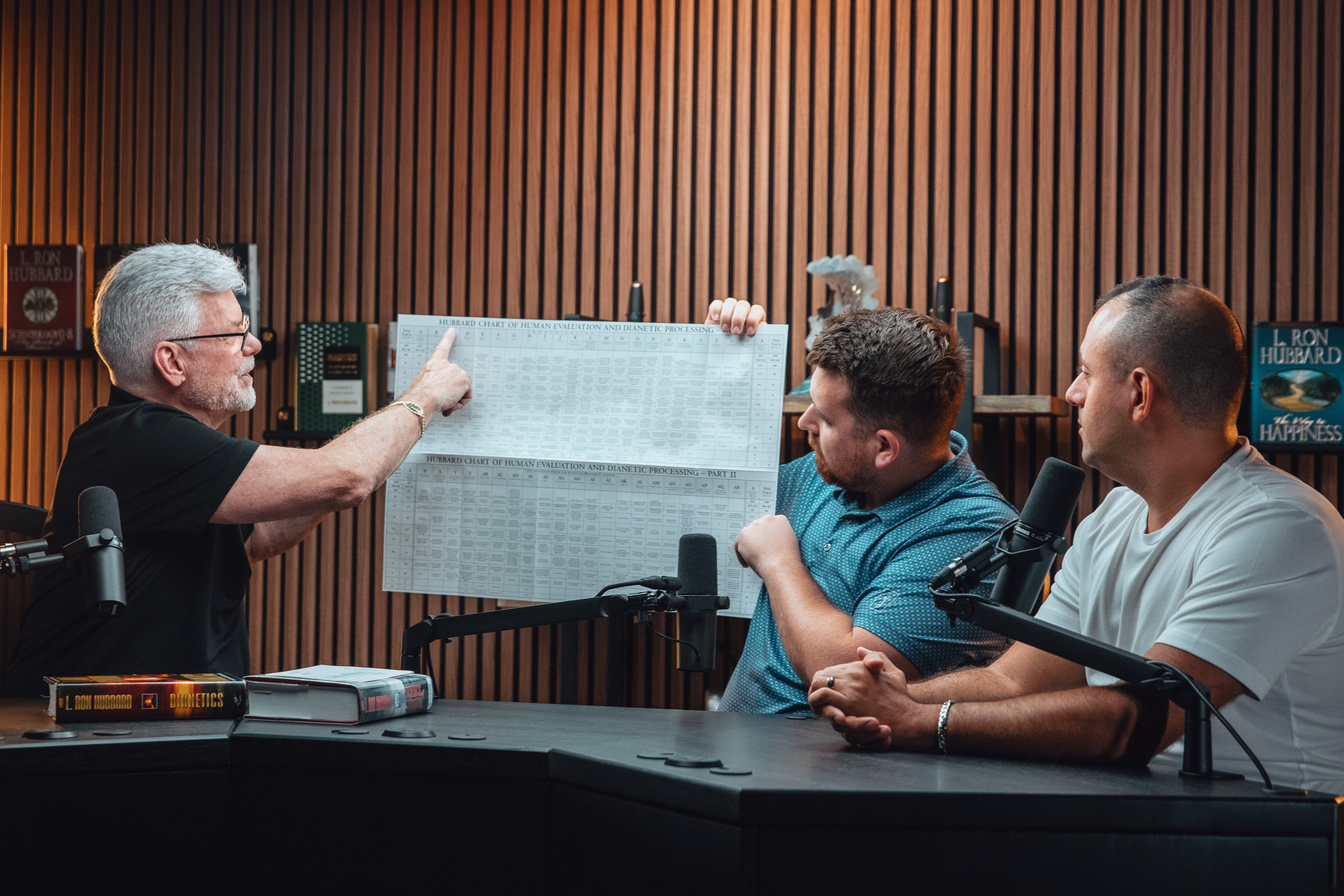
Emmett: Yeah. Now look at how he’s broken this out. So here’s the chart of human evaluation and Dianetic processing.
Mm-hmm. So he had Dianetics here, right? Mm-hmm. So he says, “As you’re processing somebody, here’s what you’re going to see as they’re getting better.”
Mm-hmm.
Emmett: Look at this. I mean, it’s like, oh my God. You know? And so you can go right across and you can predict where the person’s at. So one of the exercise is you go, “Okay good, I’m gonna pick three or four people, and then I’m gonna go each column here and I’m gonna put them there.”
And sometimes I’m gonna go, “Wow.”
Mm-hmm. Yeah.
Emmett: No wonder I feel bad whenever I talk to this person. Mm-hmm. Or you’re gonna put them across and go, “Now this is somebody that they’re… You know, I should really treat them better because they’re really good.” Yeah. Mm-hmm. You know what I mean? Yeah. And maybe my ch- my, uh, my criticism of them might be my own transgressions.
Mm-hmm. Mm-hmm. Maybe I clean that up so our relationship can improve and [00:53:00] we can make more money, make more profits, create more love, whatever it is may be. Yeah. This chart is invaluable.
Brad: Yeah, it’s incredible.
Emmett: Yeah. But what he really un- what he understood here, and hence the term book two, is is that he, he discovered that there’s different, different capabilities of a spiritual being.
Mm-hmm.
Emmett: Have you ever seen somebody that they have a hangnail and it’s like it’s devastating to them?
Yeah.
Emmett: And my wife looks at me and goes, “You’re bleeding.” I go, “Where? Really, where? I don’t know.” You know, it’s like nothing bothers me. And it’s like, well, why is that? Well, there’s different magnitudes and, and different beings and different sizes and different shapes and different, you know…
And it’s like to know all of that, I mean, how can you live on this planet without it? I can’t. It’s like you’re just handicapped without the data. Yeah. Mm-hmm. And these are just the first two books, you guys. Look at, look at this. Yeah. Oh man. It’s like, and I’ve read this one six times. But then I look at it and I go, every time I’ve done it, it’s enhanced my abilities tenfold.
Yeah. It’s like, well, this is what I wanna know.
Mm-hmm.
Emmett: You know? And they’re [00:54:00] loaded with… Oh my gosh, it’s called the basics. Let me t- I’ll give you a little, little one.
Brad: Give an example. May I?
Emmett: Yeah, yeah. Please, please. Absolutely. Okay, good. So this one, so this- Oh … is in 1950. Mm-hmm. 1955 he writes Dianetics 55.
Mm-hmm. 1955, and it’s the complete manual of
human communication. And I, I tabbed this one because it’s kinda like-
Emmett: This,
Brad: this book is sick …
oh, this is like- This is sick data in
Emmett: this book … oh my God. Talk about enabling you to handle anything, anywhere, anytime, anybody.
Mm-hmm. Th- there’s one passage, it’s like-
Aaron: What page?
Give the
Emmett: page
number … uh, page number 107. And he says, “When an in- when
Emmett: an individual has, for a very long period of time, consistently waited for answers which did not arrive, any sort of answer from anywhere will be pulled into him by him in an effort to re- remedy his scarcity for answers.” So give you an example.
My wife, uh, she, every day at, uh, 6:00 she calls and comes home, you [00:55:00] know. And one time she doesn’t call. So I have a, a scarcity of answers. What’s going on? So I wait till 6:15, no call. Scarcity of answers. What’s going on? So 6:15, I call, get voicemail. It’s like, “What’s going on?” I have a scarcity for answers.
So I start pulling, well, she, she might have get in an accident. She might have been this, she might have been that, da, da. All these answers to remedy my scarcity comes in. Mm-hmm. By the time she pulls into the garage at 6:30, I’m going, “Where were you? I’ve been calling you.” Yeah. “I’ve been worried sick.”
Right? I created that by trying to remedy the scarcity of answers rather than be there comfortably until the answer was available. Mm-hmm. So it’s a mechanical thing. This is one of 50,000 things in here like that- Mm-hmm … that imagine a married couple that do that all the time.
Brad: Mm-hmm.
Emmett: Yeah. Don’t know how to communicate, and then they wonder why their kids are at the table all the time just surfing the phone and eating so they don’t have to engage in a communication that doesn’t work.
Brad: Yep. Yeah.
Emmett: It’s not that they don’t wanna communicate, it’s just that nobody’s communicating.
Brad: Oh, [00:56:00] that’s such a good point.
Emmett: No, they want to communicate. It’s like y- when you’re interested in another and you know how to actually be interested in them-
Brad: Yeah. Yeah …
Emmett: not being interesting to them-
Brad: Hmm …
Emmett: or enforcing them- To communicate.
You know, the, it’s like when somebody’s willing to talk to you and really is there comfortably, you’re gonna get communication. So to be able to causatively create that 24 hours a day, seven days a week, it’s, it’s like how much would you pay for that? Yeah. You know? I think this is, you know, like in tens of dollars.
Mm-hmm. Yeah. Yeah. But then he started really going into with these basics, so, and then the more I study it’s like this is the one that really got me. And I brought this one, too, and then I’ll kind of… So this is called, uh, this is a book called Advanced Procedures and Axioms. So Scientology Advanced Procedures, and axioms meaning- Mm-hmm, mm-hmm
uh, gravity, you know? Mm-hmm. An [00:57:00] axiom, a stable da- light. You turn on the light, right? Yeah. It’s kinda like-
Like,
Brad: like rules of how things work …
Emmett: rules of how things work. And he’s, he’s in here and he says, uh, and this is page 43. So it, it goes into thought, emotion, and effort.
Brad: Mm-hmm. Okay?
Emmett: And this shattered a belief that- Mm
that most people have. When I talk to them about this, it’s like, whoa. So he says, “Emotion is the control system used by thought to monitor effort.” Okay, now what, what does that mean? Okay, so he talks about this, and let’s take an example. So I have the thought to, uh-
I have the thought to open this up.
Aaron: Mm-hmm.
Emmett: Mm-hmm. This is a, uh, lemon squeezer.
Aaron: Mm-hmm.
Emmett: Okay? And so the thought is what amount of energy in the physical universe as a spiritual being will I use to open this up? So what effort is needed? So then I create an emotion that has [00:58:00] that amount of effort. Boredom.
Eh, okay, good, you know? Okay, good, la-di-da. I may be just like, “La-di-da,” you know? “This is nice,” huh? Now, if I suddenly go to open it up and it doesn’t open, I need more effort, right? So I create a different emotion like anger. “This i- what is… Give me one that works.”
Mm-hmm. Mm-hmm.
Emmett: So I use emotion-
Yeah …
Emmett: to have an impact in the physical universe based on a thought of what I wanna create.
How many times have you seen somebody talking to somebody and, “Are you listening to me?” That’s a lot of effort, right?
Mm-hmm.
Emmett: Because the person’s never acknowledging them, so they think it’s gonna require more effort, so they mock up an emotion that has a tremendous amount of energy in it. So it’s like I’m thinking, “Oh my God.”
I mean, you’re, you’re looking at the junk drawer. You go to open it and it doesn’t open. You intellectually you know if you just reach under there and grab the thing that’s blocking it, you’ll be able to open it, right?
Yeah.
Emmett: But I’m mocking up the emotion of anger, [00:59:00] which is now I’m nuts. It’s like I can’t think.
I’m angry. Yeah. So I rip the drawer open, snap the thing that break what was in the way, and now the door’s flying over, and now I’m madder at who the put the thing there that’s blocking it. Now I’m just, I’m nuts. Yeah. So I made myself insane, and the intent was to open a drawer.
Yeah.
Emmett: Imagine in your interpersonal relationships having that kind of…
Now, I don’t mean stupidity in a bad way. If you don’t know how a car runs, then having the ignition key doesn’t matter because I’m stupid on where it goes and how a car runs. Yeah. So this is, it’s the technology of how to survive.
Brad: Yeah.
Emmett: It’s the technology of how to predict human behavior. It’s the technology of how to create a good marriage, to have a booming business.
It, it’s like on and on and on and on and on. It’s like there’s no part of life as a scientist-
Brad: Hmm …
Emmett: that he didn’t [01:00:00] discover. Now imagine the first time the guy’s complaining about his knees and his, his ankles, and he has none.
Brad: Yeah.
Emmett: And you’re kind of going, “Oh, and you just cured yourself.” So you’re starting to, you’re starting to practice or- Mm-hmm, mm-hmm
figure this out, and it’s like, “What am I gonna do with this? Well, I gotta write a book. I’ll give it to the Psychiatric Association and the American Medical Association. This will revolutionize it.” And they go, “I’m sorry. You know, we’re, we’re…” You know, there’s this money thing that’s going on, you know? It’s like government grants, big pharmacy, health insurance, you know.
I don’t know if you, if, if you’re anybody in this- Mm-hmm … planet right now, you know that this is the cycle. They, they’re in cahoots. Yeah. You know? Yeah. Not, not good, not bad. It is.
Brad: Yeah.
Aaron: Well, one, one thing that I’ve noticed, and I’ve asked a few people, um, I personally don’t know a single Scientologist that is taking any sort of psychotropic drug.
Like- Yeah. Oh, yeah. No. Zero … zero. I don’t-
Emmett: Wrong solution …
Aaron: know where- Yeah … have you ever met someone acro- across the world, like-
Emmett: No …
Aaron: Scientol- Like,
Emmett: it just- Well, you know, I’ve audited and, [01:01:00] uh, delivered Dianetics to people that were on them because they were- Right … they were walking in off the street. That’s non- not a
Aaron: Scientologist.
That’s a person
Emmett: that’s coming- But that’s not a- Yeah, yeah, yeah … that’s a homo sapien trying to figure out life, right? Mm-hmm. But a Scientologist, no, because early on you understand that if you’re out of gas, you don’t slice the tires.
Aaron: Yep.
Emmett: You know what I mean? And then a psychotropic drug that masks the symptoms- Yep
means you can’t handle the root that’s causing the system- Mm-hmm, mm-hmm … because you’re masking the symptom, so you can’t get at the thing that’s causing it.
Aaron: Yeah, no, I’ve… Oh, for sure, and the thing is, like- The big pharma will, of course, not want us to thrive because it i- Yeah. If more people become Scientologists, less people will be taking the big pharma drugs because they simply don’t work.
Yes. Yes. And
like, it’s
Aaron: just is, it’s unworkable.
Brad: Yeah.
Aaron: Why tr- the only reason people try, I think, they get on that path of these types of drugs, is ’cause they don’t have an answer that works. Yeah. And when you- Exactly … don’t have an answer that works, if you cannot get a result, you start trying things and trying things, and even when they don’t work, you kinda feel like, “Well, I don’t have [01:02:00] anything else.”
Mm. And they go down that route. So, and that’s what I’ve kind of… If you have no answer, y- y- you,
Emmett: you’re gonna try stuff. You’ll go for anything.
Aaron: Yeah, exactly.
Emmett: You- Yeah. Yeah … m- remember that reference that we just talked about, it w- the scarcity for answers? Scarcity. You don’t have answers. So I’ll pull anything.
Aaron: Exact- Correct. Right. Anything. Right.
Emmett: Oh, I don’t- I’m gonna go up on the internet and I’m gonna take that- Yeah … as good data. Yeah,
Aaron: yeah, yeah. Yeah. Huh. No one can tell me what’s wrong with me. No one can tell me how to fix… Oh, well, who’s gonna tell me? Yeah. Here’s the drug. Okay, I’ll take
Emmett: it. When I was a kid- Yeah
you, the, you actually would watch the news and believe it ’cause it was journalism. Yeah. Nowadays, you, if you’re getting your data from the news, you’re kinda like, “Dude, what? Snap out of it.”
Brad: Yeah.
Emmett: Yeah.
Brad: And everybody is, the, the agreement has shifted to, “Okay, well, we don’t believe the news anymore.”
Emmett: Yeah.
Brad: Just-
Emmett: It, nobody does.
Brad: Yeah.
Emmett: Yeah. Yeah. And, and that was created by the news media. So it’s kinda like- Ah … to the point, the more people evolve, the less the pharmaceutical companies will create that, and they’ll actually spend their… Maybe they’ll go to vitamins. May- whatever’s gonna sell-
Brad: Mm …
Emmett: they’re gonna have to create for their stockholders.
Brad: Mm.
Emmett: You gotta follow the money. But, you know, what they’re doing right now [01:03:00] is- Mm … when you look at it, there was a documentary called The Marketing of Madness. Mm-hmm. Oh, and it’s, a- and the, and it’s like huge- Have you seen it?
Brad: No, I haven’t.
Emmett: Oh, my God.
Aaron: Bradley. I know. We gotta see it. You
Emmett: know what? We gotta
Brad: watch
Aaron: it together.
We
Brad: gotta call
Emmett: it Scientology Claire.
Aaron: We gotta wa- It’s on- Yeah … Scientology TV.
Emmett: Yeah.
Brad: It is?
Aaron: Of course.
Brad: Oh,
Emmett: shoot. It’s a documentary. Okay, good. It’s, it’s kinda, you know how somebody says- We’ll,
Brad: we’ll watch it live. That’ll be good. That’ll be amazing.
Emmett: Yeah. It’s like if somebody goes, “Yo- We, I’m
Aaron: not even joking. We really need
Emmett: to…
Sorry, go ahead. Yeah. It’s amazing. It’s like it, it cha- It, it’s a documentary. But it’s like if you’re, if somebody says, “The Earth is flat”- Mm-hmm … it doesn’t matter that you show ’em a picture of the globe from outer space. Yeah. Their, their, their truth is the Earth is flat. But when they, you watch this documentary, and it’s, here’s people within the industry going, “Oh, here’s what we would do.
We would create the symptom-
Brad: Yeah …
Emmett: you know, fear of black microphones- Mm-hmm … and then we would spend hundreds of thousands of dollars making a fear of black microphones an actual thing- Yeah … and then we got it entered into the [01:04:00] diagnostic manual where the code is an actual thing. Now the insurance companies can pay for it, and the government grants can pay for it because it’s in the diagnostic manual, which used to be that big.
Now it’s that big.
Mm-hmm. Mm-hmm.
Emmett: And now the, the machine-
Mm-hmm.
Emmett: So, I, I mean- Wow … I was watching, I was watching a football game- Yeah … the other day. And that the ad came on and it said, you know, three, three out of four people that are taking a medication for, uh, depression are still suffering from depression.
Yeah. Perhaps you should talk to your doctor about adding blah, blah, blah. Another drug?
Yeah.
Emmett: Yeah. And I looked at my wife and I said, “Did they just say they have a 75% failure rate and the solution is to double up?” She’s going- Yeah … “Yeah.” And I go, “And there’s probably a lot of people that will go, ‘Well, I better ask,’ and write it down.”
‘Cause when there is no… When you’re hungry for an answer- I thought you were gonna talk about the Roni’s thing again … again, you know, every one of us, why is there war? Why is there… There’s plenty of food. Why are people starving? Why is we… Anybody that can evolve-
[01:05:00] Mm …
Emmett: and, and that’s my own opinion. Anybody that can evolve to a higher state had that when they were very young.
Yes.
Emmett: It’s kinda like I’ll talk to people and they’ll say, you know, as a child, eight, nine, 10, you’d see a picture of an old couple walking hand-in-hand, and you’d say, “God, I hope I have that when I’m that age.” Mm-hmm. You haven’t even hit teenage years yet.
Mm.
Emmett: Mm-hmm. But innately you knew this. It’s because you’ve always known it.
Mm-hmm. So what we’re, what, what I try and do with people is let, let’s get them back to what they already know.
Brad: Yeah.
Emmett: And get rid of everything that doesn’t work, that has never worked. Mm-hmm. And sometimes they’re continuing to do it, trying to get it to work-
Mm-hmm …
Emmett: when it’s never worked. And then when they really understand the technology of knowing how to know, which is what Scientology means, it’s scio-ology, knowing how to know, then they’re empowered to have a life that…
I, I mean, it’s just, it’s limitless.
Brad: Yeah.
Emmett: 30 years now and I’m still going at it. Like, I’m amazed every [01:06:00] time I study something new.
Brad: Mm-hmm. Yeah.
Emmett: Yeah.
Brad: Can, can we talk for a second about, you said a couple times something is very Homo sapiens, or that’s a very Homo sapien-
Emmett: Yeah …
Brad: uh, solution or something like that.
Yeah. What do, what do you mean when you say that?
Emmett: Okay, good. So, um- The best way to, to kinda… As there’s different states of existence. Mm-hmm. Okay? I’ve got object, animal, you know, uh, um, um… You know people that just lay on the couch and do nothing, being an object.
Brad: Mm-hmm.
Emmett: They can’t, can’t really do anything.
And then you’ve got animal. You know, they’re, they’re just food, sex, food, sex, food, sex, not necessarily in that order. That’s what’s- … driving their everything about them, right? And then you’ve got homo sapien where it’s like, okay, there’s groups, there’s things, but y- it- it’s Planet Earth and it’s not working.
Mm-hmm.
Emmett: I mean, we’ve got something like 12,000 nuclear warheads [01:07:00] currently.
Mm-hmm.
Emmett: That’s called not working. Mm-hmm. You know? W- why would we do that? Mm-hmm. W- we’re polluting… I mean, there’s 256,000 gallons of r- uh, chemical compounds that contain glyphosate, which is a cancer-causing thing, being dumped on our crops every year.
Mm.
Emmett: As a matter of fact, um, one of the, one of the things I volunteer for to help out with is a regenerative farm that an actor, one of, uh, Jason Dorring, a actor- He was on. He talked
about it on
Emmett: here. Yeah, yeah. Okay. So it’s like I heard about what he was doing, and it was like, man, this is fantastic. Let me help you.
Mm-hmm. You know what I mean? But it’s like, that’s when I found out all about we’re polluting our own food source. So when you look at the amount of cancer and everything like this- Yeah … it’s on the rise. Yeah. And when you kinda start researching the source, we’re getting it at the grocery store. It’s like, oh my God, how did this slowly happen?
You ever heard the, the term, uh, gluten?
Brad: Yeah.
Emmett: Yeah. Well, gluten is man-made. There’s a [01:08:00] documentary on it. And it, it… Back when, after World War II, the wheat fields, in order to make sure the locusts wouldn’t eat it all, they s- came up with a compound called DDT, and they sprayed it on the crops, which genetically altered wheat and created a part of wheat called gluten.
And so you’re gluten intolerant because you’re not designed to eat it anyway. It’s a man-made and it’s genetically a part of wheat now.
Aaron: Hmm. That I never heard of. I… Look
Emmett: into it. Yeah. It’s a, it’s a- No, I’ve heard of that … it’s documentary. You can go look… You know, it’s like, it, it’s like go on Netflix and you can learn about this.
But to, to another point, it’s like instead of watching The, The Real Housewives of Canada or whatever, I don’t know. I, I don’t… Mm-hmm. It’s like there’s so much one can learn.
Brad: Yeah.
Emmett: You know? And to be able to become inquisitive. How do I make a better son? How do I make a better daughter? How do I make a better marriage?
How do I make a better community? How do I make a safer planet? [01:09:00] How do I… As this beco- And you’d be shocked at the amount of people that I run into that think this way.
Aaron: Mm-hmm.
Emmett: It’s, it’s, and we’re just trying to get those that can Will be shocked that there’s a lot,
Aaron: or you’d be shocked that there’s a little?
Emmett: Th- th- there’s a lot.
Aaron: Mm.
Brad: It’s
Emmett: just you don’t know because- Of people thinking about how can we make it better … somebody who’s evolved never says anything against somebody who’s not. You wouldn’t criticize it.
Brad: Mm.
Emmett: But somebody who’s not evolved is gonna be critical of really anything. Yeah. You know, science of survival again.
So it’s, it’s kinda like when you’re, you’re looking for reviews as a business. People write reviews for one of two things: they really loved it or they hated it And I mean, somebody to go home and take all the time to write a bad review about something, this criticalness, right? On… Rather than call the company and say, “Hey, I think we can do better on this next time I’m in.”
Mm-hmm.
Emmett: Mm-hmm. “I might not come in again, but I had this experience, just wanted to let you know.” That would be kind. Instead- Yeah … here comes a… You know, it’s like-
Aaron: I sometimes do both. [01:10:00] Because I mean, not the way… I’m just saying, sometimes, again, I, I have… You c- my Google profile’s public. But sometimes I will do it, not kindness to the business- Go read his reviews
but kindness to other people. Kindness of other people who maybe saved the time to go visit there. You know, I’m just putting it that way.
Emmett: Oh, yeah. I’m just saying. Like, like- Like, like how- … this business is out to rip you off. Yeah. It’s like it’s a criminal- Yeah, yeah … enterprise.
Brad: It could
Emmett: happen, yeah.
Aaron: Yeah, yeah.
I, I, I mean, I’m just saying. Well, keep going. I,
Emmett: I- Well, you know, here’s a good example …
Aaron: he’s coming in on Homo sapien. He’s coming Homo sapien.
Emmett: It’s all good. Yeah. Here’s a, here’s a good example. The amount of, of, uh- I’ll take, I’ll take- … of criminal activity- Oh, oh … that’s being uncovered- Yeah, yeah … that are billions of dollars are going to.
Oh, that’s true. It’s like, oh my God. Yeah, yeah. No, yeah. So yeah, you wanna be able to go, “Okay, let’s do something about that.”
Aaron: You’re from Minnesota.
I’m from Minnesota.
Aaron: Now we’re, now we’re on the topic. Yeah. Now we’re on the topic.
Yeah, we’re on top- But, you know- We’re there. A-
Emmett: actually, it’s the entry of it.
It’s not the worst, it’s just the first one to get caught. Yeah. That’s completely
true. I had that trouble growing
Emmett: up, too. I was always the first to get caught, so it’s no wonder I’m from Minnesota. But anyway, so you [01:11:00] got Homo sapien, right? And then next- Did you have a
Brad: lot of Somali friends growing up?
Emmett: Uh, I didn’t.
They were- Okay … I was gone before that happened. Hmm.
Brad: Yeah.
Emmett: So then above Homo sapien is something called Homo novus. This is somebody no longer reactive mind. You know, they’re, “Okay, we’re doing really good.” And then you’ve got somebody operating as a spiritual being with a, a mind that’s under their control, that’s physically…
You know, they’ve got a body to operate on, you know, operate with. So you’ve got varying degrees. So with science of survival, you can predict the behavior of the Homo sapiens very easily- Hmm … of people that are there. Because once somebody really evolves, there’s nothing… We are, we aren’t… We’re so unique.
We’re like fingerprints. So how are we all gonna get along as y- immortal spiritual beings? I mean, I grew up Catholic, and the promise was immortality. And then when I started doing a dianetic session and going back in time [01:12:00] before this year, ’cause it was like, “What’s going on?” But then if you just Google child prodigy or something like that, you got five-year-olds playing concert piano.
You’ve got… I mean, if you can’t just look at YouTube and go, “Oh, there’s no way that child knew that within their first five years of life.”
Brad: You know what I just saw yesterday? Oh,
Emmett: this
Brad: is so bad. Yeah. But I have to say it.
Emmett: Yeah.
Brad: There’s a new BS label that mostly parents are putting on their children. It’s called hyperlexia What it means is they’re autistic because they’re incredibly intelligent, they can speak at an early age, and they can do math and remember numbers at an early age.
Wow. So they drug ’em. Hyperlexia. Yeah.
Emmett: Wow.
Brad: Amazing. That’s,
Emmett: that’s sick.
Brad: Isn’t that sick?
Emmett: There’s the- Yeah … there’s the machine.
Brad: Yeah, that’s
Emmett: right.
Brad: Yeah. Yeah.
Emmett: So, you know, when you, when you… All these, there’s all this evidence, and then you go all the way back in time, all the gr- many, many of the religions is like live before, live before, live before, live before.
Mm-hmm. So I first start doing Dianetics- Dude, the Dalai
Brad: Lama.
Emmett: Yeah, totally.
Brad: It’s the same
Emmett: guy. It’s the same guy. [01:13:00] Yeah. You know, it’s like on and on. There’s abundant evidence that there’s a really good possibility that there’s a past that’s gone past this Emmett thing.
Brad: Mm-hmm. Mm-hmm.
Emmett: Now, the thing about it, though, is that’s very fascinating to people.
Mm-hmm. Yeah. But you hit a point where it’s like, “Well, I could care less. I’m worried about what’s in front of me.”
Mm-hmm. ‘
Emmett: Cause you, when you, when you study Dianetics and Scientology, you really get that. You know, let’s say there’s, uh, something happened, uh, I’ve, I had a bunch of jobs that didn’t work out, right?
Let’s say that, that that’s been my history. Mm-hmm. So I’m applying for a job interview in present time, and I’m worried that they’re gonna hire me because I have all these experiences- Mm-hmm … of being fired. Mm-hmm. Oh my God, I’m worried. Okay, now if I’m not applying for it, I’m worried that I won’t find a job in the future.
So the worry from the future I’m experiencing now, the worry from the past I’m experiencing now. So really all I have is worry. [01:14:00] I don’t care what direction it’s coming from. The difference being is I can eliminate all the worry from the past using Dianetics- Mm-hmm … and I can not create worry in the future using Scientology.
Yeah. So it’s like now as a spiritual being, I’m creating things and then they’re showing up as, as I move forward in time. It, it becomes You know, it’s like somebody’s… I’ve lived before, and I kinda go, “Yeah.” Anyway, so what are we talking about? You know, versus the first time I contacted something like that, I was like, “Oh my God, oh my God.”
You know, I, uh… What is this? But the pr- the thing about it is, remember, uh, engineer, calculus, linear algebra, physics. I need, I need proof. Me, I felt that. Mm-hmm. Mm-hmm. So I’m on, I’m on what’s called an E-meter, right? Now this is so simple. It’s like, okay, we got a light here. Yeah. So you turn the light switch on, and it creates an electrical circuit, and the bulb lights up ’cause there’s energy flowing through the circuit.
Mm-hmm.
Emmett: Off, [01:15:00] on, off, on. You turn it off, the light goes off. Turn it on, the light goes on because there’s energy flowing. Too much energy, the bulb blows out.
Mm-hmm.
Emmett: So what an electrician does is to make sure the l- bulb never blows out, he introduces a mass into the circuit that won’t let the voltage go above a certain level, called a resistor.
Mm-hmm. It resists voltage so that the bulb never blows out.
Mm-hmm.
Emmett: So I’m holding electrodes that go to a meter that has a battery, which now creates a circuit.
Mm-hmm.
Emmett: And then I think of something and the mass moves in, and the circuit is impeded by the mass, which makes the needle go there. So I’m running something from the past, and the first thing that happens is, “No way.”
This is in the technology. The first thing that goes is the unbelievability. It’s the first thing that moves in. No way. But there I’m having a physical universe. There’s the needle. [01:16:00] There it’s moving. This is simple electronics. Yeah. For me, as a, as a p- physics, math, calculus, it’s like, okay, this is really hard to argue with.
Mm-hmm. It’s like, you know, I drink the water, I’m no longer thirsty. You know what I mean? So it’s like when somebody says, “That’s nonsense,” I’m go- I’m looking at them going, “Well, they obviously didn’t do calculus, physics, and linear algebra,” or they don’t know. They… ‘Cause I’m watching, there’s a physical univer- And then my pain goes away.
Brad: Yep.
Emmett: And the, and then it’s no longer reacting once the pain is gone. It’s like it’s a science. Yeah. Oh my God, what have I got my hands on here? This could be the answer to everything, and it was. Mm-hmm. It’s like 30 years now. I’m never not amazed by what’s going on. Yeah. And it just, it goes better and better and better and better, and it’s like to be able to take somebody and alleviate something they’ve been suffering from their entire life physically.[01:17:00]
Yeah. They’re just amazed. But then it’s like, good. That was back there. Let’s talk about going forward. Mm-hmm. ‘Cause people say, “Well, what about all this stuff,” and da, da, da. I go, “Yeah, I don’t know. You know, y- yeah, okay. Could care less. That was back there.” We got rid of all that. It’s like, where are we going now?
‘Cause the beautiful part about Dianetics and Scientology is once I no longer have a reactive mind… ‘Cause what happens is, is the mind gets separated into two parts, okay? There’s the reactive stimulus response. The dog smells the bone and recoils from it.
Brad: Mm-hmm.
Emmett: Doesn’t think, “Oh, that’s the bone that made me sick.”
No, there’s no thought. It just recoils.
Brad: Yeah.
Emmett: It’s reactive. So when that process, when the no longer needs to be resisted ’cause the voltage in it has been discharged, it files away as an analytical thought. In other words, I can look at the bone and go, “Oh, that’s a bone that doesn’t– that makes me sick. I shouldn’t [01:18:00] buy that at the grocery store.”
And I never have the bone in the house anymore. Yeah. So it’s like when you’re looking at… The first thing I tell everybody is like, “Get rid of that stuff because it’s just killing you.”
Brad: Mm-hmm.
Emmett: Y- if you ever like anxiety for no reason, fear for no reason, wonder about no reason, you know, e- emotions or pains or aches that don’t make sense, okay, sit down.
Close your eyes. I’m going right after it. This is easy to get rid of. Easy, easy, easy. Then once all that’s gone, okay, now let’s look to the future.
Brad: Mm-hmm.
Emmett: Let’s create something that… ‘Cause now you’re rolling.
Aaron: Mm-hmm.
Emmett: Now you’re rolling
Brad: Yeah, spring
Aaron: What was the moment… So, for you, how was it going, you know, from Dianetics then into Scientology?
So you did a lot of… How much Dianetics did you do, like at the [01:19:00] beginning?
Emmett: In the beginning, the, it, it was just a couple, two, three sessions. And I mean, I got rid of that one thing that was like, this is why I would always date girls that were the- Mm-hmm, mm-hmm … worst girls in the world. Mm-hmm. Uh. And then after they dogged me, I, “God, don’t leave me.
Don’t leave me.” I mean, when that got explained and I ran it out and it was gone, for me, that was like, talk about ruining your life. Mm-hmm,
Brad: mm-hmm. When, when you say that got explained, meaning you were, you were doing counseling. Yep. Like Dianetic counseling.
Emmett: Yep.
Brad: And you fo- you ex- you… It was explained by something you saw.
Emmett: Yeah. Right? So the auditor says to me- Yeah … you know, “Recall a moment of pain,” or something like that, right? Yeah. So here I am, I’m going through, why do I do this? Why do I keep dating these… Why? Why? Why? Is that,
Aaron: is that why, is that why you went into the, the-
Emmett: No. No, no, no. Okay. I mean, I just thought it was me.
Aaron: Okay.
Emmett: You, you know what I mean? Yeah. It’s like, a- again, at the beginning, it’s like most people don’t know what’s wrong.
Aaron: Mm-hmm.
Emmett: You know, I didn’t. I think, [01:20:00] well, I just, I’m, I’m a poor choice. I choose poorly. Oh, well, that must be… Hope that, you know, hope I don’t do that wrong next time. Mm-hmm. Yeah. And so I’m picking up this moment where I was physically unconscious because of a, a, a, and I’m, I could have died from this accident as a child.
And then I’m recalling it, ’cause Dianetics, you’re gonna recall everything about it, recall everything about it. And each time I recall it, I’m remembering more about this particular incident. And then of course it’s like, where’s all this information coming from? Nobody’s given it to me. It’s there already.
Brad: Yeah.
Emmett: But I’m refiling it from reactive. Oh, I can see this now. Oh, I can see this. It’s now moving up to analytical. Mm-hmm. It no longer is gonna have an impact on me or affect me.
Mm-hmm.
Emmett: And then I finally got to the, my mom saying, “Don’t leave me.”
Mm.
Emmett: And I gotta tell you guys, every bad relationship, I was crying saying, “Don’t leave me,” to one of the worst people in the world.
I would’ve [01:21:00] married him just to make sure I could go, “Don’t leave me.” Wow. When I hit that, it was like, oh my God. Mm-hmm. That’s what’s causing that. And I, I started just… The relief, I just sat there and it was like, “Oh my God. Oh my God. Oh my God. Oh my God.” And then of course, the person auditing me said, “Well, that’s all we’re gonna do now, since you can’t fi- you know.
Let you have the win.”
Brad: Yeah.
Emmett: So, but then- Everybody, w- I just didn’t have to have a relationship after that.
Brad: Mm-hmm.
Emmett: I could look at people and go, “Okay, that’s probably not a good idea.”
Brad: Mm-hmm.
Emmett: And then I could look at th- this one beautiful lady and go, “Wow, that’s…” I read Science of Survival. I’m going, “She checks off all the boxes as somebody you wanna have around.”
And I took her out on a date. We talked. Took her out on a second date. Found out that she had all this technology, so she also could make stuff [01:22:00] happen in life-
Hmm …
Emmett: like a happy marriage. Mm-hmm. She was trained. She was, she was able. She knew about Dianetics. She knew about, you know, all the things that make you enabled to be able to have a, a successful human relationship.
And I said, “God, w- marry me.” And she said-
And she said, “Okay.” And I went, “Uh-oh.”
Aaron: But
Emmett: don’t leave me. No, I’m kidding. It was a, “Oh, yeah. Mar- Oh, you said yes. Okay. Uh.” So but it was, that was it.
Brad: Yeah.
Emmett: And then the conversation immediately from that point on said, “Well, how would we do this?”
Brad: Yeah.
Emmett: And it was like, that was 30 years ago.
Brad: Yeah.
That’s- Love of my
Emmett: life …
Brad: 30, right?
Emmett: So- Beautiful …
30 years. Okay.
Brad: Same- So- … yeah … wait, wait, what’s the, what’s the anniversary? Did we already pass it or is it coming up? May
4th.
Brad: So what, it’s this coming year? 30th happened, yeah. Oh, already happened.
31
Brad: May 4th. Okay. Yeah. Sorry, I missed it.
That’s
Brad: okay. So May the fourth be with you again.
Yeah, I get that a lot. The 31st
time.
Brad: Okay, so I, I just wanna, I just wanna emphasize one point just to make sure it’s, it’s real to [01:23:00] anybody who sees this, is your auditor did not explain to you what happened.
Nope.
Brad: He gave you a simple-
Here’s the
Brad: question … “Go back, here’s the que- go back to the blah, blah, blah, blah,” right?
Whatever the command is. Yeah. You, he’s telling you to look And then you look and figure all that stuff out yourself.
Emmett: All the data was there.
Brad: Which… Yeah.
Emmett: It was just when it’s occluded, it can be reactive against you. What does, what does
Brad: occluded mean?
Emmett: Mean you can’t see it.
Brad: Yeah.
Emmett: So, in other words, um, you know, I, I’m gonna describe this room in totality in a week, okay?
Because I’m not unconscious or in pain, or I’m not suffering from anything, I can say, “Well, this was here. The soundproofing was there.” You know, I can describe it because I’m analytically recording this. Mm-hmm. In moments of pain and unconsciousness, uh, I might be at the dentist, you m- uh, drug addicts, their, their bad drug trips, uh, hit by a car.
If you go to dianetics.org, you can see videos on examples of [01:24:00] this.
Mm-hmm. Mm-hmm.
Emmett: But it’s like when your analytical ability to look is reduced by pain and unconsciousness, you’re still recording. You’re just recording it at a lower level that can s- s- you know, restimulate and make you do… Well, keep you from doing things you wanna do- Mm-hmm
and make you do things you don’t wanna do. Mm-hmm. That’s when I, “Hey, have you ever wanted to do something you couldn’t do it, or you do things and you, you can’t stop from doing it? It’s because you got a reactive mind. Would you like to see yours?”
Brad: Mm-hmm. Mm-hmm.
Emmett: Love that. And the moment somebody goes, “Can I?”
I go, “I got a live one here.”
Brad: Yeah.
Emmett: Ah, yeah. And I’ve got somebody, it’s like, “Okay, let’s go.” ‘Cause I feel it’s important for me to do for them what was done for me. Yeah. And it’s like, I think, uh, people introduced, I think in the last four years, it’s like 5,000 people all over the world, something like that.
They’ve given me awards for it, but, you know, getting an award [01:25:00] for doing something you’re supposed to do, it’s cool. But the acknowledgement is when somebody comes to you years later and said, “Man, I was on… I’m really doing well. Thank you. Thank you for showing me me.” Get that a lot. Yeah, and what else would one do with their life?
You want that for your children. Mm-hmm. You want that for your spouse. You want… It’s like at the end of the day-
Brad: Yeah. It’s li- it’s like The Matrix.
Emmett: Yeah.
Brad: It’s very much like The Matrix. You take, you take the red pill, you can’t unsee it. It’s the red pill, right?
Emmett: Yeah.
Brad: Pretty sure.
Emmett: The, the, yeah. Yeah.
Brad: Yeah, yeah.
Aaron: That’s why they call you being red pilled.
Brad: That’s right. That’s right.
Emmett: Got me. Oh, whatever. Okay.
Brad: You’ve never seen the movie The Matrix?
Emmett: Oh yeah, but I can’t remember it was
Brad: the blue or green- It’s the
Emmett: red. It’s the red … or the red. Right, right,
Brad: yeah. I, I remember there’s like internet forums. Tell you,
Emmett: you took- Red pill.
Yeah … you, I remember the pill. You take the red pill. Yeah,
Brad: yeah. Yeah, and- And then boom. Boom. Yeah. Yeah, you’re out of the- Yeah … the matrix basically.
Emmett: Yeah.
Brad: For, uh, for me, that’s, that’s what Scientology has… I’m just saying my personal experience here. Mm-hmm. But like, that is a lot of what Scientology has been is, [01:26:00] it’s really been seeing things as they actually are.
Yeah. And once you know what something is, you can’t unsee it.
Emmett: Yeah.
Brad: You
Emmett: know? What’s true for you is what’s true. Yeah. I mean, case in point, when you, when everybody I… Early on it’s like, “Is this all there is?” You know, you guys- Mm. We’ve had that since we were kids, and look, look at who I’m sitting across from.
Your philanthropy’s been in the millions. I, I remember watching a video a while back, Aaron, where you were like, it was you and your lovely wife and the kids in a little one-bedroom apartment.
Mm.
Emmett: And you’re kinda, and you were convincing her that, “I’m gonna try a business, and y- you’re gonna have to have faith in me this time.”
And, and there was a, it’s a, how many times has an entrepreneur said that? And then your- Yeah … your construction company that has expanded and expanded, and how your, your philanthropic donations. I mean, I don’t know if everybody that watches this podcast is, who is actually putting it on. You guys are amazing.
You’re examples of everything that we’re discussing here. It’s just an honor to call [01:27:00] you my friend. It really is.
Aaron: Likewise. Thank you. Thank
Emmett: you. Yeah. Yeah.
Brad: Thank you
Aaron: It’s been, it’s been a, it’s been a, it’s been fun. It’s been fun.
Emmett: Yeah. Yeah. I
Aaron: have to say, I
Emmett: do, I do- Well, you know, and let me ask you guys then.
Yeah, yeah. Okay? We’ll turn the tables here. Oh, sure. You know, so when the more able I became- Mm-hmm … and I partnered up with, uh, my partner Patrick Valton, and we did this little… We’ve got a, a new consulting firm called TrueNorth.World to help people get, you know, out of the traps of their own- Mm
businesses, if you will. You know, ’cause somebody can be so successful that they can’t get out of their business to have a life. And that’s a technology. And so he and I now are full-time, this is all we do. And so we go, “Well, let’s share this data to the business owners.”
Mm.
Emmett: You guys are… I mean, we gave a tour of the business earlier, and it’s like major successful businesses.
And y- being able to do what you’re doing philanthropically, there’s [01:28:00] also your own personal enhancement that you guys are making happen.
Brad: Mm-hmm.
Emmett: And when… How much of that was the technology that you were learning that allows you to do that in your lives and in your businesses?
Brad: Uh, for me, literally 100%.
Lit- like, it’s, it’s not even a question. If you look at the graph of, of my… And they all go in parallel for me of-
Emmett: Mm-hmm …
Brad: business, family life, relationship.
Emmett: Mm-hmm.
Brad: And, and also just not being miserable in life. It all just, it all just goes all boom at the same time.
This is me and Aaron relating, not laughing at you.
Yeah,
Brad: I know. I know. I’m
going, “Oh, yeah, I remember that.” Yeah.
Brad: I know, dude. Yeah. Yeah. Not just being… Uh, we’re gonna have to bleep this out, but not being a miserable is just like, even though I was pretending I was so happy- Yeah … just, like, dead inside, it all, boom, moves at the same time, and it’s when I walk into a Church of Scientology, and I start getting counseling.
And it started with Dianetic sessions. Yeah. Like, the, the Dianetic Audit. Yeah. [01:29:00] From right out of the book Dianetics.
Emmett: And your lovely wife, too. I mean, it’s like- Yeah … the, it, it, it’s, it’s so, it’s so, for me, being able to see you kinda come in and start really, you know… Uh, uh, it’d just been around a while.
Mm-hmm. You know what I mean? And where’s the next up-and-coming monster spiritual beings that’s gonna change the world? And I’m sitting across from a couple of them. It’s like, “Oh my God, I’m in the presence of gods,” right? And… But it, but y- to your point, it’s, it’s when you realize it’s everything. It’s the business, it’s the wife, it’s the kids, it’s the m- my own personal relationship with myself.
And you can- Yeah … kinda pick just one of them, and they all start going up. And then there’s a technology embracing all of it. It’s like you just, “Oh my God, how much of this can I get? How much can I use?” And it’s endless.
Brad: And you can’t overdose on it.
Emmett: You can’t.
Brad: You can’t overdose on Scientology.
Emmett: Yeah. I mean, the, the administrative technology that’s now a college curriculum, there was, like, [01:30:00] 3,000 policies he wrote and lectures.
It was like, that was just… And then it’s being used by nonprofits, profits, governments.
Aaron: That was a side quest.
Emmett: Side,
Aaron: side… You didn’t get that one. You didn’t get that one.
Emmett: And I, I… Poof. Yeah. Yeah. Anyway, it’s like, it’s like, that’s great. Yeah. Yeah. That’s amazing. And same,
Aaron: Aaron? Yeah, so that’s… So, um, it was…
It’s actually interesting. I th- either I forgot or somehow, but I actually started with a Dianetic session also. Wow. Wow. I actually, I did my personality test. At Tampa? Yeah, Tampa. It was Tampa. Uh, 2004, ‘5, or ‘3. Something-
Brad: 2003?
Aaron: Something like that, yeah. I was 13, or 13, 14. I forget what happened first ’cause I remember I did the course at 13.
I don’t know if this was right after or before. Anyway, early teens. Yeah. Okay? And- I [01:31:00] started with the Dynamic Seminar. Mm-hmm. That was the first thing I did.
Brad: Mm-hmm.
Aaron: And I remember… Well, the, the, the, the change was so drastic because I remember probably the summer before, like just bef- right before I went there, I saw this, uh, uh, commercial from Zoloft, right?
Mm. The big pharma. And the commercial’s so aligned, I think we should do a reaction video on that thing ’cause it’s crazy. Yeah,
Brad: yeah, we should.
Aaron: But the commercial’s so deceiving.
Brad: Mm-hmm.
Aaron: And it’s full of lies as well. But anyway, it’s like, “Hey, maybe this terrible feeling you have could be maybe possibly…”
Someone said it could’ve been, uh, this chemical imbalance, right?
Emmett: Yeah.
Aaron: And now it’s been fully disproven, right? You can see that the, the most popular- Yeah … research paper of all time was, uh, uh, the debunking of the chemical imbalance theory. Yeah. That was the most shared research paper of all time- Oof.
Which you can d- Yeah … we can, we can put a ling- link to it. Anyway.
Brad: Tom Cruise was right.
Aaron: Yeah. Yeah. So it’s true. That is true as well. Yeah. So I remember I was in that scenario when I, I just thought life was so bad. Like, I just- Yeah. But it wasn’t even that I, [01:32:00] I would say, like, life is bad. I just is in, we’re in this level where there was nothing almost to look forward to.
Mm-hmm. Kinda like floating. Yeah. That’s kinda where I was at.
Emmett: Is this all there is?
Aaron: Yeah. Yeah. But all- I had that thought a lot … I don’t think I, I don’t think I was in the level of even thinking, “Is this all there…” Like- Mm … there’s a level of, “Is there all that this is?” And then I’m, like, below that, where you, you don’t even, you don’t even think.
Like, you’re- Yeah … not even aware of, like, b- And it was weird. Wow. So anyway, I did this personality test, and I was like… Well, and I, and I talked about this story on this podcast probably already, but the guy was like, “Do you, do you wanna ch…” My happiness was negative 78. Um, and he’s like, “Do you wanna do something about it?”
I was like, “Well, what do you mean do so- like-“
Emmett: Yeah. Do
Aaron: what? It was the weirdest question.
Emmett: Yeah.
Aaron: I was like, “What?”
Emmett: Yeah. “
Aaron: Huh?” Like-
Emmett: I
Aaron: don’t know … that’s not, like, well, that’s not pos- Yeah. What do you mean? What do you mean? What do you mean? He’s like, “What would you like to change?” I’m like-
Emmett: Yeah …
Aaron: no one has ever invited me to change.
Emmett: Mm.
Aaron: And I said, “Let’s [01:33:00] do it.” And I did the Dianetics session, and it wasn’t even the best one. Like, like it wasn’t even… Like, you know what I mean? Yeah. Like, I- It was something … knowing procedure and stuff, no. Like, we did some, but like the fact that it was e- it, it’s 80% there. Yeah. And it just changed my outlook on everything because I realized something could be done.
And this is why- Mm-hmm … the podcast is called Don’t Do Nothing. Mm-hmm, yeah. Because I was like, “You could do something. Why not observe it, examine it, look at it?” And after that, like my whole life turned around, and I remember, um, there had been times when I was just like, “What, why do thi- why?” Like, just no purpose, just nothing’s happening.
Yeah. And, and that’s what started then. And of course, I didn’t… Like, I was involved a little bit, but I, I l- I didn’t have a car. I couldn’t be involved that much. I was with my dad here in Tampa, and I went back home, so I was away from Scientology and Dianetics for a while. I did order a book and I read some stuff, but like it’s probably was another four or five years before I- Mm-hmm
got more involved ’cause I got my car, okay? Ah, you got a car, yeah. And that’s when I, I got, got in my car. Maybe three years. [01:34:00] And, um, but I remember in different times there was no purpose to do anything. Business, marriage, kids, like not- nothing. So I, I, I feel like it’s almost impossible to say, to quantify, like what the change would be.
Right. Because if I, if I, if I try to imagine if I never got out of that like funk or whatever-
Emmett: Wow …
Aaron: what, what it would be. Mm-hmm. I just, I don’t-
Emmett: Wow
Aaron: I, I, I don’t know what it would be, but it d- it was, it was a big change
Emmett: Yeah. Yeah, I find one for one with everybody that I, that I work with these days. It’s like there’s an a- there’s an awareness…
When somebody becomes aware of the fact that there’s hope-
Aaron: Yeah.
Emmett: Yes … and, and it’s hope- Yes … from something.
Aaron: Mm-hmm. Yeah.
Emmett: You know, I, I have hope that it doesn’t have to be like this forever.
Aaron: Yes. Yes.
Emmett: The next thing up from that is, okay, where do I find the help to get it?
Aaron: Mm-hmm.
Emmett: Hope, help, and then now- Mm-hmm.
Mm-hmm … now you’re, [01:35:00] you’re entering like there’s an introductory courses. Mm-hmm. Mm-hmm. You know, I, I think they even bought the… Yeah, it’s called, uh, what do they call they here these? Life improvement courses. Mm-hmm. Mm-hmm.
Mm-hmm.
Emmett: And I remember looking at it going, okay, here’s all the different areas that I can, I could improve my life there, setting achieving goals.
I could improve my life with effective leadership. Mm-hmm. And then there’s finance and overcoming financial stress and happy marriage, and this is another r- I mean, I think these things are 50 bucks.
Brad: Mm-hmm. Yep. These courses are sick.
Emmett: Oh my God. Goals. They’re
sick. Yep. Yep, yep,
Emmett: yep. I’ve done all of them, some of them many times.
Mm-hmm. Mm-hmm. Mm-hmm. It’s like, okay, I want… I’ve got a new business here. I’m gonna go the, do the targets and goals course. Mm-hmm. 50 bucks.
Mm-hmm. Mm-hmm.
Emmett: And then I’m gonna apply it to this new thing I’m doing, and then drip, strap it all out and, okay, good. Now I know what I’m doing. I know where I’m going.
It’s all organized. Mm-hmm. And again, now I’m n- I don’t have a bunch of past going, “Yeah, but what about… But be careful.” You know, that’s all gone. It’s like, “Good, let’s go.” And it’s the [01:36:00] pedal to the metal and you’re just flying.
Brad: Yeah.
Emmett: Yeah. Uh, it’s just so much… There’s so much one can easily, uh, value, yeah.
Brad: This one right here, personal values and integrity.
Emmett: Boy, it’s a big one.
Brad: Changed everything- Yeah … for me. And actually, uh, it was one of the things when I… Just full confession here. The very first thing that I did when I came to a church was, uh, a course called Overcoming Ups and Downs in Life. Yeah. I need to, I need to do it several more times ’cause I, I now have revisited what’s in that course at a, a higher level and I’m like-
Emmett: Mm-hmm
Brad: oh my God, I didn’t get it at all. Mm-hmm. You know? Yeah. But you… It’s a number of times over. But then I do personal values and integrity, the course I just showed, and it, like the opening paragraph s- or something like that says, you know, “In Scientology, what is true is what’s true by your observation.”
Mm-hmm. In other words, what’s true-
Emmett: I love
Brad: that … is what’s true for you. And I was
Emmett: like- Nobody, nobody’s force-feeding me anything. I was like- It’s like what’s true for you …
Brad: good, let me look at all of it. Yeah. And I will decide- Yeah … what’s true. Yeah. And that, and that’s how it’s been for me the whole time.
Emmett: Yep.
Brad: [01:37:00] And that’s how it is for, for, I’m sure for you guys as well. Mm-hmm.
Emmett: Yep. Yeah. Totally.
Brad: Yeah.
Emmett: And then what’s true for me has always changed too. That’s right. This is what’s really wild. It’s like- Yeah … okay, now I understand more, so that’s no longer true. What’s actually true is this. But it’s always a new truth that’s more effective.
Mm-hmm. Mm-hmm.
Brad: Yeah.
Emmett: It’s like, okay- And simpler … you know, the Earth is flat. Okay, well, that’s what’s true for them. Mm-hmm. Do I really want to engage? Probably not. Mm-hmm. Let me go over here, you know, and if somebody says- Mm-hmm … “Hey, tell me about how you and Allie met and how your marriage is so good after 30 years.”
Now, okay, that’s the person I wanna… You know, it’s, again, it’s the prediction of human behavior.
Aaron: Beautiful. Okay. Um, what is your favorite L. Ron Hubbard quote, if you have it? And if you don’t, then maybe just open a book and open up a page. He’s
Brad: like, “I can flip to any page in any
Emmett: book.” ‘Cause it’s so damn good.
Well, in the, in the interest of not having, um, misunderstood words for the audience, uh… Yeah. I think I, I [01:38:00] think I, I… It’s, it might be in my phone. Okay. Favorite quote. W- this is one of 10,000.
Okay.
Emmett: That’s fair. Okay? Fair. Fair. That are all my favorites. That’s fair. It’s like, you know, over 30 years ago, oh my God, oh my God, oh my God.
And my favorite quotes all have one thing in common. When I read it to another, they rise up to a new reality- Mm … that’s better than the last one. Oh, that’s
Brad: beautiful.
Emmett: One of, one of my, uh, other favorite quotes basically is, was where I was just at better because it was there?
Brad: Mm.
Emmett: Very simple. Yeah.
Mm-hmm.
Emmett: W- was where I, where it’s just at, is it better because it was there?
Brad: Wow.
Yes.
Emmett: So here we go. This comes from, um, one of the lectures in these basic studies that, that we… It’s a, it’s a, uh, lecture. And he said, he’s talking about-
Aaron: Is it, is it, is it a confusing name or what?
Emmett: Yeah. It’s a lecture. It’s a, it’s comes from a [01:39:00] lecture, and it’s from the Freedom Congress. Okay,
good, good,
Emmett: good. Okay, good. Yeah, that’s right. It’s from the Freedom Congress. Okay, good. So he’s talking about awake beings.
Hmm.
Emmett: Okay? He says most of them have always considered themselves a bit of an oddball.
That’s almost a common denominator of a Scientologist. Up to the time he came into Scientology, he considered himself as just slightly an oddball. He’d look at things and he would see that they weren’t quite right, and the other fellows around would take a look at them and they’d say, “There’s nothing wrong with that.”
Brad: Mm-hmm.
Emmett: Mm. So the person who was going to become a Scientologist someday would say to himself, “Well, there must be something wrong with me.” Well, there was something wrong with him. He was awake
Brad: Yeah.
Emmett: So every time I’m with somebody and they’re on a path, a pursuit of happiness that can only be achieved from s- spiritual [01:40:00] enlightenment and getting rid of the trappings along the way, it’s always, “You know, when you were a kid, didn’t quite fit in, did you?”
They go, “No. You know, I just didn’t… What’s, why is there war? I don’t get it.” You know? It’s like- Mm-hmm … we never could think with it.
Yeah.
Emmett: So it’s like, um, one-on-one, it, it, or should say one-for-one, this has been a constant with everybody. When I meet somebody like you guys, I mean, a mover and a shaker on this…
But, and not just nes- Scientologists.
Mm.
Emmett: I’m, I’m working with business owners to help them extradite out of their businesses and, and they’re, they’re Catholic. They’re, uh, they’re, you know, they’re, they’re m- they’re, uh, um, S- Seventh Day Adventist. There’s… My, my ex-business partner was Mormon. My best man’s Jewish.
So it’s like they’re… It’s all over the place. And, um, one of my good friends, Reverend Freddie Johnson, Baptist minister- Mm-hmm … was on here and we- Yep … way back when, I remember 30 years ago, he [01:41:00] was starting something called the World Literacy Crusade. Mm-hmm, yep. You know what I mean? It’s like these are enlightened people.
But when I’m working with somebody, it’s like the same thing. It’s like, “When you were a little kid, did you kinda like… I don’t get it.” One for one, yeah. Yeah. They were, they were never able to go along with what was being shoved on them by another that wanted to control them.
Brad: Yeah.
Emmett: Yeah. So that’s a favorite quote.
Brad: Totally. I love that. Yeah. Okay. In your own words, what is Scientology?
Emmett: What is Scientology? Well, I spoke the history of and how it all- Mm-hmm … came about, but my favorite, uh, is when it’s referred to as applied religious philosophy. Now, here’s why it’s my favorite though. So it’s something that I apply and I see.
I get a result.
Mm-hmm.
Emmett: If I say, “Honey, that dress is really nice on you,” she goes, “Thank you.” That’s a result. I applied something, I got a result.
Mm-hmm.
Emmett: If I say, “That dress does not look good [01:42:00] on you,” she goes, “Oh, why?” See, the bad result, right? Yeah. Mm-hmm. So when something can be applied, I make up my own mind about it.
Mm-hmm.
Emmett: I see a result. I have firsthand experience, okay? So in life, if I can apply it, it’s mine. So a philosophy is here’s how something should work, and it’s religious, so it deals with the spirit.
Mm-hmm.
Emmett: So for me, it being an applied religious philosophy, this is of utmost importance to me because when somebody’s…
Okay, their, their body’s now they have a great body But they’re unhappy.
Brad: Mm.
Emmett: Okay, good. They have a great body and their thinking is straight. They’re very, very logical. They’re straight. There’s nothing really bothers them. They’re not… If they have, if the, if they have an em- emotion that’s really bad, like if they have to put the dog down because it’s old, grief is an appropriate emotional reaction, [01:43:00] and they have the grief, and they come up and they remember their dog, and it’s appropriate.
If they’re o- if their mind isn’t just trashed, I mean, if they’re still grieving 10 years later, okay, there’s a problem here.
Mm-hmm. Mm-hmm.
Emmett: You know what I mean? So their, their reactions to life are appropriate to life. So they might have a good body, but they’re miserable. Their m- reactions to life are good, but they’re lonely and they’re alone.
And then the enchilada is the spirit. So if I can apply something to a spiritual being that straightens out the mind and the body because it’s the senior point- Yeah … that makes me the most effective guy in the room. And when I’m actually focused on how well is that being doing, then the rest of it goes w- I mean, it just gets handled by sheer fact that the being now is rising up.
And so an applied religious, ’cause it deals with the being, I can apply something to a spiritual being that changes everything about their life. The empowerment of that [01:44:00] description is, for me, what Scientology is. It’s an applied religious philosophy. Get your own result, make your own opinion, and then once you’ve got it and you, you figure it out and it works, there’s hundreds of thousands of people applying this daily to their lives.
Mm-hmm.
Emmett: You know, a- and I mean, our events are massive, thousands of people, you know, some of the top na- I remember when I was a kid, I was looking at, um, an, uh, “Return to Forever” album, and it said, “Dedicated to L. Ron Hubbard.” And I go, “I don’t know who that is, but I really like this music.” I mean, it was amazing.
Wow. It was Stanley Clarke and, you know, now it’s Stanley Clarke’s on stage with Swachikari. It’s like, it, it, it’s just the movement is massive. Yeah. But it comes down to one spiritual being caring enough about another spiritual being to do whatever’s necessary to help them get past, and then above anything they could ever dream for themselves.
Applied religious philosophy.
Brad: Love that.
Aaron: Nice. Thank you, brother.
Brad: [01:45:00] Thank you, Emmett.
Aaron: It’s been great to have you on.
My pleasure. God dang you. And remember- Thank you very much … don’t do nothing
Links mentioned in this episode:
Dianetics: https://www.dianetics.org
What is Scientology: https://www.scientology.org
The Administrative Scale: https://www.scientology.org/courses/targets/
Scientology TV: https://www.scientology.tv
The Marketing of Madness: https://www.scientology.tv/series/cchr-documentaries/marketing-of-madness.html
L. Ron Hubbard: https://www.lronhubbard.org
Science of Survival: https://www.bridgepub.com/store/item/science-of-survival-hardcover.html
Dianetics 55: https://www.bridgepub.com/store/item/dianetics-55-hardcover.html
Guinness Book of World Records Holder: https://www.guinnessworldrecords.com/world-records/most-published-works-by-one-author
Follow Emmett Osborn:
https://www.instagram.com/osmetemborn/ https://www.facebook.com/emmett.osborn.5
https://truenorth.world/
Follow us on other places:
- https://www.instagram.com/dontdonothingpodcast/
- https://www.facebook.com/DDNPod
- https://www.tiktok.com/@dontdonothingpod
- https://x.com/dontdonothing8
Curious about yourself?
Take a personality test: https://ddnpod.com/test
#dontdonothing #emmettosborn #dianetics
Leave a Reply